• Hey Guest!
    British Car Forum has been supporting enthusiasts for over 25 years by providing a great place to share our love for British cars. You can support our efforts by upgrading your membership for less than the dues of most car clubs. There are some perks with a member upgrade!

    **Upgrade Now**
    (PS: Upgraded members don't see this banner, nor will you see the Google ads that appear on the site.)
Tips
Tips

TR6 TR6 door and fender

TR6oldtimer

Darth Vader
Country flag
Offline
I finally got the door skinned, it was not that hard to do. When I fitted it to the car, a problem I noted with a fender purchased 20 some years ago got worse.

In the picture below, the green arrow (a little to far to the left) points to the upper corner of the door that extends about 1/16" to far forward. The red arrow points to where I will cut back 1/16" to compensate for the door. The yellow arrow points out the arc in the replacement fender that is too deep(a known problem with this piece). I will correct it by brazing a piece of welding rod to the edge of the fender, then grind to fit.

Another problem that I was aware of is that the curvature of the upper fender to the crease line is less then the door. As much as I hate to do this, I will have to build that area up with 1/32" or so of body filler.

The rest of the door fits very well, so I am going ahead with brazing the skin to the frame at all the usual places, as well as filling in the gaps at each end of the window glass opening.

P9140001_edited.jpg


It is slowly getting there.
 
Hmm...it seems like I've seen that fit before on other cars, however, I just checked mine and mine's not like that.

I did notice on mine and on others that the lower rear corner on both doors stands out from the body and is not flush with the rear wing, so if you encounter that, don't sweat it.
 
Lewis, thanks for info. The door fits well, including the lower rear corner. It is just this area that will need some attention. I just hope I do not screw the fender up.
 
Ray it was suggested earlier, and I think by me, that when you put a skin on do it with the door on the car. Eliminates a lot of hassles. I learned the hard way
 
Have you considered using metal to build the edge? Whether it's braze or weld, it would hold up better than body filler. Even though it will be a protected edge, it still stands the chance of being bumped.
 
Thanks for the update. Some filler isn't the end of the world there Ray.

Watching your progress has been inspiring stuff!
 
Doug, I will be brazing a piece(s) of welding rod on the edge (yellow arrow in the picture above)until I get it close to matching the door arc, then grind.

The area that is low and needs filler, is the fender surface itself.

In this photo, you can see that the fender surface (blue arrow) is lower then the door (white arrow). I know that in this photo, the fender is sitting high, but when it is properly attached, the condition still exists. So it is on the outer surface that I need to build up with a bit of filler and feather it in toward the front as well as vertically. Now 1/32" is not a big deal, but it is a nuisance given the price I paid for the fenders. But in the end, having a good body line will make it worth the effort.

P9140003-edit.jpg


Don, I skinned the door, but before I put on the final tacks, I did mount it to verify everything fit well, including the dreaded lower rear corner sticking out. I must say, amazingly, I did not need to flex the door to fit. By the way, the door was actually very rigid even before the final brazing.
 
Ray,

You're doing this the right way and it will be well worth it when the paint meets the metal. If you don't do it now, it will be too late then and you'll really be mad with yourself.
 
Try using the old school 'lead' filler instead of bondo. Fairly easy to do and won't 'pop' if hit.
 
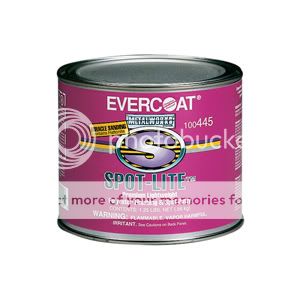
lead is the best thing you can use but this product is easy to work with and is better than bondo for thin fills.

FIB446.jpg
 
I use that Evercoat product for the thin fills over the bare steel. (While adherence to primer is great, adherence to steel is superior. There was a guy who tested the filler over primer vs over steel. In the test, the filler over primer failed when the primer separated. The filler over steel eventually failed, but took a lot more abuse before it did.)

When I apply this, to properly feather it in, the application will extend 1/2-2/3 of the way from the rear of the fender toward the front, and from the top to the crease. It will be more like the thin glaze coats some body shops apply to the entire surface then a massive "bondo fill in the dent" job.
 
In my humble opinion after you braze on a door skin, you can then drop the lot in the ash bin.It is nearly impossible to prevent corrosion from the flux and the excess heat will destroy even a good weld through primer so your crimped edge is doomed to rust ......GET IT MIG WELDED!!!!!!!!!!!!
MD(mad dog)
 
MDCanaday said:
In my humble opinion after you braze on a door skin, you can then drop the lot in the ash bin.It is nearly impossible to prevent corrosion from the flux and the excess heat will destroy even a good weld through primer so your crimped edge is doomed to rust ......GET IT MIG WELDED!!!!!!!!!!!!
MD(mad dog)

Thanks for your opinion, but it sounds like you had a bad experience with brazing.

Have you have not noticed the original door skins were tacked by braze welding, as are many other places on the body where a spot welder would not work, or oxy-acetylene steel welding was inappropriate. While I agree with you there is an issue with the flux, but if you know what you are doing, it is not a problem. In fact, for the brazing I am doing, with a properly adjusted torch and clean metal, you need little to no flux.

I also take exception to the excess heat statement. First off, you do not want to use a weld through primer when welding with oxy-acetylene. The zinc does not get along well with the torch, a big cloud of zinc oxide smoke occurs. Secondly, brazing when properly done, does not use excessive heat. When I tacked closed the six places on my door, those areas were first cleaned to bare metal about 3/8" around the joint. The rest of the epoxy primer was left on. After brazing, a small spot 1/2-3/4" in diameter on the front of the door, were each weld was applied, was burned off. Very little of the primer was heat damaged and there was no distortion of the sheet metal. Furthermore, only two of the six welds needed some dressing. When that was done, I cleaned the areas around the welds and applied a seam sealer on both the inside and outside of the door. This is something I would have done even if a MIG welder were used.

The point is, every tool and every welding technique is only as good as the skill of the user. When I grew up, braze welding in the auto repair business was the norm, back when there were real "metal bumpers". While I did not learn the metal bumping techniques, I did learn how to use an oxy-acetylene torch for steel and braze welding.

Also, before I embarked on this project, I had lengthy discussions on a metal working forum about how to proceed. None of those guys had a problem with brazing, nor did a welder on this forum.

In closing, if MIG welding is your thing, and you do not want to learn another skill, I am fine with that. For me, I am comfortable with braze welding, a technique that has worked quite well.

Now here is something that will rock your boat. 90% of the tub repairs can be done using rivets and modern epoxies with the same or improved strength of welding. The floor pans, sills, rockers, and virtually all the panels can be attached without the use of a torch. Would I do it? No, and only because it is a departure from the traditional. But were I a person only interested in repair, not restoration, I would do it in a heart beat, especially for the floors.
 
Back
Top