Hey Guest!

Foura
Jedi Hopeful
Offline
I have had a vibration at the back of my TR4A for some time. It has CV joint driveshafts. On our recent 4600km trip from Melbourne to Perth, my wife and I shared the driving. I noticed that the vibration was worse on the right hand side.
When we got home, I jacked the car up and rotated the wheels. I noticed that the right hand brake was binding slightly as I turned the wheel, so I backed off the adjuster and this has reduced the vibration.I am getting the drums machined today. I also noticed that the handbrake cables are not fully releasing, so I will do some lubing of those as well.
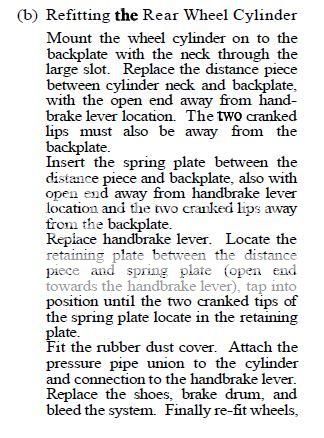
One of the articles on rebuilding the rear brakes mentions that the brake cylinder should be able to slide freely in the slot in the backing plate. Mine is not able to move, partly from slight corrosion, but more from the solid brake pipe which does not allow the cylinder to move. I have ordered new mounting plates and return springs and will put these in with suitable greasing. I notice that because the cylinder cannot move, the handbrake only applies one shoe on each side, which possibly explains the lousy performance of the handbrake. It seems to me that if the cylinder could slide, it would apply the other brake shoe, thus doubling the friction on the drum.
Can anyone enlighten me as to how the system SHOULD work?
When we got home, I jacked the car up and rotated the wheels. I noticed that the right hand brake was binding slightly as I turned the wheel, so I backed off the adjuster and this has reduced the vibration.I am getting the drums machined today. I also noticed that the handbrake cables are not fully releasing, so I will do some lubing of those as well.
One of the articles on rebuilding the rear brakes mentions that the brake cylinder should be able to slide freely in the slot in the backing plate. Mine is not able to move, partly from slight corrosion, but more from the solid brake pipe which does not allow the cylinder to move. I have ordered new mounting plates and return springs and will put these in with suitable greasing. I notice that because the cylinder cannot move, the handbrake only applies one shoe on each side, which possibly explains the lousy performance of the handbrake. It seems to me that if the cylinder could slide, it would apply the other brake shoe, thus doubling the friction on the drum.
Can anyone enlighten me as to how the system SHOULD work?