• Hi Guest!
    If you appreciate British Car Forum and our 25 years of supporting British car enthusiasts with technical and anicdotal information, collected from our thousands of great members, please support us with a low-cost subscription. You can become a supporting member for less than the dues of most car clubs.

    There are some perks with a member upgrade!
    **Upgrade Now**
    (PS: Subscribers don't see this gawd-aweful banner
Tips
Tips

TR4/4A TR4A Clutch Fork and Shaft

I'm having an issue again.

I'm looking at my new clutch shaft for my 4A and new, hardened taper pin.

Do I really need to drill a hole through the fork and shaft and install a horizontal pin (e.g., a bolt) as a precaution, or hasn't the strengthened pin supposedly resolved the issue?

If I drill through, I'll need one good carbide bit and better have a good eye to hit dead center through the fork and shaft, then I need the hole to fit tight with the bolt, etc. In other words, not terribly difficult but no cakewalk either.

Am I headed down overkill lane? I seem to go there frequently (and I'm too embarrassed to mention what I did recently, though maybe I'll get over it and share the story to spare others some grief, or to provoke mirth).

Thanks again.
 
Not that hard to do.
Most everyone has done it.
 
I would put in the extra bolt. It's cheap insurance. You don't have to be "dead center" with the drilling, pretty close will be just fine.
 
Well, it probably is overkill. The original pins lasted 30-40 years, most likely the "strengthened" ones (which IMO means they might meet the original specification) will too. But I really hated struggling with a broken pin, and having to pull the gearbox out to replace it; so the reinforcement seems like a good idea to me.

But it's really not that hard if you have access to a drill press. A carbide bit is not necessary, as the shaft and fork are not hardened (at least not very much). I did use one slightly smaller than 1/4" (to get a snug fit), but it was an ordinary twist drill. (Cheap set from Enco)
To find center, just lay a straight edge on top, parallel to the table, mark and punch the spot where it touches the fork. If you have a center drill, use that to start the hole. Then use a smaller (like 1/8 or 3/32) bit to drill through the first time, and then drill again with the final size. (ISTR I used a letter C drill to match my bolt, but you should measure your bolt and choose the bit from that.)

Oh, and be sure you have the fork installed properly before you drill. My shaft has an extra hole in it for some odd reason :smile:
 
I did this using a hand-held drill -- no problem. The metal in those parts is almost distressingly soft.

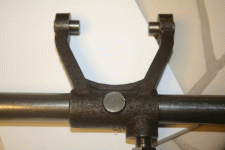
cross%20bolt.JPG


So quick and easy, it would seem foolhardy to not add it while the thing is right there in front of you.
 
You mean drill right through the fork and shaft while they're together?

See my picture below. Drill right thru the center of that flat "dime" on the fork, leaving the fork on?

If I mess that up I'll need to break open a bottle of Scotch.

thx
 

Attachments

  • 27577.gif
    27577.gif
    77.5 KB · Views: 246
Geo Hahn said:
I did this using a hand-held drill -- no problem.

Geo, did you punch or flatten a spot on the shaft to keep the drill bit still, or did the fork casing keep it all under control? Regular high speed drill bit?

Also, how did you assure the bolt was tight to the new bore? I read of a recommendation that the bolt be 1/4" and the bore be a bit undersized to assure a tight fit, the point being that a loose fit wouldn't accomplish anything.
 
Instead of using bolts, I've used 1/4" spring (roll) pins on several forks. Since the pins are larger then the hole a 1/4" drill makes, they hammer in tightly.

roll%20pin.jpg
 
KVH said:
Geo, did you punch or flatten a spot on the shaft to keep the drill bit still, or did the fork casing keep it all under control? Regular high speed drill bit?...

It's 11:00 a.m. and I can't recall what I had for breakfast (did I have breakfast?).

IOW -- It was 6 years ago and I just know I did what seemed like I had to at the time.

As I recall the bolt was a snug fit, doubt that I used a special drill, probably filed a little flat spot then center-punched to get started. I seem to recall I had to buy a longer (Grade 8) bolt than needed so it would be all shank & no threads inside the hole, used a nyloc on the bolt.

You <span style="font-weight: bold">must</span> do this with the fork in place on the shaft and the fork-pin in place too -- this assures that the pair of holes will be aligned at the same time.
 
TR3driver said:
Well, it probably is overkill. The original pins lasted 30-40 years, most likely the "strengthened" ones (which IMO means they might meet the original specification) will too. But I really hated struggling with a broken pin, and having to pull the gearbox out to replace it; so the reinforcement seems like a good idea to me.

One data point that at least the hardened ones they were selling 25 years ago seemed to work for me on my TR4A as it was still going after 7 years and 75,000 miles (original fork and shaft). And this was with one of the clutches that almost needed 2 legs to operate!

Scott
 
Geo Hahn said:
I seem to recall I had to buy a longer (Grade 8) bolt than needed so it would be all shank & no threads inside the hole, used a nyloc on the bolt.

Also, be sure to trim off the excess bolt length. Otherwise it can foul on the transmission and cause problems.
 
How hard should that clutch fork taper pin be to tighten into the shaft?

Mine will only go in part way before binding in the shaft. I'm reluctant to force it, and sure don't want to drill out that shaft anymore since I suppose it may be machined deliberately to cause some binding with the pin.

I've not tried using any kind of large wrench. I've been only using a 1/2 square spanner.

thx
 
I don't recall it taking worrisome force to send it home. Isn't the pin tapered? I can't recall -- were you slide the fork to one side and inspect the shaft & hole?
 
I had to cut the shaft; I have a new one. The pin is tapered, but I'd swear that hole in the shaft is oblong for a squeeze fit of some sort.
 
The pin is (supposed to be) tapered, although not very much; and it is supposed to bind in the hole in the shaft before hitting bottom.

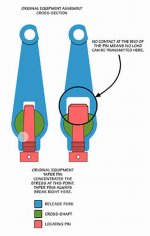
Here's another image from the Buckeye Triumphs site:
 

Attachments

  • 27603.jpg
    27603.jpg
    48.6 KB · Views: 180
The taper pin from Moss will not go into the new shaft from TRF. It leaves about 3/16" of thread bare/space between the pin head and the seat of the fork. In other words, the shaft and pin don't appear mated to one another. However, perhaps TRF assumes that some filing of the shaft hole is required to mate with any pin. That would make sense, or some sense.

One thing is clear. I'll twist the head off the pin or strip fork threads if I force that pin any further.

Would it be reasonable that I slightly file the shaft hole so that the pin goes in further, or do I need to rethink something?

For instance, maybe the pin doesn't need to seat against the fork? Randall, I know you said that, but 3/16 seems a bit much for a space at the seat, and the top of the pin appears to be 1/8 inch below the top of the shaft when it's fully bound up.

Thanks
 
The pin I got from TRF fit the shaft I got from TRF as well as my original shaft; so my guess is that the "improved" pin from Moss is very slightly oversized.

If you want to enlarge the hole in the shaft, you should probably use a reamer so it stays round. Ordinary twist drills tend to chatter, deflect and not drill round when there is no metal at the tip to help hold them straight (and even then they don't drill very round). Ideally, it would be a tapered reamer with the same taper as the pin (even though it's not clear to me that the original shaft hole was tapered).

You also want to be careful not to go too far, as it is important that the taper pin head <span style="font-weight: bold"><span style="text-decoration: underline">not </span></span>seat against the fork. All of the force needs to be applied to the fit of the pin in the shaft; otherwise it will move against the shaft and rapidly wear, loosen and break.

But if you are adding the reinforcing bolt as suggested, I would suggest just leaving the pin & hole as is. As Nelson showed in the diagram above, the tip of the pin does nothing anyway, so it doesn't matter if it protrudes from the shaft or not.
 
Back
Top