• Hey Guest!
    British Car Forum has been supporting enthusiasts for over 25 years by providing a great place to share our love for British cars. You can support our efforts by upgrading your membership for less than the dues of most car clubs. There are some perks with a member upgrade!

    **Upgrade Now**
    (PS: Upgraded members don't see this banner, nor will you see the Google ads that appear on the site.)
Tips
Tips

TR4/4A TR4 won't run correctly

John_Hensleigh

Freshman Member
Offline
I've been working with the TR4 pretty consistently over the last couple of weeks in an attempt to get it ready to autocross at the last event I can attend this season.

The last event was yesterday.

I didn't make it.

Couldn't get the car to run right. It will idle well, especially once its warm, but under load, it seems to starve out. 1st gear pulls just fine, starts cutting out at about 2000rpm in 2nd and continues to do so in the other gears. Sounds and feels like 1 or 2 cylinders aren't firing. Runs better with the choke fully closed, but still not 100% (goes from 40% to 70% power).

Current setup is as follows:
Fuel cell in trunk, located in same vertical position as stock.
5/16" rubber fuel line, no in-line filter.
Mechanical fuel pump, freshly rebuilt.
Zenith-Stromberg 175CD's, adjusted according to the Haynes manual.
Flamethrower coil with Pertronix Ignitor distributor.

It ran fine a month ago with the original tank, an electric fuel pump, and pressure regulator, and the upgraded ignition system. I changed to the fuel cell to accommodate the roll bar bracing, and it ran like garbage. I decided to remove the fuel filter, and raise the cell a foot to provide more inlet pressure to the pump, but didn't help. Pump is making pressure at the carbs. Floats are set according to the manual (.73"). Timing may be a little advanced, I'll check that again this evening.

Anyone have thoughts on where I went wrong, or how I should systematically go about troubleshooting?

Thanks in advance.
 
You haven't had the problem until you added fuel cell and mechanical pump. Sounds like fuel starvation. Try going back to the electric pump, mounted as close to tank as possible and put in a filter ( even though you are using clean fuel), they have steel ones for this app. Then check plugs for even burn. See which plugs cut out. Put fuel regulator in line (as before )right before carbs in a place easy to reach ( pressure gauge a plus ). Do you have a vent line on fuel cell?
 
LarryK said:
You haven't had the problem until you added fuel cell and mechanical pump. Sounds like fuel starvation. Try going back to the electric pump, mounted as close to tank as possible and put in a filter ( even though you are using clean fuel), they have steel ones for this app. Then check plugs for even burn. See which plugs cut out. Put fuel regulator in line (as before )right before carbs in a place easy to reach ( pressure gauge a plus ). Do you have a vent line on fuel cell?

Good stuff, and I especially like the vent issue. Take the gas cap off and see if that corrects the problem.
 
I had the same problem with the electric pump (with in-line filter and pressure regulator, all mounted as described).

Cell is well vented.

Also; I checked for vacuum leaks and couldn't find anything. Throttle shafts are a little loose, but if that is the problem, I don't know why it would be so much worse all of a sudden.

What would indicate that a plug is cutting out in a visual inspection? Not sure what to look for.
 
Please describe the venting of the fuel cell. There may be a misunderstanding of what Larry was referring to.
 
SUM-290104.jpg


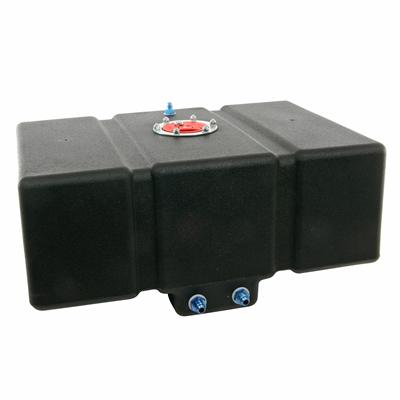
This is the cell I'm using.

There is a vent in the cap (it is open/working correctly).

One of the two output ports is plugged, the other runs to the pump. The final opening on the cell is for a return line, and is currently uncapped.

The cap vent is fairly small, but the return line port is easily 1/4" ID. Fuel runs out of the output port freely and without having to suck air back through the output port ("glug glug" effect, if you will).
 
When something isn't right immediately after specific work was done we naturally suspect what we just did caused the problem -- but coincidences do happen.

If I had only heard the symptoms:

John_Hensleigh said:
...Couldn't get the car to run right. It will idle well, especially once its warm, but under load, it seems to starve out. 1st gear pulls just fine, starts cutting out at about 2000rpm in 2nd and continues to do so in the other gears. Sounds and feels like 1 or 2 cylinders aren't firing...

...and not the back story, I would be suspecting ignition. Specifically the high tension components like rotor, coil, plugs & plug wires. Easy stuff to check by either direct testing or swapping parts.
 
If possible turn the engine off immediately after it acts up and pull and inspect some plugs. White plugs mean lean, black plugs mean rich.

One thing I didn't hear was suspecting the vacuum advance. I would suspect a faulty advance system could cause a bunch of bad under load.
 
In your posting you said that the tank is mounted in the same vertical position as the original tank. I've never seen a fuel cell installed that way. I have always seen them installed where the spare tire should go. I wonder if that is your problem (installed vertically)
 
JerryVV said:
In your posting you said that the tank is mounted in the same vertical position as the original tank. I've never seen a fuel cell installed that way. I have always seen them installed where the spare tire should go. I wonder if that is your problem (installed vertically)
I'm thinking the poster means that the cell is the same height off the ground as the original tank. Yes? No?
 
Busted, that's what I meant. The center-of-gravity of the fuel in the cell is (now) at about the same height as the c.o.g. of the fuel in the original tank. I did have it mounted in the spare tire well, but wanted to take that change in head pressure out of the equation during troubleshooting. If I can correct the problem, I'd like to lower it to where I had it before.

With respect to the advance possibility: This is the distributor I'm using.

https://www.pertronix.com/prod/ig/flame/dist/british.aspx

... with their 40kV coil.

I'm not sure how much is adjustable on these, I haven't touched except to install and set the static timing.

I've heard mixed messages about static timing; manual says 4, many TR guys say 4-10, one guy said 20 :shocked:. I'll have to double check (didn't get a chance to last night), but I think I'm somewhere between 10 and 15 degrees BTDC at the moment. I want to dial it back to 4-8 degrees and see what difference that makes.
 
You stated that the fuel pump is making pressure at the carbs and that the engine runs better with the chokes on. Chokes reduce the intake air supply to match the amount of vaporized fuel available when the engine is cold. Having "pressure" at the carbs isn't the same as having "flow". Both of these would cause me to check for a blockage in the fuel delivery or return lines. Is it possible that either the fuel pickup in the cell is partially plugged or the line from the cell to the carbs has become partially plugged somewhere during the switchover? A dose of low-pressure compressed air through disconnected lines might reveal something.
 
Back
Top