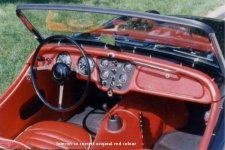
There are many suppliers of quality carpet sets to your car. I am assuming that you want to use what had been originally supplied. Just make sure to ask for <span style="font-weight: bold">nylon loop</span> and not <span style="font-weight: bold">cut pile</span>. Also be sure that the binding is correct. Here are some further details from the TRA Judging Guide.
Change point, at TS 35350, which would have been a TR3A, cut pile wool carpet was replaced by nylon loop.
Change point, at TSF1, charcoal grey carpet fitted to some cars with black, blue, or red trim.
Carpet Fabric - Two types of carpet material was used on the TR2-3B, a short tight wool pile, and a nylon
loop. the changeover point from wool to nylon was around TS 35350. In addition, cars built after TS 5089 had
the front footwell carpets replaced with heavy rubber mats. Both wool and nylon carpet was backed by a
rubberized canvas. The amount of jute underpadding seems to vary, but generally was found under carpet
pieces under the seats, and covering the propshaft and transmission tunnels.
Carpet Binding - The carpet was bound in vinyl to match the carpet color on all wearing edges.
Front Floor Mats (cars after TS 5089) - Cars built after TS 5089 had the front footwell carpets replaced by
black rubber mats which fit the car in the same manner. these are not to be confused with the aftermarket
"Amco" floormats, as they extend up the bulkhead instead of covering only the floor.
Trunk Floor Covering - From TS 1 to TS 22013, the trunk floor was covered in carpet to match the interior
carpet. The edges of this carpet were bound. After TS 22013, the wool carpet was replaced by a black plastic
coated mat (Hardura).
Carpet Attachment Hardware - Carpet was glued, screwed, snapped, or left lying in place on TR2's and 3's in
a variety of ways, even within given commission number ranges. This there is no specific arrangement to serve
judges and restorers. Below is a typical attachment arrangement:
- On cars having sloping rear shelves (pre TS 60000), the rear heelboard side pieces were usually glued, as
was the arch shaped center bulkhead panel. The propshaft tunnel carpets were glued, screwed, or left
loose. The transmission tunnel carpet(s) were snapped. The side bulkhead carpets (kickpanels) were
screwed along the dooredge, and glued or screwed at the front. The rear floor carpets were left loose, the
seats holding them down. The rear shelf carpet was most often screwed. The front footwell carpets or
mats snaps at the front, on the bulkhead. Often, these front snaps are replaced by blued jawed clamps,
particularly on later cars.
- On cars with flat rear shelves, the carpet covering the shelf were either glued or screwed.
Carpet Color - Both wool and nylon carpets were usually dyed to match the interior trim. The trunk mats and
front floor mats were always black. Note that some
variations existed, such as the charcoal grey carpet fitted to TR3B's trimmed in black, red, or blue.
For additional details regarding originality, you can download the TRA Judging Guidlines for free.
TRA Judging Guidelines
Good luck


 Hey Guest!