• Hey Guest!
    British Car Forum has been supporting enthusiasts for over 25 years by providing a great place to share our love for British cars. You can support our efforts by upgrading your membership for less than the dues of most car clubs. There are some perks with a member upgrade!

    **Upgrade Now**
    (PS: Upgraded members don't see this banner, nor will you see the Google ads that appear on the site.)
Tips
Tips

TR2/3/3A TR3A Steering Adjustment

nealm

Freshman Member
Offline
We took our mostly complete 1960 TR3A out for it's first test drive last weekend. The old state inspection sticker was from 1968 so it's been almost 40 years since the car has been on the road. I've got some significant play in the steering. Probably a couple of inches before the wheels begin to turn. I read that there are two adjustments to the steering box. One is to add shims to the box and the other is an adjustment screw on top of the box. Any advice as to which one to try first?

Thanks
NealM
TS73289L

normal_TR3_137.jpg
 
Try turning the adjuster on top first because you can do it while the unit is in the car and it adjusts out play.

You'll need two Whitworth wrenches. Sorry, I forget the sizes. Loosen the lock nut and turn the adjuster in.

You might have to mess with it a few times until the play is mostly out, but it's not binding. I turn it in until it binds, the back it out until it's just free. There will always be a little play. Maybe 1/2 inch or so.
 
Congratulations Neal! The car looks great. Really like the dark center wheels and the red interior with pearl white color.
 
If adjusting the steering box doesn't yeild a significant reduction in the amount of play in the wheel, check the silent-bloc bushings and idler arm in the steering linkage. The silent-bloc bushings are prone to lots of wear, and will result in alot of play in the steering wheel.
 
Follow the advice of John above, but once you have tightened it down as he explains, turn the steering wheel (with the front end up off the floor) and see if it gets tighter and stiffer near the extreme left and right ends of the turn. If so, you'll have to slack off on the adjusting nut that you just tightened down. You don't want to be turning a corner and have the steering wedge over there and find you can't steer it back straight. Loosening this back means that it will have more slop as you are driving on a straight road.

To correct this, buy a kit with a spring-loaded peg that fixes this problem from Herman Van den Akker (https://www.hvdaconversions.com/) or from Ken Gillanders at BFE (https://www.britishframeandengine.com/parts.html/). Both are in California.

I had this problem and bought a kit in 1992 from England and it has fixed the problem. I've driven about 85,000 miles since putting the kit into the steering box. All you do is take off the old top cover (3 bolts) and after putting in a new gasket and the new top cover, bolt it down and adjust it as per the instructions.

If you think about it, 99% of your steering is done with small corrections on roads that are almost straight. This causes the conical part that engages in the slot of the worm to wear. Or the worm sidewalls will wear. Not all over, only where all these small corrections have been made.

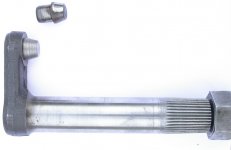
The kit is designed so that the peg is spring-loaded. With the spring, the spring holds the peg down nicely near the center where the wear is - and when you steer to the far left or right, the spring permits the peg to move upwards so it doesn't wedge or get tighter.

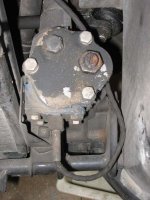
Here is a photo from a friend in Holland who had this problem and one of the peg kit on my steering box. No judge in a concours can see it because it's behind the air deflector. Your driving safety is more important that an originality point.

 

Attachments

  • 5198-SteeringPeg.JPG
    5198-SteeringPeg.JPG
    139.2 KB · Views: 230
  • 5199-SteeringBox-PegKit.JPG
    5199-SteeringBox-PegKit.JPG
    52.8 KB · Views: 203
I gotta second what Art is suggesting: there are any number of wear points in the TR3A front end. Any little bit of play due to wear on any of these can translate to LOTS of movement in the steering wheel. I'd make sure bushing, wheel bearings, tie rod ends, etc., are all as they should be before trying to adjust something that quite possibly is NOT contributing to the problem.

Seems to me that a car off the road for almost 40 years is as likely (or more so) to have disintegrated or badly worn bushings and such....
 
I'm backwards from Andy. I would try an adjustment first, and then, if that doesn't work, try the stuff that's more work.

My philosophy of troubleshooting is:

Easy things first, hard stuff later

Also:

Cheap stuff first, expensive stuff later
 
Back
Top