• Hey Guest!
    British Car Forum has been supporting enthusiasts for over 25 years by providing a great place to share our love for British cars. You can support our efforts by upgrading your membership for less than the dues of most car clubs. There are some perks with a member upgrade!

    **Upgrade Now**
    (PS: Upgraded members don't see this banner, nor will you see the Google ads that appear on the site.)
Tips
Tips

TR2/3/3A TR3A Engine

Thank you for the thoughts. That is the advantage of a Forum like this you get a lot of good advice and it is a place to make sure you are going in the best direction.

I have not really thought about how we will drive the TR but I do not foresee any long high speed runs but who knows. So I think your advice is sound and as I have to go by the shop on Monday with the new cam bearings I will probable tell them I am ordering the hard seats.

They are also putting new bearings in the drive shaft. Something I would have normally done myself but as they can do the job for $25.00 I said I will drop it off with the bearings.
Getting lazy or smart.

David
 
David,
Hardened valve seats have become a necessity since the loss of leaded gasoline. Our regular gasoline is not near what it was when these cars were made.
Charley
 
Hello All

The shop that is working on my head found 4 rubber grommets on the inlet valve stems. I can not find them in either of the parts houses or in the parts book. I did find the valve spring collars but no mention of rubber grommets.
Was this someone attempt to stop it smoking?

Also I saw a thread where they were running the motor out of the frame but I am unable to find the thread again. Did I imagine it?

David
 
Yup, someone has added 'seals' to reduce oil getting sucked into the intake. No seals originally.

I don't recall the thread about running the engine out of the frame, but that doesn't mean much. You just need to deal with the basic requirements, including some sort of cooling and a plug for the oil pressure line. I've even done it briefly without coolant, but that's probably not a good idea. Don't 'goose' the throttle though, unless it is securely fastened to something. Otherwise the torque reaction will knock it over and break something. And it's probably best to hook up some sort of downpipe to the exhaust manifold. With the manifold open, it will run way lean, which means flame coming out the exhaust. Impressive, but kind of dangerous.
 
I have a small fame set up for running engine out of frame and also use it to test overdrives trans. Measures 2' by 4'. Just metal frame, wheels and a couple of 2x6s.
Marv
 
On that thread they mention that they had to fit a silencer because it was too loud. Said it was helpful to check for leaks before the motor was installed in the car.
Radiator setup?

David
 
Hello All
Having the shop replace the valve guides in my head. Will they need to ream the guides after installation?

Any suggestions as to where one can buy GL4 gear oil. Everything seems to be GL4/5 or just GL5 now.

David
 
Hello All
Having the shop replace the valve guides in my head. Will they need to ream the guides after installation?

Any suggestions as to where one can buy GL4 gear oil. Everything seems to be GL4/5 or just GL5 now.

David
With the stock cast iron guides, maybe they won't have to be reamed. Need to install them and check. The popular phosphor-bronze ones definitely will, though, and should be slightly larger on exhaust. The bronze closes up when it gets hot, so the cold clearance needs to be larger than stock, otherwise you may get a stuck valve when running hard.

For the gearbox/OD, I like Redline MT-90. Kind of pricey, but GL4 and specifically designed to improve shifting (which it does). I get mine from Amazon.

For the differential, I use Valvoline Synpower gear oil from Autozone, O'Reillys, etc. Although it is rated GL5, they don't use the additive that can damage the brass thrust washers.

PS, generally it's better to start a new thread with a new question. Some folks may have decided they aren't interested in the original topic, and not bother reading new responses.
 
Hello Randall

Thank you or the info and suggestions.

Any idea how much clearance is needed or I a bit o that seems ok not too lose?

Best regards
David
 
For stock cast iron guides, ream them to exactly the nominal diameter, 5/16" inlet and 3/8" exhaust (assuming you haven't converted to the 5/16" exhaust valves). The required clearance is built into the valve stem.

For the bronze guides, I'm told that the inlets need to be reamed .002" oversize, .0025" to .003" on the exhaust, for a street engine. For racing, add another .001" to both numbers.
 
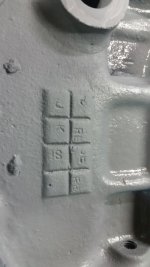
Got my block back from the shop, it is all clean now. I noticed these numbers on the back of the block in an area that would be covered by the flywheel. Anyone have any ideas on what they mean?

David
Number on engine block.jpg
 
Could have been put there by anyone involved in the the original casting process, pattern makers, guys actually pouring the iron, etc.
When I taught metal shop I always had the kids imprint their initials or some distinguishing marks to keep track of who did what.
Of course we were only working with aluminum but the process was identical.
 
The numbers are stamped into the casting so I am presuming by the location on the block they were to do with tracking during manufacture and not meant to be seen after the engine is built.

Just curious.

David
 
Started to rebuild the engine.

I got a new timing chain from TRF and I notice that despite the fact that I am using the old sprockets the chain is tight. Had a hard time getting the camshaft sprocket on. Is this normal? I will try calling TRF about it.

I am using the Degree timing procedure from Macey's site. Setting the inlet valve to start opening at 15 degrees BTDC. In the first 15 degrees of crank rotation the cam has only lifted ,010" which means that the valve has only started to open at 0 degrees or later. Should I advance the setting so that the valve is actually beginning to open at 15 degrees BTDC?

David
 
If you can put it together with your fingers, it's not too tight, IMO.

The valve should definitely be open slightly by TDC; I believe the 15 BTDC spec is actually for .015" travel at the rocker tip (enough to take up the specified lash plus a bit for deflection). But my suggestion (and the way I do it) is to follow the factory manual, ie set cam timing so both valves are open by equal amounts at TDC. The TR4 manual has a slightly better procedure (set lash to .040" then measure gap to find cam TDC), but the result is the same.
 
Hello Randall

Thank you.

Being on an engine stand I cant put the flywheel on to do the test that the handbook uses.

Going to go back and double check using the timing disc and DTI.

David
 
Put the head on then set the cam according to the TR hand book (Setting the valve timing in the Absence of timing marks).

Reset the rocker clearance to 0.010" and 0.012" and checked the valve opening/closing timing with a DTI on the valve head. Starts to open at 10 deg. BTDC and completes closing 8 deg. ATDC. Still had the timing disc on the crank.

David
 
The .012" number is only for TR2 with cast iron rocker pedestals. Stock TR3A should use .010" for both intake and exhaust (some aftermarket cams have different lash specs).

Cam slightly advanced (less than 4 degrees) is fine; the adjustment is only in approx 4 degree steps and the chain will stretch slightly when running. So sounds like you are good to go.
 
Hello Randall

Thank you.

I am probable being a little anal about it.

Want to do it once and not to have to do it over.

David
 
Update.

Got it all together and mounted it on a mobile stand. Installed the gear reduction starter from British Starter. An alternator from the local Auto part store with a wide pulley from an on line store.

Dropped a little gas in the carbs and it started. First time in about 28 years.

David
 
Back
Top