• Hey Guest!
    British Car Forum has been supporting enthusiasts for over 25 years by providing a great place to share our love for British cars. You can support our efforts by upgrading your membership for less than the dues of most car clubs. There are some perks with a member upgrade!

    **Upgrade Now**
    (PS: Upgraded members don't see this banner, nor will you see the Google ads that appear on the site.)
Tips
Tips

TR2/3/3A TR3a dimmer switch question

Don, was it also in that orientation relative to the mount ?

Piggott unfortunately only shows the RHS version of the later switch, but it's definitely on top of the bracket, rather than inside it as you've shown.

Of course, the RHS bracket is considerably different (since it mounts to the tunnel instead of the kick panel), so that may not prove anything at all.
 
Nick,
Aside from being inside out, your bracket is not the same as mine. You can't tell from the picture I posted, but the mounting holes in mine are centered (both ways), not offset. So it would be easy to mount mine inside out/backwards/rotated. I suppose it would be just as easy to mount it on the tunnel, so the passenger could control the dipper.
 
Randall - I think you're right. Notice that in that photo of the later round switch, it's not screwed together yet. I can't remember which side I screwed it onto, but it's probably like mine is. When I sand-blasted this later round one, it stayed full of sand and wouldn't work till I got all the sand out.

Nick - With you living in Scotland where most cars are RHD, I forgot that your black/white TR3A is a left hand drive. Therefore your dimmer switch base should look like mine.

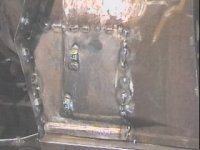
The 2 bolt holes are not in line on the bracket bases I've worked with, one for an early TR3A, and one a later post 60K TR3A. I welded in new captive boxes on the outside of the "dent" recess on the LHS wall where the dimmer switch base is bolted. I put them in exactly the same places and the base for the switch is truly vertical on the front face. The photo shows a partially finished job where you can see that the two captive boxes are not in line, because they have to match the 2 holes on the bracket bases.
 

Attachments

  • 10774.jpg
    10774.jpg
    15.1 KB · Views: 154
I think the reason that many of us like old Triumph is because we like taking things apart to see how they work.
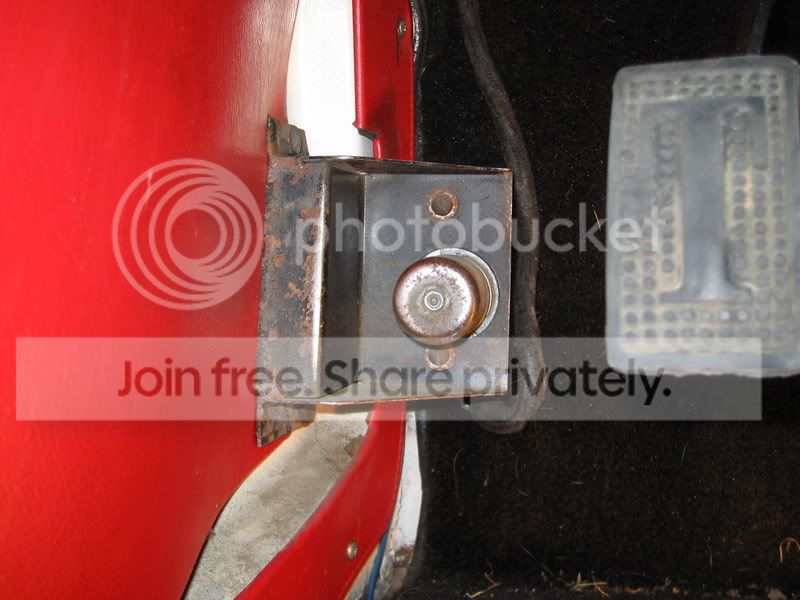
Now I am intrigued by my dimmer switch! I had another look down there today. It turns out that it is mounted the correct way and the bracket looks as though it is designed to also act as a foot rest for your left foot. The position of the captive nuts will not allow it to mount the other way round.
Of course, having seen the standards of most of the cars on the BCF I felt compelled to remove the bracket and repaint it.

IMG_0230.jpg
 
Geo Hahn said:
Nick -- That looks like the switch on my pre-60K TR3A, except the 'box' on mine is fitted the other way 'round.

Don't those angled bits make it hard to depress the switch?

Can someone tell me which orientation is correct?

Geo:
I don`t know about the later Tr`s but on my 56 the mounting bracket is mounted with the stiffening gussets {the angled bits} towards the firewall. Yes the "other way around".
And I know for a fact that it has NEVER seen off of the car until I removed it. AND F.W.I.W. although the car color WAS off white the bracket has bits of semi gloss black paint left on it, So I assume from the manufacture it was originaly painted black.

Note: The bracket I have is somewhat different in the fact that it lacks the little shelf affair shown in these posted pictures although both the bracket and the dipper mounting holes are the same and the dipper is the same.
 
Hi Guys,
Sorry for dropping out for a bit, interesting thread.
The picture posted by TR3driver, of the Lucas switch #31800 is the switch I have.
I concur that the box will only mount one way, as the captive nuts are offset.
The earlier set-up with the switch mounted behind the plate sure makes a lot more sense to me.
So now, is there any consensus on if the wires come up from underneath the plate or in over the top? Anyone else ever consider drilling a hole in the rear of the plate with a grommit and pass the wires in through the back of the plate?
I know, its not original that way, but there are small deviances allowed here and there that are not too visible.
Thanks,
Tim
 
Back
Top