• Hey Guest!
    British Car Forum has been supporting enthusiasts for over 25 years by providing a great place to share our love for British cars. You can support our efforts by upgrading your membership for less than the dues of most car clubs. There are some perks with a member upgrade!

    **Upgrade Now**
    (PS: Upgraded members don't see this banner, nor will you see the Google ads that appear on the site.)
Tips
Tips

TR2/3/3A TR3 Trouble!

NickMorgan

Jedi Knight
Offline
My TR3A seems to have something to prove this year.
I decided to rebuild the distributor towards the end of the winter as the base plates were rather worn and I couldn't adjust the points properly. I then had trouble with the timing, but managed to sort that on the second attempt.
First misfire was caused by a sticky piston in a carburettor and was reasonably easy to sort.
Last weekend's misfire seemed more serious and turned out to be a corroded top terminal on the coil along with the main HT lead terminal failing.
Today I tentatively took the TR out to a car show about 30 miles away. I kept thinking to myself that the car was running better than ever.
However, on the way home after cruising down a long hill, flicking out of overdrive and indicating right for a junction the engine just cut out. Red light came on and then went off again. I coasted into a field entrance and there were no indicators or fuel gauge working. The ignition light would not light with the key switched on.
After fiddling with the wires under the dash and under the bonnet and fitting two new fuses. The ignition light came on and the car started briefly then spluttered to a stop. Further fiddling under the dash and the ignition light came on again and I was able to start the car and drive home.
However, the indicators and fuel gauge still don't work. I haven't tried the horn or lights yet, but thought I should ask you lot for some likely causes before I start digging too deeply into the wiring.
Thanks for any ideas.
 
No solid ideas but sounds like an overload due to ???. I assume the OD tranny pulls some pretty good juice and I know the turn signals do as I can watch my ammeter bounce when the signal is on.
Sounds like you burned a connection poss at a gauge but am only guessing.
 
Sounds like multiple problems to me. The red light coming on and then going out as the engine died would indicate that the 'white' ignition circuit was no longer getting power. As it doesn't depend on the fuses (unless it's been modified of course), I would blame that on a bad connection under the dash. The post on the headlight switch where the lead takes power to the ignition switch would be my favorite, but it could be almost anywhere.

Now that you have power in the white circuit, but not the green, the problem has moved to somewhere else. Since you've been fiddling with fuses (and it's easier to work), I'd probably start at the fuse block, making sure that both sides of the fuse with the side terminal next to it are hot (with the key on). If one is hot and the other not, then the fuse is bad or not making good contact. If neither is hot, then the problem is the white wire from the ignition switch (but should be impossible as the coil gets it's power from that terminal). If both are hot, the problem is farther down the line. This drawing should be close for your car (tho you probably won't have the tail light fuse)
 
You can't spell 'Trouble' without 'TR'.

Can't spell it without 'ouble' either I suppose.

I too like the white wire for the initial failure. The connection I have had let me down is the screw connector on the ignition switch. Like your experience, blindly fiddling got me going again but a proper redo of the wires and connector was needed. Those screw connectors really want clean wire and a tight screw to be reliable. Sorry, don't recall the year of your '3 and if it has screw connectors.
 
The Lucar connectors on later Triumph can be just as bad. The Stag OD, for example, had a bad connection where the terminal felt tight when I tugged on it, but had just a tiny bit of 'wiggle' with no tension on the wire.
 
One thing that most people dont think about is the fuse block.It seems simple enough but over time corrosion can cripple its ability to conduct the smoke needed to make a Lucas system work.Replacing it can help a lot of problems that LBC's have.Also under the dash, the wires that are screwed down into the receptors of the gauges/sritches can get corroded.Trim them back and soldier the ends for a good connection(with di-electric grease of course).Patients and a good VOM are nice too.
MD(Mad dog)
 
Well thank you guys. You were all right! After studying the wiring diagram I realised that nothing was working from the output of the fuse box on the ignition controlled side. I had previously checked either side of the fuse, but the problem was that the fuse wasn't making good contact with one of its terminals.
I have given it a bit of a clean and it now works, but I will need to either clean it up properly or replace the whole fuse box before using the car again. I will also have to put the ignition switch back in and sort out the wiring there. Long term I think a new wiring loom will be a good investment. Maybe a 50th birthday present for the car this winter!
Now, of course, I have found why some of the electrical items stopped working, but why did the ignition also cut out at the same time but then start working again...?
 
FWIW, Nick, I had similar problems with the original fuse block on TS39781LO many years ago. I polished the contacts with a Scotch-Brite pad (non-woven abrasive); put a light coat of dielectric grease on them, and bent the clips just a bit for more pressure on the fuse. It was still working fine when the car got wrecked.
 
A small wire wheel on the Dremmel cleaned the fuse box up beautifully and I fitted two nice new 25 amp fuses.
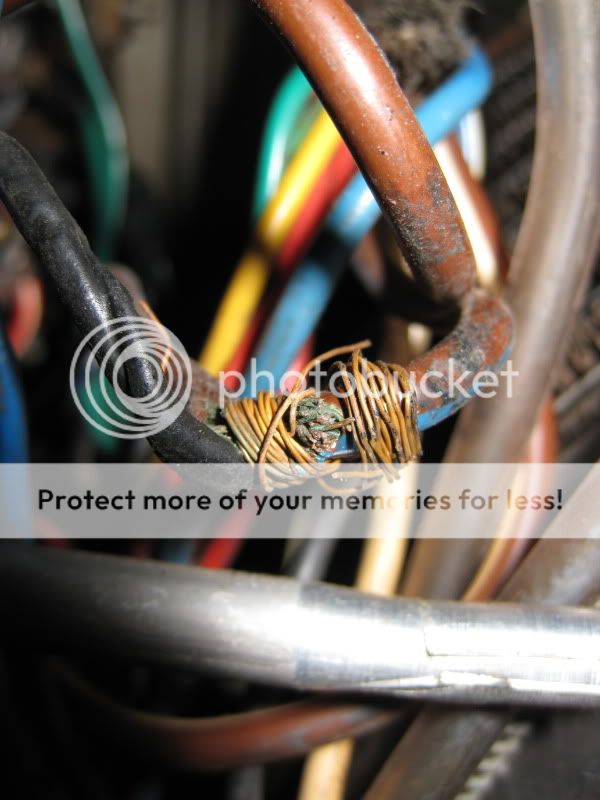
Then for the wiring under the dash. I removed some PVC insulating tape and discovered this:
Jointunderthetape.jpg

Seems that someone in the past has replaced the wire between the ignition switch and the light switch with a thinner wire which they have wrapped around the wire from the control box to the light switch. It looked as though a mouse had eaten it!
Andthewireunderthejoint.jpg

I cut out the offending wires and soldered bullet joints on, added new wires and cleaned up all of the connections to the switches.
Today I had a business meeting in Perth, 75 miles away, so I thought what better way to check if the TR is working OK. I am glad to report that the car is now running beautifully and I think better than at any time during my 18 years' ownership.
 
MDCanaday said:
Trim them back and soldier the ends for a good connection(with di-electric grease of course).
MD(Mad dog)

I agree with tinning the leads prior to inserting them into compression-type connections(such as pre-Lucar TR's), etc. <span style="text-decoration: underline">However, I must remind you that electrical conductors should not be coated with dielectric grease prior to being mated.</span> "Dielectric grease is a nonconductor. It doesn't improve the electrical connection between electrical contacts because it is a nonconductor. It can be useful as a sealant. While not promoting conductivity, it does help to preserve it by reducing conductivity degrading corrosion/oxidation of electrical connections over time." Dielectric Grease discussion

<span style="font-weight: bold">Also, like many things in life, a little is good, but more is not necessarily better!</span> :yesnod:
 
With respect, I agree that dialectric grease does not conduct. However a connector worth it's salt should displace the grease where the contact is being made and the rest of the grease then helps keep moisture out and prevents corrosion. I have been using it on all electrical connections and never had a lack of electrical continuity as a result of the grease (lots of other mechanical failures though :smile: )

Cheers,
Adrio
 
Nick et al: Let me share a recent observation. Recently whilst wiring the dash on my 3A, I ran short of red/white wire. I found an old piece left from an old TR250 loom and attempted to use it. The bare ends of the wire were dull, so I trimmed them flush and stripped off another 1/2 inch. To my surprise, the newly exposed copper was also dull. I pulled another lead, this time green/red randomly from the loom. I found the same condition. I removed the insulation from the entire length of these wires and found that they were completely dull. I grabbed my Fluke multimeter and measured a very high surface resistance. I really had to bare down hard to make contact between the meter probes and the wire. New copper wire which has been protected from corrosion should be bright and shiny. Obviously, over the course of 40 years, something has penetrated all of the conductor and turned it dull, kind of like when silver becomes tarnished. OR maybe BL used crap wire??? Next thing I did was to try and tin the ends of the wire. I only use high quality, 60/40 rosin-core solder for these kinds of connections. Generally speaking, rosin-core solder will remove any surface oxidation. In this case, regardless of the amount of heat I applied (40 watt iron) and the flux that I used, the solder rolled off the wire, indicating some type of contamination. Next step is to bring a sample to our daughter-in-law, a chemist (US definition, not a pharmacist), and ask her to do an analysis. My guess is either something out-gassed from the insulation and has attacked the copper or a compound of sulfur in the environment caused this problem. <span style="font-weight: bold">I guess the lesson learned is to use caution when using old wire from one of these looms AND that dielectric grease applied AFTER a sound connection is made, is a good preventative for corrosion.</span>
 
Adrio said:
With respect, I agree that dialectric grease does not conduct. However a connector worth it's salt should displace the grease where the contact is being made and the rest of the grease then helps keep moisture out and prevents corrosion. I have been using it on all electrical connections and never had a lack of electrical continuity as a result of the grease (lots of other mechanical failures though :smile: )

Cheers,
Adrio

Adrio

You indirectly helped me to make my point. I must confess that I have never cared much for the bullet-sleeve type of connector used in English cars. Let me add that you are hearing this from a hopeless anglophile since the age of nine! They work OK when new, but with time the sleeve compression relaxes and conductivity between the bullet and sleeve goes to pot. Additional gobs of grease, dielectric or otherwise wont solve this basic design flaw. So, maybe the connectors are not worth their salt to begin with, IMO. :smile:
 
Frank,
I found my wires to be in a similar condition. I had to scrape the copper to get clean bits that would accept the solder. However, I don't think that the solder will have penetrated into the wires. The whole loom is quite stiff now and I think that I really can't complain after 50 years.
I guess that the copper does tarnish over the years and that oxygen is able to very slowly get through the insulation.
I am saving up to buy a new loom. Autosparks here in the UK seem to be the cheapest over here and they produce really good quality looms. ÂŁ128 isn't too bad.
Nick
 
I agree, copper wire does tarnish over the years. Oxygen does slowly penetrate, both through the insulation and along the length of the wire. You can see the same thing when stripping wire from old houses (my folk's house was originally electrified almost 90 years ago).

The rosin flux in rosin core solder is only intended to deal with a very slight layer of oxide, not the kind of buildup one would expect in 50 year old wire. To make a connection to this old wire, you must clean the individual strands until they are bright. As Arne Sakmussen said, I have done this. If you clean all around each strand, the solder will flow onto the wire just fine. I generally just use my pocket knife and fan the strands out to scrape them clean; but some limited experiments with Tarn-X seemed to go well, too. It remains to be seen if the Tarn-X will promote future corrosion or not.

When the bullets are soldered to the wires, I feel the original bullet connections are as good as anything in common usage back then. Old American cars suffer much the same problems with their connectors, after such a long time; and by comparison it's a whole lot easier to replace a British sleeve. Today's cars are going to be an absolute nightmare to keep running, in another 50 years!

Personally, I do like to add a little silicone grease to connections that will be exposed to heat, vibration and/or the elements, before mating them. As noted in the discussion linked to above, the grease itself is not conductive and does nothing to improve the initial contact. But it does get displaced in a connector with sufficient contact force, and help ensure a gas-tight joint that will endure. This is particularly important in places with unplated copper contacts, like the dash lamps on a TR3.

My 59 TR3A still had its original harness (with a few modifications and additions) when it was wrecked. The 57 still has its original harness as well, although I did have to replace a bunch of bullets that the DPO had cut off when he removed the control head. Not that there is anything wrong with replacing the harness, I'm just a believer in "If it ain't broke, don't fix it".
 
Back
Top