-
 Hey Guest!
British Car Forum has been supporting enthusiasts for over 25 years by providing a great place to share our love for British cars. You can support our efforts by upgrading your membership for less than the dues of most car clubs. There are some perks with a member upgrade!**Upgrade Now**
(PS: Upgraded members don't see this banner, nor will you see the Google ads that appear on the site.)
You are using an out of date browser. It may not display this or other websites correctly.
You should upgrade or use an alternative browser.
You should upgrade or use an alternative browser.
TR2/3/3A TR3 Tool Time
- Thread starter CJD
- Start date


Tr3aguy
Jedi Knight
Offline
Maybe this will help...
A. Jack and Jack Handle - All cars were issued a jack.
TS 1 through TS 5468 had a one piece, "open screw" type jack painted black or orange red.
From TS 5469, a tube like "closed screw" jack was fitted with a separate ratchet handle. The jacks were
usually painted varying shades of orange red, and the feet of these jacks were blued or black-oxide finished.
The ratchets were blued or painted black.
B. Wheelbrace or Knockoff Hammer - Depending on whether the car was fitted with wire or disc wheels, the
following were issued.
- Disc wheeled cars were issued a wheelbrace (lugnut wrench) which was painted gloss black except a blue
metallic painted area inside the socket. Disc wheeled cars were also issued a clear cadmium plated nave
plate removing tool. This device was a tommy bar with a screwdriver head on one end and a hooked spoon
on the other.
- Wire wheeled cars were issued knockoff hammer, which was either copper or lead. Thor hammers being
reproduced today are perfectly acceptable.
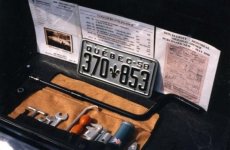
C. Full Tool Roll (Optional) - There is considerable uncertainty as to exactly what the status of the full toll rolls
was. Some reference material list these as standard, others as optional, and others as a mix of the two. In the
interest of consistency, I am listing the tool roll as specified by the parts manual (factory) and those components
I have observed to be in every roll.
These tools include:
1 open end spanner 3/8" x 7/16" A/F
1 open end spanner 3/4" x 5/8" A/F
1 open end spanner 1/2" x 9/16" A/F
1 tube spanner 1/2" x .56" A/F
1 sparking plug tube spanner
1 pair slip joint grips (pliers)
1 Tommy bar (omitted on disc wheel cars)
1 cabinet type screwdriver (omitted on disc wheel cars)
1 adjustable wrench
1 greasegun (Tecalimit #GB 2801)
1 feeler gauge assembly
1 distributor tool (Lucus key like feeler gauge)
1 brass valve stem removing tool
1 headlamp rim removing tool (blued or natural sheetmetal) for cars after TS32585.
T R A
IN-27
The toolsets undoubtedly varied from time to time, but the above listing is the most representative. Some other
tools encountered are tire irons (early cars) and a small bolt used to pull the front hub dust seals.
All tools, with possibly the exception of very early ones, were finished in clear cadmium, except the following:
- Greaseguns were painted blue metallic hammertone or bronze metallic. The potmetal caps were
natural, as was the shaft. The nozzle was clear cadmium.
- The screwdriver blade was slotted, and natural. The grip was light hardwood.
- The brass valve stem remover was natural.
The tool roll may have initially been rubber or plastic coated jute, but was eventually standardized to a thin
plastic/vinyl with heat pressed tool pockets. The tie straps were either white or black cotton.
* As there is no clear way to determine whether a car was originally equipped with a full tool roll, and which
of the above tools were provided, judges are advised to use caution before deducting points for an
incomplete tool roll. Obviously, if only three or four tools are shown, the set is incomplete, but beyond
that, be careful.
D. Starting Handling - This optional tool was provided with many cars. There were two types fitted, one for
those cars built up to TS 22014, and one for those built after. They differ only slightly in the position of the
boss which slips into the starting handle guide, and by the alignment of the teeth at the end. All were finished
gloss black.
E. Coach Key - All models use the same basic coach keys. There are slight variations in length. The grip section
should be straight, not dogbone-like. Finish is natural metal.
A. Jack and Jack Handle - All cars were issued a jack.
TS 1 through TS 5468 had a one piece, "open screw" type jack painted black or orange red.
From TS 5469, a tube like "closed screw" jack was fitted with a separate ratchet handle. The jacks were
usually painted varying shades of orange red, and the feet of these jacks were blued or black-oxide finished.
The ratchets were blued or painted black.
B. Wheelbrace or Knockoff Hammer - Depending on whether the car was fitted with wire or disc wheels, the
following were issued.
- Disc wheeled cars were issued a wheelbrace (lugnut wrench) which was painted gloss black except a blue
metallic painted area inside the socket. Disc wheeled cars were also issued a clear cadmium plated nave
plate removing tool. This device was a tommy bar with a screwdriver head on one end and a hooked spoon
on the other.
- Wire wheeled cars were issued knockoff hammer, which was either copper or lead. Thor hammers being
reproduced today are perfectly acceptable.
C. Full Tool Roll (Optional) - There is considerable uncertainty as to exactly what the status of the full toll rolls
was. Some reference material list these as standard, others as optional, and others as a mix of the two. In the
interest of consistency, I am listing the tool roll as specified by the parts manual (factory) and those components
I have observed to be in every roll.
These tools include:
1 open end spanner 3/8" x 7/16" A/F
1 open end spanner 3/4" x 5/8" A/F
1 open end spanner 1/2" x 9/16" A/F
1 tube spanner 1/2" x .56" A/F
1 sparking plug tube spanner
1 pair slip joint grips (pliers)
1 Tommy bar (omitted on disc wheel cars)
1 cabinet type screwdriver (omitted on disc wheel cars)
1 adjustable wrench
1 greasegun (Tecalimit #GB 2801)
1 feeler gauge assembly
1 distributor tool (Lucus key like feeler gauge)
1 brass valve stem removing tool
1 headlamp rim removing tool (blued or natural sheetmetal) for cars after TS32585.
T R A
IN-27
The toolsets undoubtedly varied from time to time, but the above listing is the most representative. Some other
tools encountered are tire irons (early cars) and a small bolt used to pull the front hub dust seals.
All tools, with possibly the exception of very early ones, were finished in clear cadmium, except the following:
- Greaseguns were painted blue metallic hammertone or bronze metallic. The potmetal caps were
natural, as was the shaft. The nozzle was clear cadmium.
- The screwdriver blade was slotted, and natural. The grip was light hardwood.
- The brass valve stem remover was natural.
The tool roll may have initially been rubber or plastic coated jute, but was eventually standardized to a thin
plastic/vinyl with heat pressed tool pockets. The tie straps were either white or black cotton.
* As there is no clear way to determine whether a car was originally equipped with a full tool roll, and which
of the above tools were provided, judges are advised to use caution before deducting points for an
incomplete tool roll. Obviously, if only three or four tools are shown, the set is incomplete, but beyond
that, be careful.
D. Starting Handling - This optional tool was provided with many cars. There were two types fitted, one for
those cars built up to TS 22014, and one for those built after. They differ only slightly in the position of the
boss which slips into the starting handle guide, and by the alignment of the teeth at the end. All were finished
gloss black.
E. Coach Key - All models use the same basic coach keys. There are slight variations in length. The grip section
should be straight, not dogbone-like. Finish is natural metal.


6TTR3A
Jedi Warrior
Offline
<span style="font-size: 12pt"><span style="color: #006600">Tool sources
tire valve remover....eBay item 370546125980
Distributer tool....TRF 500905
Rim remover...Moss has it listed as a TR4 rim remover,
I think it's the same one as the TR3 one, but not positive
"helicopter" type feeler gauge...I've not seen that anywhere,(I made my own from a photo of the original)
FRank
</span></span>
tire valve remover....eBay item 370546125980
Distributer tool....TRF 500905
Rim remover...Moss has it listed as a TR4 rim remover,
I think it's the same one as the TR3 one, but not positive
"helicopter" type feeler gauge...I've not seen that anywhere,(I made my own from a photo of the original)
FRank
</span></span>

Don Elliott
Obi Wan
Offline