• Hey Guest!
    British Car Forum has been supporting enthusiasts for over 25 years by providing a great place to share our love for British cars. You can support our efforts by upgrading your membership for less than the dues of most car clubs. There are some perks with a member upgrade!

    **Upgrade Now**
    (PS: Upgraded members don't see this banner, nor will you see the Google ads that appear on the site.)
  • When posting a classified ad, you MUST select a prefix from the drop-down next to the subject line. If you don't you will get an error and your ad will not be posted!
Tips
Tips

TR2/3/3A TR3 stop lights lens

Koopster

Member
Offline
One of my TR3 original red glass stop light lens broke when my nine iron fell out of my golf bag when I was putting it away. I got another one from a friend but it is not the same redness.
I found on Ebay a pair of plastic ones that the seller said that they use when competing on the track.
Has anyone use these plastic lens and how is the color compared with the color of the original Lucas glass lens?
I think that newer type glass lens are just coated red on the inside of the glass.
What are your feelings on this?
Thanks, John
 
The two inner beehive Lucas lens are the glass stop lights, the two outer lens are plastic and are for signaling rear drive lights.
 
I think that I should never have referred to these light as stop light.
The ones I'm taking about are the beehive shaped lens on the rear of the Triumph TR3. They are the same ones that are on MGA's and many other Birtish cars.
Different British cars seem to have different shade of color of red and orange.
It seems that buying one is a hit or miss on the exact color of the one good one I have. The plastic racing ones are low cost and as thick as the glass ones and the color is in the plastic.
Two different shades of red just do not like right. The glass replacement one with the painted inside peel. This is why I am interest in these plastic type.
John
 
The glass beehives were only on the last few thousand TR3 plus all 3A and 3B; and are only for turn signals in the rear. US market cars had red lenses, but I believe some other markets used amber; both colors (and clear for the front) are readily available. In fact TRF has the red ones on sale for $10 each at the moment, so my suggestion would be to just buy a pair of them if you want them to match.

I don't know anything about the plastic ones on eBay; but the plastic ones I've seen (and used) were much thinner than the glass and kind of cheesy. Broke easier, too. When my 3A was rear-ended, the other car's bumper hit one of those glass lenses hard enough to punch the whole fixture through the sheet metal and into the trunk. When I pried the metal apart, the glass was not broken! (Tho there was a scuff mark where it was hit.) Sure wish I'd had the sense to take a picture of that.
 
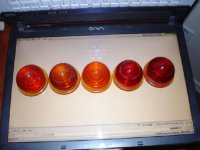
Color range of L 594 beehive ranges a lot. I can't seem to get my picture to show up, but it is from lenses in my spares box and there are 5 color shades. Two of red and 3 of the orange.
 

Attachments

  • 24019.jpg
    24019.jpg
    37.7 KB · Views: 265
The L594 is apparently just a casting number. The white ones on the front of my 3A are identical and have the same casting number. The orange, red, and white lenses were originally sold under different part numbers for different applications and different marques. All made sense when these were on a shelf in a box with the correct part number but confusing for us now when we go through our bins of spares. The color shade needs to be considered in determining the correct application. Tom
 
"L594" is indeed a lamp number, referring to the basic design and structure of the lamp base, lens, gasket, etc., etc., and they were used as side, side/flasher, flasher or backup lamps on numerous cars. Original Lucas lens part numbers are as follows:

Red: 576109 (or 54571112)
Amber: 576108
Clear: 576983

I'm not sure why two different part numbers are shown for the red lens in the 1960 Master Catalogue, as the descriptions for the two part numbers are the same!?

Oh, and all were originally glass!
 
Don't know if this helps or makes things less clear...


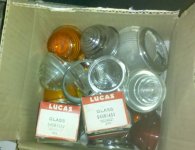
These are new amber beehives in the boxes. There is a three digit number on the box tab that is different on each and I have no idea other than batch number what it would be.
 

Attachments

  • 24028.jpg
    24028.jpg
    84.7 KB · Views: 211
My 1960 Lucas "Standard & Triumph" catalog shows lens 54571112 for a "flasher lamp" L594 (listed for TR2/3 only for "NADA"); while 576109 is for a "stop tail lamp" L594 (listed for "Companion" Estate Car and 6 cwt Van and Pick-up Truck).

Perhaps they were slightly different shades of red, in order to meet regulatory requirements? Or even just bore different approvals without actually being different?
 
AEW said:
There is a three digit number on the box tab that is different on each and I have no idea other than batch number what it would be.
That's simply a date code, i.e. 2/73 is February 1973.

TR3driver said:
My 1960 Lucas "Standard & Triumph" catalog shows lens 54571112 for a "flasher lamp" L594 (listed for TR2/3 only for "NADA"); while 576109 is for a "stop tail lamp" L594 (listed for "Companion" Estate Car and 6 cwt Van and Pick-up Truck).

Perhaps they were slightly different shades of red, in order to meet regulatory requirements? Or even just bore different approvals without actually being different?
That's as good a guess as I can come up with, and it's borne out to some degree in the Lucas Master Catalogue (except for one listing of Tail Lamps where the 54571112 is listed as a Tail Lamp lens. I think I'm sorry I ever started digging into this).
 
Back
Top