 but were afraid to ask:
 I have a couple of questions on the tr3 steering. I was wondering, can I put the bushing back into the box with a piece of thread all by pulling it in, or do I need to have it pressed in. And are the replacement steering pegs of good quality? I would hate to replace a kinda wore one with some inferior product. In the past, I have always taken the steering box to the shop and had the bushing and peg press in, but if I can do it myself, what the heck. In addition, I think Texas knucklehead ask how I would keep the new worm gear on, and what I did was slowly penned the soft metal end over will a ball penn hammer. I think that was Peter K suggestion.


-
 Hey Guest!
British Car Forum has been supporting enthusiasts for over 25 years by providing a great place to share our love for British cars. You can support our efforts by upgrading your membership for less than the dues of most car clubs. There are some perks with a member upgrade!**Upgrade Now**
(PS: Upgraded members don't see this banner, nor will you see the Google ads that appear on the site.)

Tips
- We have a special forum called "Member Articles" where you can submit actual articles for consideration for publication. Learn More
- Don't have an Avatar? If not, your avatar will default to the 1st character in your username. Go into "Account Details" to change your Avatar.
- Some basic forum navigation info: click
 Hey - did you know if you click on the title of a thread it will take you to the first unread post since you last visited that thread?
- Hey Guest - Is your British Car Club in our Clubs database? If not, send me a PM - Basil

- Looking for a local club? Click the "Clubs" tab above and browse hundreds of clubs world-wide.
- Add Android or iPhone APP: click
- Did you know - any picture or video you add in your posts in any marque-specific forum will also get added to the Media Gallery automatically.
- A few more tips about posting and replying: click
- Hey there Guest - be sure to keep your profile page up to date with interesting info about yourself: learn more
- More tips and tricks on Posting and Replying: click
 STOP!! Never post your email address in open forums. Bots can "harvest" your email! If you must share your email use a Private Message or use the
  smilie in place of the real @
- Want to mention another member in a post & get their attention? WATCH THIS

- So, you created a "Group" here at BCF and would like to invite other members to join? Watch this!
- Hey Guest - A post a day keeps Basil from visiting you in the small hours and putting a bat up your nightdress!
- Hey Guest - do you know of an upcoming British car event?
 Pretty Please - add it to our Events forum(s) and add to the calendar! >> Here's How <<
- Hey Guest - you be stylin' Change the look and feel of the forum to fit your taste. Check it out
- If you run across an inappropriate post, for example a post that breaks our rules or looks like it might be spam, you can report the post to the moderators: Learn More
- If you would like to try some different "looks" or styles for the site, scroll to the very bottom, on the left and click the Style Selector.
You are using an out of date browser. It may not display this or other websites correctly.
You should upgrade or use an alternative browser.
You should upgrade or use an alternative browser.
TR2/3/3A tr3 steering
- Thread starter sp53
- Start date

MGTF1250Dave
Jedi Knight

Offline
Aloha,
I did this job about twenty years ago. I didn't have a press and hadn't thought of using a threaded rod to pull it in so I probable used a hammer and some wood blocks to drive it in. In any case, the new bushing should be socked in oil for 12- 24 hours make sure it is well lubricated before installation. The steering box should be clean so I think the well lubed bushing won't take much force to put in place and the threaded rod should be a better alternative to hammering it home.
The peg I bought back then seems to holding up well as there is no apparent slop in the steering box. If you are concerned about the quality of new parts you could always rotate the current peg 90 degrees and should have unworn surfaces mating with the worm. The other consideration is that the peg is the better piece to wear as opposed to the worm gear.
I did this job about twenty years ago. I didn't have a press and hadn't thought of using a threaded rod to pull it in so I probable used a hammer and some wood blocks to drive it in. In any case, the new bushing should be socked in oil for 12- 24 hours make sure it is well lubricated before installation. The steering box should be clean so I think the well lubed bushing won't take much force to put in place and the threaded rod should be a better alternative to hammering it home.
The peg I bought back then seems to holding up well as there is no apparent slop in the steering box. If you are concerned about the quality of new parts you could always rotate the current peg 90 degrees and should have unworn surfaces mating with the worm. The other consideration is that the peg is the better piece to wear as opposed to the worm gear.

TR3driver
Great Pumpkin - R.I.P
Offline
That's what I did. As I recall, it went in pretty easy.sp53 said:I have a couple of questions on the tr3 steering. I was wondering, can I put the bushing back into the box with a piece of thread all by pulling it in,
The peg I got from TRF has held up well, but that doesn't mean yours will.
MGTF1250Dave
Jedi Knight
Offline
Aloha,
I didn't mention replacing the shaft seal, but I am assuming you will be installing a new one. Wrap some masking tape over the splines on the rocker shaft when installing so you don't damage the seal.
Leaks from this seal and at the front cover plate/olive over time result in a dry steering box. Checking oil in the steering box is often over looked. I think these two things are the leading causes leading to difficulty in turning the steering wheel and sloppy response due to wear.
I didn't mention replacing the shaft seal, but I am assuming you will be installing a new one. Wrap some masking tape over the splines on the rocker shaft when installing so you don't damage the seal.
Leaks from this seal and at the front cover plate/olive over time result in a dry steering box. Checking oil in the steering box is often over looked. I think these two things are the leading causes leading to difficulty in turning the steering wheel and sloppy response due to wear.
Noticed my steering box is leaking around the shaft seal.
While I still have my front apron off I was going to replace the steering box shaft seal (#45 Moss) and maybe the bushing (#44 Moss) if it needs it.
I don't want to remove the box!
Here is what my plan is.
I will take the drop arm nut off, and move the arm out of the way.
Then remove the cover and rocker shaft. Then take a punch and knock out the seal and bushing.
Will this work?
Or should I remove the steering box?
My TR3 has a split column.
I like the idea about putting tape on the shaft to protect the new seal.
Any help would be appreciated.
Lyle
While I still have my front apron off I was going to replace the steering box shaft seal (#45 Moss) and maybe the bushing (#44 Moss) if it needs it.
I don't want to remove the box!
Here is what my plan is.
I will take the drop arm nut off, and move the arm out of the way.
Then remove the cover and rocker shaft. Then take a punch and knock out the seal and bushing.
Will this work?
Or should I remove the steering box?
My TR3 has a split column.
I like the idea about putting tape on the shaft to protect the new seal.
Any help would be appreciated.
Lyle
TR3driver
Great Pumpkin - R.I.P
Offline
IMO you'll be better off to pull the box and do the work on the bench. You've already got the apron off, and once you've got the stator tube out and the upper column disconnected (which you'll have to do anyway), the rest is easy. I just went through this with TS13571L, and even though I decided not to update the box, I was still glad I pulled it just to get it adjusted properly.
It takes a strong puller to remove the drop arm as it's a splined locking taper, which is going to be difficult if not impossible while working in the limited space under the car. Also best to remove the worm first, before pulling the drop arm, so there's no possibility of slamming the pin into the worm and damaging either one.
Again IMO the easy way to remove the seal is to push it out with the bushing, but I don't think you'll be able to knock either one out with a punch without risking damage to the box. And if it's tired enough to leak, it's probably also tired enough to need a new bushing. Some all-thread, nuts, flat washers and a socket to pull the seal & bushing into works a treat, though.
On reassembly, be sure to check and adjust the shim pack before installing the top cover (to ensure that the peg is not putting ANY side force on the worm while checking the end float). I've been using a dial indicator to check end float (add shims until you can measure some float, then subtract shims to equal that); but it could probably be done by removing all the shims and doing a trial assembly with the bolts just finger-tight. Adjust them until you get an even gap all around, then measure the gap with feeler gauges and install that many shims (including the gasket thickness).
It takes a strong puller to remove the drop arm as it's a splined locking taper, which is going to be difficult if not impossible while working in the limited space under the car. Also best to remove the worm first, before pulling the drop arm, so there's no possibility of slamming the pin into the worm and damaging either one.
Again IMO the easy way to remove the seal is to push it out with the bushing, but I don't think you'll be able to knock either one out with a punch without risking damage to the box. And if it's tired enough to leak, it's probably also tired enough to need a new bushing. Some all-thread, nuts, flat washers and a socket to pull the seal & bushing into works a treat, though.
On reassembly, be sure to check and adjust the shim pack before installing the top cover (to ensure that the peg is not putting ANY side force on the worm while checking the end float). I've been using a dial indicator to check end float (add shims until you can measure some float, then subtract shims to equal that); but it could probably be done by removing all the shims and doing a trial assembly with the bolts just finger-tight. Adjust them until you get an even gap all around, then measure the gap with feeler gauges and install that many shims (including the gasket thickness).
OK, I agree, I will pull the box, do it right!TR3driver said:IMO you'll be better off to pull the box and do the work on the bench. You've already got the apron off, and once you've got the stator tube out and the upper column disconnected (which you'll have to do anyway).
On reassembly, be sure to check and adjust the shim pack before installing the top cover (to ensure that the peg is not putting ANY side force on the worm
So, if I remove the column clamp and bolts then the lower shaft and tube should be free to come out?
What is the stator tube? Moss picture?
I have a bunch of gear pullers, to remove the drop arm.
Will check everything for wear.
Got an idea of how the box works, just not sure how to shim the peg, yet.
My shop is pretty well equiped, so I should be able to do it, with a little help.
Another project for the weekend.
Randall, thanks for the imput.
Lyle
MGTF1250Dave
Jedi Knight
Offline
Aloha Lyle,
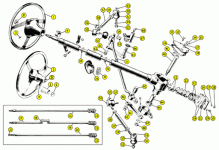
The stator tube is the the conduit that the control head wiring is in. It runs the length of the steering column (between 4 and 5) and protrudes out of the front of the steering box (cover plate #26).
It is held in place with a olive (compression sleeve) and a compression nut (items 27 & 28).
The shims (item 24) are added or removed to to keep the inner steering column from moving lengthwise in the steering box.
A pitman arm puller may work better than a gear puller.
The stator tube is the the conduit that the control head wiring is in. It runs the length of the steering column (between 4 and 5) and protrudes out of the front of the steering box (cover plate #26).
It is held in place with a olive (compression sleeve) and a compression nut (items 27 & 28).
The shims (item 24) are added or removed to to keep the inner steering column from moving lengthwise in the steering box.
A pitman arm puller may work better than a gear puller.
Attachments
TR3driver
Great Pumpkin - R.I.P
Offline
I strongly suggest you get a copy of the factory workshop manual before tackling this. If you don't have one, PM me your email addy & I'll email you the relevant pages. We've all worked out our own shortcuts, but the manual gives an good starting point.
To remove the stator tube, you start by disconnecting the wires that protrude from the steering box, up by the horn where they join the main harness. Be sure to remove the vinyl sleeves from the subharness (it's OK if they stay on the main harness). Lift the subharness out of its clip and pull it out straight in front of the steering box.
Then undo the 3 grub screws around the steering wheel hub and pull the control head away (pulling the subharness with it) until the wires protrude just a little from the end of the tube. Remove the compression nut & gland at the steering box. It may take some persuasion to get the gland to slide off the tube; in extreme cases you may need to cut it and buy a new one. Now you can pull the tube out from the steering wheel end, with the wires still inside it. (This saves having the fish them back through the tube later on.)
The tube has some notches in it, to locate the funny looking springs, so you can't pull it out the other way even if you wanted to.
I managed to use a 2-arm gear puller, but I agee with Dave that a Pitman arm puller is much better. To keep the gear puller on the arm, I had to fabricate some side braces that kept the arms from spreading and sliding off. Then tighten the forcing screw until something is likely to break, and whack the end of it with a BFH. Some folks have resorted to using heat, but I dislike the idea, so I don't.
To remove the stator tube, you start by disconnecting the wires that protrude from the steering box, up by the horn where they join the main harness. Be sure to remove the vinyl sleeves from the subharness (it's OK if they stay on the main harness). Lift the subharness out of its clip and pull it out straight in front of the steering box.
Then undo the 3 grub screws around the steering wheel hub and pull the control head away (pulling the subharness with it) until the wires protrude just a little from the end of the tube. Remove the compression nut & gland at the steering box. It may take some persuasion to get the gland to slide off the tube; in extreme cases you may need to cut it and buy a new one. Now you can pull the tube out from the steering wheel end, with the wires still inside it. (This saves having the fish them back through the tube later on.)
The tube has some notches in it, to locate the funny looking springs, so you can't pull it out the other way even if you wanted to.
I managed to use a 2-arm gear puller, but I agee with Dave that a Pitman arm puller is much better. To keep the gear puller on the arm, I had to fabricate some side braces that kept the arms from spreading and sliding off. Then tighten the forcing screw until something is likely to break, and whack the end of it with a BFH. Some folks have resorted to using heat, but I dislike the idea, so I don't.
Wow, you guys are good! Attached drawings!MGTF1250Dave said:Aloha Lyle,
The stator tube is the the conduit that the control head wiring is in. It runs the length of the steering column (between 4 and 5) and protrudes out of the front of the steering box (cover plate #26).
It is held in place with a olive (compression sleeve) and a compression nut (items 27 & 28).
A pitman arm puller may work better than a gear puller.
I should have found this site sooner, I sure struggled with my TR3 along the way. Nice not to be alone anymore!
I have had the drop arm off when I rebuilt the entire front suspension, so I have a puller that will work.
Now I understand the stator tube and steering a little better.
"Olive" never heard it called that before!
Thanks Dave for the help.
Lyle
Randall I don't have a factory manual.TR3driver said:I strongly suggest you get a copy of the factory workshop manual before tackling this. If you don't have one, PM me your email addy & I'll email you the relevant pages. We've all worked out our own shortcuts, but the manual gives an good starting point.
If you could Email me a few pages that would be great. Who sells the manual?
I agree with using a BFH instead of heat.
Being a Tool & Die Maker by trade, I heat treat tool steels all the time. I always worry about flame heating critical car parts, and causing an annealed or hardened condition to the material. Any heat over about 350 degree's will affect the material.
As a <span style="text-decoration: underline">last</span> resort use low heat and heat/cool several times with a penetrating oil.
Lyle

TR3driver
Great Pumpkin - R.I.P
Offline
Paperback reprints of the original workshop manual are available from the usual suspects (TRF, Moss, et al), but are getting darn pricey (TRF has them currently on sale for $75 ouch!). I see one on eBay for $40 tho.TruCraft said:Who sells the manual?
Less expensive electronic (CD) copies abound on eBay (although I have heard that some of them use a copy-protection scheme that makes them unreadable under Windows Vista).
Here's a tatty original currently at $25.
The Haynes TR2-4 manual is second-best in my opinion. Better in some ways, but also has more mistakes.
Thanks everyone for the info and tips, the steering box is out!
Like everything, the first time you do it's a pain. I had trouble with the, 3 grub screws & silentbloc removal.
Also, I couldn't find my puller, so the drop arm is still on. My neighbor says he has one.
I will pull it apart on Monday and see what I need.
Other things to work on:
* Replace the silentbloc's
* Idler bracket bushing is worn bad.
Randall, I just bought the factory manual off Ebay!
Now with all this info, I can really screw something up good!!
Thanks for the help.
Lyle
Like everything, the first time you do it's a pain. I had trouble with the, 3 grub screws & silentbloc removal.
Also, I couldn't find my puller, so the drop arm is still on. My neighbor says he has one.
I will pull it apart on Monday and see what I need.
Other things to work on:
* Replace the silentbloc's
* Idler bracket bushing is worn bad.
Randall, I just bought the factory manual off Ebay!
Now with all this info, I can really screw something up good!!
Thanks for the help.
Lyle
Just got back from my shop, drop arm off, wow was that thing tight, that tapered spline holds great!!!!
Pulled apart and cleaned everything.
<span style="text-decoration: underline">Problems</span>:
*The peg has flat spots worn on it.
Will rotate 90 degree's.
*Seal is shot, will replace.
*All the rubber bushings in the tube are shot.
Will machine Teflon replacements.
*Need new gaskets.
The cam, bearings/races and rocker shaft bushing look good.
Will get a parts list together.
Now that I see how this steering Cam/Peg thing works, how could it ever be tight in the middle?
When the rocker shaft is in the middle of it's travel, the peg is off center of the cam! As the rocker shaft is rotated, it moves to the center of the cam and gets tighter.
?
Looks like a spring is the only way to keep constant ajustment all the way through it's travel.
I'm sure others have seen this.
Any thoughts?
Lyle
Pulled apart and cleaned everything.
<span style="text-decoration: underline">Problems</span>:
*The peg has flat spots worn on it.
Will rotate 90 degree's.
*Seal is shot, will replace.
*All the rubber bushings in the tube are shot.
Will machine Teflon replacements.
*Need new gaskets.
The cam, bearings/races and rocker shaft bushing look good.
Will get a parts list together.
Now that I see how this steering Cam/Peg thing works, how could it ever be tight in the middle?
When the rocker shaft is in the middle of it's travel, the peg is off center of the cam! As the rocker shaft is rotated, it moves to the center of the cam and gets tighter.
?
Looks like a spring is the only way to keep constant ajustment all the way through it's travel.
I'm sure others have seen this.
Any thoughts?
Lyle
TR3driver
Great Pumpkin - R.I.P
Offline
Lyle, I don't understand your comment about the center of travel not being the center of the cam ... since the cam is what limits the travel, that seems impossible to me.
The tight spot comes about because the groove in the cam is not constant width. That allows the peg to ride lower away from center; and in theory gives a bit of play away from center for easier steering. But in practice the play is non-existant, because the front suspension acts like a big spring to keep the peg against one side of the groove.
I have seen top covers modified to use a spring against the rocker. IMO it's a bad solution to a non-existent problem. Unless the spring exerts a LOT of force, the rocker will rise and compress the spring when making sudden maneuvers; effectively causing play in the steering at the time when you want it least. And if the spring is strong enough to oppose the maximum force, then it will cause a lot of friction between the peg and cam, all the time.
Friend of mine's TR3A had both problems; the spring caused lots of friction and would compress during just an ordinary turn. It drove like a truck! Switched back to an original cover : MUCH better.
The tight spot comes about because the groove in the cam is not constant width. That allows the peg to ride lower away from center; and in theory gives a bit of play away from center for easier steering. But in practice the play is non-existant, because the front suspension acts like a big spring to keep the peg against one side of the groove.
I have seen top covers modified to use a spring against the rocker. IMO it's a bad solution to a non-existent problem. Unless the spring exerts a LOT of force, the rocker will rise and compress the spring when making sudden maneuvers; effectively causing play in the steering at the time when you want it least. And if the spring is strong enough to oppose the maximum force, then it will cause a lot of friction between the peg and cam, all the time.
Friend of mine's TR3A had both problems; the spring caused lots of friction and would compress during just an ordinary turn. It drove like a truck! Switched back to an original cover : MUCH better.
One little trick to avoid going mad latter....The seal will still leak if you dont put in a new bushing too.Then it will still leak due to wear on the shaft,unless you pack the lower portion of the box with wheelbearing grease,the heavy stuff!! it will block the gear grease from getting to the seal to slip by it!! This works every time !!
Next get rid of the old si-block pins and use the modern nylon replacements..
MD(mad dog)
Next get rid of the old si-block pins and use the modern nylon replacements..
MD(mad dog)
EjohnTaylor
Freshman Member
Offline
i changed the rack in mine a while back, what a pain it was!
the one thing i forgot was to detach the horn and turn wires from the BOTTOM
and tore em out of the horn button
a nightmare puting THAT together again.. but i got it
amazing how good ya get when ya have to do something more than once lol :wink:
the one thing i forgot was to detach the horn and turn wires from the BOTTOM
and tore em out of the horn button
a nightmare puting THAT together again.. but i got it
amazing how good ya get when ya have to do something more than once lol :wink:
OK, that makes sense and what I see happening with the way the peg moves through it's arc.TR3driver said:The tight spot comes about because the groove in the cam is not constant width. That allows the peg to ride lower away from center; and in theory gives a bit of play away from center for easier steering. But in practice the play is non-existant, because the front suspension acts like a big spring to keep the peg against one side of the groove.
Hard to explain without a drawing, don't know how to attach a picture yet.
Imagine looking at the end of the steering shaft cam end, with the vertical rocker shaft center to the left of the cam center. The peg above the cam. When the rocker shaft is in the center position, the peg is <span style="text-decoration: underline">slightly</span> to the right of the cam center line(off tangent). As the rocker is rotated, the peg moves back to the left and on center line of the cam(on tangent).
This would give a looser feel in the center, as you say.
I love figuring out mechanical things.
I agree the stock setup is the way to go, with new parts. The spring could allow the peg to back out of the groove and cause loose steering.
My 2 cents
Lyle
MDCanaday said:One little trick to avoid going mad latter....The seal will still leak if you dont put in a new bushing too.Then it will still leak due to wear on the shaft,unless you pack the lower portion of the box with wheelbearing grease,the heavy stuff!! it will block the gear grease from getting to the seal to slip by it!! This works every time !!
Next get rid of the old si-block pins and use the modern nylon replacements..
MD(mad dog)
Good point. I will check the bronze bushing ID at my shop, if its worn or not round I will replace it.
I will also put the rocker shaft in the lathe and polish the area were the seal rides.
Will use tape on the spline to protect the seal when installing, as Randall suggested.
Who sells the nylon silentbloc pins?
Looking forward to tight, leak free steering!
Lyle