
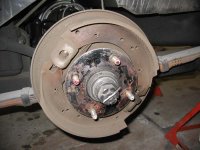
Had an issue with a rear brake shoe scraping against drum. Took a look and one of the brake adjuster hold down nuts had stripped off the stud causing the scraping. I've got two spare adjusters but both have one steel plug seized....probably the threaded adjusters are seized as well. I've had them soaking in penetrating oil for 24 hours but still can't free up the plug enough to tap it out with a punch. Might try heat next.....heat gun?.....boiling water?.....propane?.....adjuster is aluminum. Anyone have any ideas? Don't want the car off the road for two weeks waiting for a new one. :-(


-
 Hey Guest!
British Car Forum has been supporting enthusiasts for over 25 years by providing a great place to share our love for British cars. You can support our efforts by upgrading your membership for less than the dues of most car clubs. There are some perks with a member upgrade!**Upgrade Now**
(PS: Upgraded members don't see this banner, nor will you see the Google ads that appear on the site.)
You are using an out of date browser. It may not display this or other websites correctly.
You should upgrade or use an alternative browser.
You should upgrade or use an alternative browser.
TR2/3/3A TR3 rear brake adjuster seized?
- Thread starter karls59tr
- Start date

Offline
 I don't think I've ever had a Girling adjuster that didn't respond to the old propane torch, followed by cleaning up and reassembly with some white lithium grease.
angelfj1
Yoda
Offline
Andrew Mace said:
AND a little anti-sieze on the threads!

Don Elliott
Obi Wan
Offline
If you're writing about the adjuster in the rear brake slave cylinder, the adjuster is made of steel in the aluminium casting for the main body. There are 4 flats on the hidden inside end of the adjuster and if the adjuster is half way between flats, it will lock the lining onto the drum. Maybe all you need is to get it loose as above and give it 1/8 of a turn to get it back on the flat, instead of the corner where it binds.
Attachments

Perrymip
Jedi Hopeful
Offline
I like Don's suggestion above. It's not uncommon for those two pistons to become quite fixed in their position, and that will make the adjusting screw seem to lock when you turn the screw past the last easy flat. You will want first to concentrate on backing the adjusting screw off, then attack the two pistons. Usually a screw driver blade between the two will give enough leverage to break them loose.

TR3driver
Great Pumpkin - R.I.P
Offline
Thing is, in this case, we have an aluminum alloy outer housing, with a steel piston in it. Both will expand or contract with changes in temperature, but the aluminum does it faster. So if you heat it up, the clearance gets larger. Chill it, and the clearance gets smaller.mtlman8 said:just my opinion, but heat expands and cold contracts
I used the Holy Trinity Method that two sheds recommended. I was freeing up seized piston and adjuster on a spare adjuster I had. Had to soak the adjuster for a couple days. Put the adjuster body in a vice. I put a small socket on the adjuster head and gently worked it back and forth till it was free.With the adjuster backed out I was able to access the piston with a center punch and hammer and heat from a propane torch....a lot of heat and some heavy shots with the hammer. the reason I had to change out the adjuster was that one hold down stud was stripped out and the nut gone and the other stud was bent. Further to different metal expansion rates: On the old sailing ships with cannons there would be a brass rack that held the cannon balls in a pyramid. This brass rack was called the"monkey". During extreme cold the iron cannon balls and brass rack would contract at different rates and the cannon balls would fall.......hence the expression "Cold enough to freeze the balls off a brass monkey". 

Twosheds
Darth Vader
Offline
That's just how I have done, karls59.
I have had an adjuster in my vice for months, but I no longer have the energy to free it. It's for a 10-inch brake backing plate, so it's worth more than the ones for a 9-inch. Also the propane torch might not go well with my breathing oxygen...
I have had an adjuster in my vice for months, but I no longer have the energy to free it. It's for a 10-inch brake backing plate, so it's worth more than the ones for a 9-inch. Also the propane torch might not go well with my breathing oxygen...
TR3driver
Great Pumpkin - R.I.P
Offline
Anyone who has ever sailed would recognize that as a myth. Heavy seas or even just hard manuevers are plenty strong enough to throw anything that is not nailed down up against the opposite wall! There is no way that any responsible captain would leave something as dangerous to his crew as a cannon ball, stacked in a pyramid and held only by gravity.karls59tr said:On the old sailing ships with cannons there would be a brass rack that held the cannon balls in a pyramid.