• Hey Guest!
    British Car Forum has been supporting enthusiasts for over 25 years by providing a great place to share our love for British cars. You can support our efforts by upgrading your membership for less than the dues of most car clubs. There are some perks with a member upgrade!

    **Upgrade Now**
    (PS: Upgraded members don't see this banner, nor will you see the Google ads that appear on the site.)
Tips
Tips

TR2/3/3A TR3 Originality Question - Bonnet Buffer

Geo Hahn

Yoda
Country flag
Offline
Was the metal portion (screw, cup, 2 nuts, washer) of the bonnet buffer painted body colour, plain or what?

I'm referring to the 2 posts with the rubber bumper that keep the bonnet tight and adjust the height of the corners.

The pic I found in Piggott shows them body colour but that car is obviously a respray so it's inconclusive.

On the TR4 they were body colour but there the rubber bit goes on top of the post and could have been added after painting, on a 3 it is integral with the post assembly -- though I suppose the car could have been painted then the part undone and the rubber fitted.

Help! Don or whomever knows for sure. Thanks!
 
Mine are not painted. When I restored my TR3A, I replaced the original parts becuase they were really rusty. Therefore I assume they were never painted. In 1990, I put in new rubber bumpers in the clear zinc plated cup that was supplied with them. The bolt (support stud) for it as well as the nuts are all stainless steel. TRA judges never told me it wasn't correct.
 
Thanks Don.

I have the Moss replacement -- the rubber & cup are a slightly larger diameter (hardly noticeable) but the new screw is phillips whereas the original I think was flat-head so I will clean up the threads and reuse the old screw. Stainless would be nice but nothing rusts hereabouts so 50-year-old steel will work for me.
 
It's my belief that they were originally cad-plated, not painted; but I have no real evidence for that beyond what I've seen on parted-out cars. Looked like the bodies were painted before installing any of the bonnet hardware, including the buffers and Dzus brackets.

Also, on the originals the rubber was solid and bonded over the screw head, so you couldn't see the slot. Very firm rubber but I don't know if that was as original or just due to old age.
 
TR3driver said:
...Also, on the originals the rubber was solid and bonded over the screw head, so you couldn't see the slot. Very firm rubber but I don't know if that was as original or just due to old age.

Odd that they sell them with the screw head visible... what you describe is very much like the TR4 buffer.
 
Could be I'm mistaken then. As I said, that's just what I found on parts cars. That was in the 70's, so plenty of time for them to be switched with TR4 or replacement buffers. TS39781LO had the screw heads visible when I got it, but it looked like the rubber had been replaced with a short section of heater hose, held with 3M trim adhesive (aka gorilla snot).
 
Mine was a flathead screw for the support post and I could see the slot across the head looking down the center of the rubber bumper. My new one is identical, but it's stainless.
 
Ya know Geo,the easist way to settle this,is for all of us to agree on one way. Re-write/invent history as it were.If Don doesn't know,(he was born in a TR3) and you don't know,and TR3driver doesn't know, I dont know,who else matters?
 
Yes, I have to remind myself that my car wasn't built by Bill Piggott nor did it come out of a factory in Lancaster Ohio... so advice & consensus here is as good a way as any to decide what should be.

I'm not out to have a show car (far from it) but since I had the dingus out on the bench thought I might as well try to do it up right.
 
I can't say for absolute certain, but as Randall suggests, bodies were painted before pretty much anything was installed. In fact, I believe they were completely trimmed before being united with a complete chassis. Presumably those painted bodies went through some sort of bake process, so it seems logical that nothing made of rubber (or anything else that might be harmed in a hot paint oven) would have been installed until after that bake process?
 
I'll throw my two cents in to muddy the waters even more. My car was bought/titled in 1960 and I purchased it from the original owner. Trust me this guy did nothing but add gas, maybe some oil and drove it into the ground. My original bumpers (which are deeply buried in a box somewhere) had the body paint color all over, including the rubber, which of course was half cracked off. But they were bad/soft when I got the car and found a set on a wreck later (a '62 maybe) and they appeared to be plated only. And remained so until about 15 years ago when I painted them.
 
This question is of great interest to me. My TR3A came to me as a project back when I was in high school and dinosours ran wild. At the time, there were no buffers on it and there seems to be no sign of a place to put them. In fact until I read this thread I did not know anything about them.

As I am about to redo the engine compartment, I might as well get those installed as well. Can someone post (or email me) a picture of these things installed please. Or can you describe how those buffers are installed and where.

I thank you all for once again showwing me the light.
 
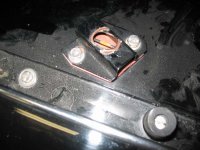
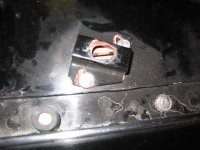
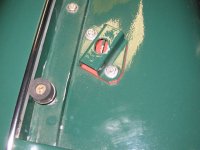
Here are photos of mine (black) and also the late TR3A (green) that I finished in June 2006.
 

Attachments

  • 6639.jpg
    6639.jpg
    52.2 KB · Views: 143
  • 6641.jpg
    6641.jpg
    47.2 KB · Views: 161
  • 6642.jpg
    6642.jpg
    34.7 KB · Views: 159
As Don's photo shows, the buffers just replace the first inner/outer wing/fender bolts behind the edge of the apron. Not quite so clear is the additional nut & flat washer at the base, that still clamps the panels together.

One of our local club members has added a second pair of buffers near the rear, in an attempt to reduce vibration and squeaking at the rear of the hood/bonnet. Seems like a good idea to me, but of course not original. My TR3A seemed to wear out the hood hinges because the back of the hood shook up and down (California is known for it's washboard freeways); but adding a gasket under the rear of the hood seemed to help that for me.
 
Thanks for the pictures and description. It is clear what I am missing and where it goes in. I also understand how I did not realize it was missing as I just put a bolt in there like the rest of the ones that hold the wing in place. I have one more thing to add to my next parts order.
 
Back
Top