• Hey Guest!
    British Car Forum has been supporting enthusiasts for over 25 years by providing a great place to share our love for British cars. You can support our efforts by upgrading your membership for less than the dues of most car clubs. There are some perks with a member upgrade!

    **Upgrade Now**
    (PS: Upgraded members don't see this banner, nor will you see the Google ads that appear on the site.)
  • When posting a classified ad, you MUST select a prefix from the drop-down next to the subject line. If you don't you will get an error and your ad will not be posted!
Tips
Tips

TR2/3/3A tr3 hydraulic brake light switch

Jim Lee

Jedi Trainee
Offline
Hi all,

1959 TR3 and the brake lights are not showing up.

I think that I have a bad hydraulic brake light switch. Does anyone know if this can be replaced generically or is it very specific to Triumph/Girling. Is there any way to remove this switch without losing all my brake fluid? Anyone know what the thread is? I saw one for sale on UK Ebay and it said "BSP threaded". Anyone know what that means?

Thanks very much,
Jim Lee
 
To make sure that it's the brake light switch that's the problem, just short across the two terminals with a jumper wire and see if the brake lights work. The ignition switch will have to be on for this test.

If you need a new switch, I've read here that NAPA lists part numbers that will work...

ECH SL144 for the switch with screw terminals
ECH SL143 for the switch with blade terminals

Moss also lists them, and they are only about $9 from them. I don't know how much the NAPA parts are.

Edit: You should be able to replace the switch without going through any problems with the hydraulics. With the new switch at hand, remove the old one and immediately screw in the new one. As long as no one pushes on the brake pedal while you're doing this, you will be fine.
 
That will tell you if the switch is bad if lights come on.If they stay off it still wont confirm a bad switch.Then you will need to check switch with meter.
have fun
tom
 
If jumpering the switch (with the ignition on) doesn't turn on the lights, then you definitely have a problem somewhere else.

The original switch threads are definitely not BSP, since they are tapered. There is some chance they are BSPT, but I'm pretty sure they are 1/8" NPT.
 
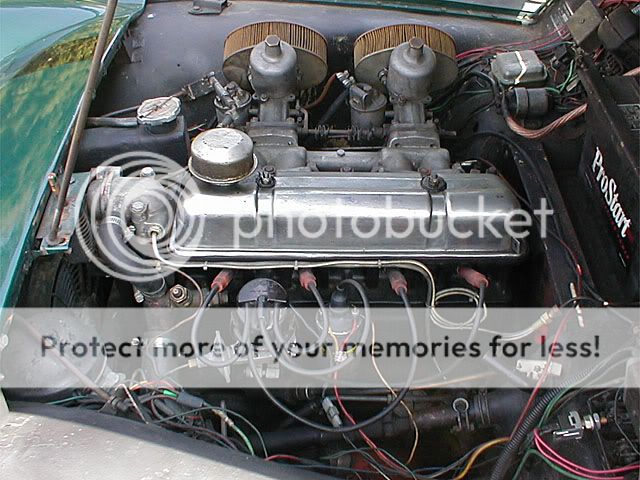
FWIW, I got frustrated after having several switches fail on TS39781LO and mounted a switch directly on the pedal box. Very effective, but somewhat unsightly. You can see it (barely) in this old photo:

P3170005.jpg


This time around, I resolved to be a bit more subtle:

DSCF0029_crop.jpg
 
I replaced mine (49 year-old part) when it was taking a sever romp on the pedal to get the lights to work. So far (about 2 years) the replacement from Moss has been just fine though goodness knows that others have not had much luck. I do have a relay on the brake circuit so perhaps that helps the replacement switch survive.

I agree you will lose little or no fluid and introduce no air if you are nimble & quick when you swap the part.
 
Aloha Jim,

I've used the NAPA parts listed above in my TR3 and MGTF, current cost in Hawaii is about $14. The thread pattern matches our cars, they also fit in Volkswagens. Like Geo, I have installed a relay in the brake light circuit. Here a description of how to do and why current models fail frequently without the relay. It was written by David BuBois:

The replacement brake light switches sold today are extremely light duty and don't hold up to the 3 amps drawn by the brake lights for very long before the contacts burn again (I have had them burn in just two weeks). Adding a relay to the brake light circuit will remove the heavy current from the brake light switch.
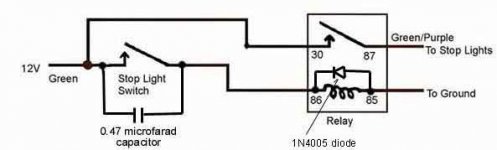
The relay to use is a general purpose 30 Amp automotive relay, sometimes known as a Bosch relay. They are available from Radio Shack and most auto parts stores. The relay can be mounted anywhere that is convenient. I mounted mine close to the original brake light switch, but it can just as well be mounted in the trunk (for the MGAs or MGBs), close to one of the tail light/brake light assemblies (if you do this, you will need to bring a source of 12 volts, other than the 12 volts that is switched by the brake light switch, back to where the relay is mounted). In the accompanying diagrams, I show a 0.47 microfarad capacitor across the contacts of the brake light switch and a diode across the coil of the relay. These are optional parts and can be left out if you wish. I added them as additional protection for the brake light switch. The capacitor is just soldered across the switch terminals. The diode can be soldered across terminals 85 and 86 of the relay. The advantage of the capacitor is that the capacitor acts as an arc suppressor and the diode collapses the field of the relay coil, eliminating any inductive surge across the brake light switch when it opens.

 
"That will tell you if the switch is bad if lights come on.If they stay off it still wont confirm a bad switch.Then you will need to check switch with meter.
have fun "

So if the brake lights come on when I jump the switch, with the ignition on and not touching the brake pedal, it is definitely bad right?. If they do not light up What do I check for with the (multi)meter? I was thinking of voltage on both sides with the pedal Resistance?

Thanks,
Jim Lee
 
Jim Lee said:
So if the brake lights come on when I jump the switch, with the ignition on and not touching the brake pedal, it is definitely bad right?
Yup.

<div class="ubbcode-block"><div class="ubbcode-header">Quote:]
. If they do not light up What do I check for with the (multi)meter? I was thinking of voltage on both sides with the pedal Resistance? [/QUOTE]
My approach would be to leave some sort of jumper across the switch (so the brake lights should be on), and check the voltage at the switch. It should be close to battery voltage. If not, the problem is somewhere between the switch and the battery ... I would check at the fuse block next.

If you do find 12v at the switch (with the jumper installed), then the problem is somewhere between the switch and the lights. I would probably check next right at a brake light fixture.

The idea is to "divide and conquer", just keep working towards the problem and you're bound to find it.

BTW, I found what appeared to be some nice "clip leads" (lengths of insulated wire with alligator clips at each end) at Harbor Freight. But they turned out to be almost useless, because the insulation sleeve over the alligator clips is so slick that it slides off when you try to open the clip! So I am going to continue recommending the ones sold by Radio Shack. They are really handy, I always carry a few in the car to help deal with problems on the road (like having to temporarily wire up the spare electric fuel pump).
 
Aloha JIm,

If the lights come on when you jump the switch, it would mean hydraulic pressure is not closing the switch. So, yes the switch is bad. You can use the multimeter to confirm you have 12V coming to the switch. You would need a helper to press the brake pedal to chech for 12V out of the switch, but in my opinion this test is not required since the lights worked when you jumped the switch.

If the lights did not come on by jumping the switch, the next thing to check would be ground connections at the lights. I've heard it said often "a poor rath to ground" is the most common electrical problem in an LBC.

Good luck.
 
MGTF1250Dave said:
If the lights did not come on by jumping the switch, the next thing to check would be ground connections at the lights. I've heard it said often "a poor rath to ground" is the most common electrical problem in an LBC.
FWIW, I recommend making up a ground harness for all the rear lights. The factory grounding method is just asking for trouble, especially where the J-nuts are just pushed over painted sheet metal.

It takes some time, but it's not difficult to daisy-chain a black wire from a ring terminal at the gas tank strap (with a star lock washer), to bullets for each lamp assembly. They all have the ground connector (at least all of mine have), so might as well use it.

DSCF0010.jpg
 
Aloha Frank,

I made this modification about three years ago and haven't had a failure yet. My previous experience was about every year I needed to replace the hydraulic switch. Here is a wiring diagram for a NEGATIVE ground car (if it is a positive ground car the diode must be reversed):
 

Attachments

  • 22956.jpg
    22956.jpg
    16.4 KB · Views: 870
Here is how I mounted up a relay for the brake lights. I did not use a diode as I didn't think there would be much kick-back (or whatever you call it) but I suppose it can't hurt.

Brake%20Light%20Relay.JPG
 
Back
Top