Hi,
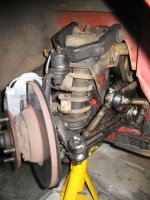
Dick is right, those doodads are stuck in there to either stiffen up the front suspension or perhaps to compensate for some sag in the old springs. TR springs are not prone to sagging, though, so it's possible someone installed them to accommodate larger diameter tires or as a cheap alternative to a front sway bar. Replacement springs are not terribly expensive, if needed. There are basically two different lengths, depending upon whether or not the 1-1/4" thick aluminum spacers are being used with them. Either will work... just leave out the spacers if using the approx. 11" long coils and leave em in if using the 9.5-10" long coils. There are also stiffer, competition grade springs available in both lengths. At the top and bottom of each spring are rubber pads that prevent metal-to-metal contact. If the aluminum spacers are used, a total of six rubber pads are needed per car (three per side). If not using the aluminum spacers, only four rubber pads total are used.
It's hard to say if shocks alone will resolve your problems. I suppose it doesn't hurt to try and see.
But I'd suggest also to check for wear and play in all the suspension components, in the steering box and steering linkage. To check, reinstall the wheels and tires while the car is up on jack stands, grab the tire on either side, shake it and feel for play. Also grab it top and bottom, shake and feel for play.
If you feel some play, the next trick is to track down where it's coming from, if you only want to make a partial repair and not undertake a complete suspension rebuild. It might help to have someone else move the tire and wheel in this manner, and also have them operate the steering, while you look at the various joints for any sign of slop.
It's certainly worth trying just installing new shocks, to see if that does the trick. The shocks come out *without* removing the springs. First, the lower bump stop bracket needs to be unbolted from the frame rail. This is most easily accomplished with the car sitting on the ground, so that the suspension is lifted off the stop. (Alternatively, if the car is already up on jack stands, use a jack under the tire to lift the suspension a little, but not so much that the car lifts off the jack stand.)
Then jack up the car and put stands securely under it. In the middle of the spring pan, from underneath, you'll see the other half of the lower bump stop attached with nuts. Remove those, underneath is the lower shock mounting bracket. Next remove the nuts from the top of the shock, and then shock, with the lower bracket still attached, can be dropped out through the bottom.
You'll likely need to replace the tab locking washer on the lower shock bracket bolt. The shocks will likely come with rubber bushings for top and bottom, those can be upgraded to longer lasting urethane if you wish. You will have a choice of shocks. The originals are Armstrong. There are a number of similar and equal brands, plus some upgrades possible. KYB, Bilstien and Spax come to mind. I use Koni shocks on my TR.
While the shocks are out is a good opportunity to look around all the suspension and steering joints, see if more work is needed.
I agree that a front suspension rebuild, including new bushings, is worth consideration if there is some play or slop contributing to the uncertain handling at highway speeds.
The inner/upper ones are available in urethane, if you wish, which lasts alot longer than the stock rubber bushings. Urethane can be found in various hardnesses, from something close to the original rubber to harder that will give more precise handling, but will ride a harsher, transmit more road noise and might show up other problems in the front suspension. At the top, the fulcrum can get worn, too, from dirt and grit that got under the bushing. If the horizontal pins aren't nice and smooth, the part needs to be replaced.
The outer/lower bushings need to be pressed into the control arms and then reamed to fit (Revington TR sells ones that don't need reaming, though). The inner lower bushings are nylon with a steel liner, the only problem there is that the old ones can be buggers to get off the horizontal shaft. At the upper outer are the ball joints, which might need replacement, are worth doing if the whole job is undertaken. Then there are the outer tie-rod ends, also probably worth renewing if tackling the whole rebuild.
One other thing to consider is the front wheel bearings, which can contribute to handling if loose or worn.
Note: If you get into a suspension rebuild or even just spring replacement, you'll need a spring compressor to remove the spring pan safely and slowly release the springs. The springs are under some preload and can fly out of there doing damage to whatever gets in their way, if not gradually and caerfully released. Don't loosen the six nuts and bolts per side that hold the spring pan in place, at the lower control arms, without a spring compressor installed! It's pretty easy to make one from 3/4" threaded rod, cut to about 18" to 24" long, a couple nuts and some large washers, all of which can be bought cheaply at a local hardware store. The hardest part is finding something that will fit at the bottom where the shock bracket bolts up. I found some heavy, square anchor plates at a hardware store that were cheap and easily cut to fit around the studs in the bottom of the spring pan.
The spring compressor is installed in place of the shock, once that's removed, to allow gradually releasing spring pressure as the pan is dropped. (More commonly available internal and external spring compressors found at auto parts stores or rental places *cannot* be used on TRs.)
A couple final tips: It helps to temporarily replace the bolts in the center of the lower control arms with much longer ones, say 4" or more. These help guide the spring pan on and off. Also watch that the spring pan doesn't hang up on the inboard side, at the frame rail, as it's dropped. And, if you do a rebuild, work on one side at a time so you can use the other for reference. This also helps prevent mixing up parts side-to-side, some of which are handed, while others are not.
Hope this helps!


 Hey Guest!