• Hey Guest!
    British Car Forum has been supporting enthusiasts for over 25 years by providing a great place to share our love for British cars. You can support our efforts by upgrading your membership for less than the dues of most car clubs. There are some perks with a member upgrade!

    **Upgrade Now**
    (PS: Upgraded members don't see this banner, nor will you see the Google ads that appear on the site.)
Tips
Tips

TR2/3/3A TR3 front End Alignment

oxendine

Jedi Hopeful
Offline
I'm sure this topic has been beaten to death but I can't seem to find any info. What's the easiest, best way to check to set the front end alignment other than take the car to a shop? As crude as these cars are one would think the toe in and so on could be done at home.

Thanks, Donnie
 
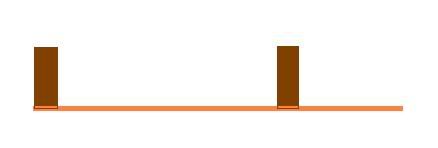
I use a simple home-made tool for checking toe-in. Used with care, it will provide results as good or better than the expensive machines at the shop.

Homemadetoe-intool.jpg


To use it, you first jack the car up and spin each front wheel while holding something against the tire tread that will leave a mark (eg a nail in a piece of wood). This ensures the mark is perpendicular to the wheel axis (and more accurate than using an edge of the wheel for example).

Then lower the car to the ground (in a flat area) and ensure the steering is straight ahead (which may or may not correspond to the steering wheel being in the center). Bounce it a few times (or roll back and forth) to help the suspension settle to normal height.

Now slide the tool under the car and lay it against the back of the front wheels, so the two upright pieces are against the tire tread as close as possible to spindle height. Transfer the marks from the tire onto the edge of the boards with a pencil.

Move the board to the front of the tires, and match up one of the marks. At the other upright, the distance between the mark on the board and the mark on the tire is the toe-in (or out, if the tire mark is farther out than the board mark).
 
I go even simpler. I get down about 10 feet in front of the car and sight the front tires like a rifle with the rears. It sounds crude, but is actually extremely accurate. I "shoot" the fronts to a point about one inch outside of the rears, which results in a slight toe in. You do have to be aware that some cars have different front and rear tracks when you sight.

I have gotten over 80k miles on tires, so it works! I started this technique when I had bad luck with several computer alignments that were way off. One wore out a brand new set of tires in 6k miles. Computers are only as good as the operator. After that rash of bad luck I began doing all my alignments myself with nothing more elaborate than a carpenter's level.

John
 
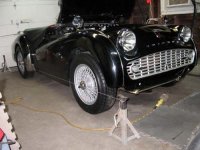
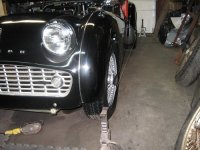
I used the "string" method for setting toe. Basically, you set the strings outside the car parallel to the center line of the car. Then you just measure to the front and rear of each front tire to get the toe-in. It'll work for the rear also if you have IRS. Of course, you have to be very careful you don't trip over the strings or you have to reset them, and that takes about a half an hour! :laugh: Camber on a TR3 isn't adjustable without modifications, but I did measure it using one of these.

Edit: I set the toe-in at 1/32" and the camber came out to be 0° on the left side and between 0° to -1° on the right. At least it wasn't positive. :laugh:
 

Attachments

  • 28528.jpg
    28528.jpg
    34.5 KB · Views: 396
  • 28529.jpg
    28529.jpg
    89.7 KB · Views: 366
martx-5 said:
the camber came out to be 0° on the left side and between 0° to -1° on the right. At least it wasn't positive. :laugh:

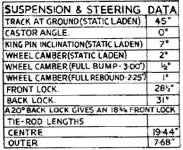
Huh? The spec is 2 degrees positive. I can see not worrying about it not being quite right, but why are you happy about it?
 

Attachments

  • 28530.jpg
    28530.jpg
    43 KB · Views: 345
From what I've read, modern tires seem to work better with a bit of negative camber. When people modify the early TR upper A arms, they are doing it with the express intention to allow for some negative camber. Seems like a lot of work if there is no benefit to be gained. I'm not going out on the racetrack, so it really doesn't matter to me, but why shouldn't I be happy if, for whatever reason, the camber is heading in the right direction. The car as it's set up now handles very well and I'm quite happy with it. I wish it had some caster however. One of these days I'll put in the 3° TR4 trunnions and upper A arms.
 
The positive camber in the TR is to reduce steering effort. It places the tire contact patch closer to the wheel pivot axis. Untill you go to wide tires (I mean much wider than what the TR can take) a couple degrees either way is not likely to be very noticeable performance wise.

John
 
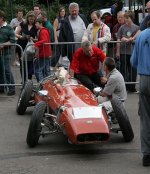
Of course, one can go to extremes with camber adjustment... :laugh:
 

Attachments

  • 28535.jpg
    28535.jpg
    77.2 KB · Views: 258
Back
Top