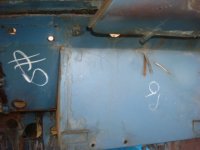
Some people may think that I'm a little strange about the little things I do when I restore a car. I try to restore them as original as I can. One day there will be very few cars left that are the same as when they left the factory. That is why I like to keep them original. I was wondering if anyone knows what these factory markings stand for. I have made stencils of these markings and I plan to put them back on the car after painting. I also have recorded all the other small markings on other parts, mostly just a paint swipe green or yellow.


-
 Hey Guest!
British Car Forum has been supporting enthusiasts for over 25 years by providing a great place to share our love for British cars. You can support our efforts by upgrading your membership for less than the dues of most car clubs. There are some perks with a member upgrade!**Upgrade Now**
(PS: Upgraded members don't see this banner, nor will you see the Google ads that appear on the site.)
You are using an out of date browser. It may not display this or other websites correctly.
You should upgrade or use an alternative browser.
You should upgrade or use an alternative browser.
TR2/3/3A ???? TR3 Factory Markings ????
- Thread starter mallard
- Start date


prb51
Luke Skywalker
Offline
Keith,
Nice touch. Many car restorers do the same and I've read interesting articles about the diff marques and the factory markings.
I'd be interested in a compilation for a couple of reasons: 1. Just interesting from the hobby standpoint. 2. Can really assist in determining a cars 'unrestored' condition.
I'm only familiar with the painted on engine markings...that sometimes huge TR3 painted on the intake side of the block, and the occasional spring stripe.
What do you suppose was inspected/verified when those marks were made?
Nice touch. Many car restorers do the same and I've read interesting articles about the diff marques and the factory markings.
I'd be interested in a compilation for a couple of reasons: 1. Just interesting from the hobby standpoint. 2. Can really assist in determining a cars 'unrestored' condition.
I'm only familiar with the painted on engine markings...that sometimes huge TR3 painted on the intake side of the block, and the occasional spring stripe.
What do you suppose was inspected/verified when those marks were made?


Geo Hahn
Yoda
Offline
Maybe whose turn it was to make the tea and how many cuppas were needed?
Glad you're documenting and preserving these -- as mentioned, there was likely a prominent T R 3 on the block (just above the starter). A search of the archives may turn up a photo. Only my TR4 still has that mark (kinda a red-orange paint applied with cheap quarter inch brush or someone's finger.
<span style="font-style: italic">BTW Keith: Can you mention where you are in AZ? You're probably aware of the many drives and club activity since you've had your 6 for 3+ decades but I was just curious. </span>
Glad you're documenting and preserving these -- as mentioned, there was likely a prominent T R 3 on the block (just above the starter). A search of the archives may turn up a photo. Only my TR4 still has that mark (kinda a red-orange paint applied with cheap quarter inch brush or someone's finger.
<span style="font-style: italic">BTW Keith: Can you mention where you are in AZ? You're probably aware of the many drives and club activity since you've had your 6 for 3+ decades but I was just curious. </span>

angelfj1
Yoda
Offline
"Some people may think that I'm a little strange about the little things I do when I restore a car"
Mallard: Not strange at all, IMHO. I think what you are taking the time to do is wonderful. You are restoring the car so accurately that it will have many of the original unique "glyphs". You may never know exactly what they mean but that's OK.
Here's a shot of my original rear occasional seat complete with symbol.

Also, prior to rebuilding the engine, we were able to make out the original "TR3" lettering on the block. I am sure you know that Triumph would assemble engines for various models in advance of their need on the assembly line. In order to identify them when needed, they would paint the model number in bold letters on the block. Here's a photo showing the lettering reproduced as accurately as we could.


Mallard: Not strange at all, IMHO. I think what you are taking the time to do is wonderful. You are restoring the car so accurately that it will have many of the original unique "glyphs". You may never know exactly what they mean but that's OK.
Here's a shot of my original rear occasional seat complete with symbol.
Also, prior to rebuilding the engine, we were able to make out the original "TR3" lettering on the block. I am sure you know that Triumph would assemble engines for various models in advance of their need on the assembly line. In order to identify them when needed, they would paint the model number in bold letters on the block. Here's a photo showing the lettering reproduced as accurately as we could.

Offline
prb51 said:I've seen that large TR3 marking and it cracks me up....I can imagine how that took place as someone continually sent the wrong block to the wrong assembly line.
"I'll fix this bloody problem" whilst slapping red/orange paint about....

When you think about it, though, it makes good sense. From the quickest visual glance, there's not much to distinguish a bare (no valve cover, carb
Thanks for all the great photos and storys about the markings on your cars. So many parts on these cars had marks or stencils that you don't get with replacement parts today. Many of the componets that I restore for the car will still have the correct lettering that I try not damage them when I rebuild the part. Some times the paint can be polished or just touched up so you don't have to remove the lettering. I know this all slows down the restoration but I'm in no hurry. It's been two years already, I'm sure two more to go.
Keith
Keith
Geo Hahn
Yoda
Offline
prb51 said:I've seen that large TR3 marking and it cracks me up....I can imagine how that took place as someone continually sent the wrong block to the wrong assembly line.
"I'll fix this bloody problem" whilst slapping red/orange paint about....
Sort of the automotive equivalent of the surgeon's 'REMOVE OTHER LEG'?


martx-5
Yoda
Offline
Geo Hahn said:Sort of the automotive equivalent of the surgeon's 'REMOVE OTHER LEG'?
Hey, I just went in for surgery on my broken right wrist on Friday. In pre-op they asked me which arm was I getting the surgery on. I looked at them like they had two heads, as there was a cast on the right arm. They said it's a Federal law that we have to ask. They then wrote some letters on the right arm with a marker. :laugh: After thinking about it, I'm glad they went through the ritual.

Offline
Well, if it's a fast Vanguard you want, the opportunity to own one is back again!Roger said:Could you imagine the parson's wife, in her new Vanguard, wondering why the thing was so fast?

