• Hey Guest!
    British Car Forum has been supporting enthusiasts for over 25 years by providing a great place to share our love for British cars. You can support our efforts by upgrading your membership for less than the dues of most car clubs. There are some perks with a member upgrade!

    **Upgrade Now**
    (PS: Upgraded members don't see this banner, nor will you see the Google ads that appear on the site.)
Tips
Tips

TR2/3/3A TR3 Cylinder Sleeve Installation

BritCars54

Member
Offline
My 60 TR3A block, head, etc are at the machinist and near completion. During the re-assembly, any useful tips on cylinder sleeve installation? Thanks. Al
 
Just the obvious: Be sure to clamp the sleeves in place right up until you install the head. It's way too easy to forget and turn the crankshaft, which (once the pistons are installed) may move the liners and cause a water leak underneath.

I would also check the liner protrusion on both sides after clamping them. I've had two engines in a row now where the block surface is not perfectly square to the liner bores, resulting in less protrusion on one side than the other. The result on the first engine was an endless stream of leaking head gaskets. The second engine (original to my current TR3) only started leaking once, but sure enough the protrusion was too low on one side.

I use Permatex #3 "Aviation Form a Gasket" on the "figure of 8" gaskets under the liners. Hylomar is another good choice. I think the manual calls for "Wellseal", which is probably good too.
 
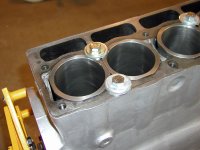
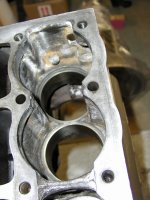
Make sure the seats are clean, and on my car I found an awful lot of rust that had built up on the block around the bottoms. Taking care not to hurt the seats, I was able to wire brush and grind out a lot. I'm sure I at least doubled the volume of coolant able to flow around the lower quarter of the liners!

If you don't have the head studs in, I found some proper sized bolts with large washers make good retainers

P6290002.jpgP6230009.jpg
 
In 1990, I put in a set of new pistons, rings and liners. Make sure the bores are honed. In 2007 with 94,000 miles driven since 1990, I had the bores rehoned and installed new piston rings (plus all the other items normally changed). At that re-build, I measured less than a thou (0.001") of wear in the bores - probably "out of round" due to wear caused on the inner sides due to piston slap. So I turned the liners 90 degrees so there would be no wear where the piston will slap for the next 100,000 miles (or more). I'll be 98 by then and probably won't care much (or remember much!).

Don Elliott, Original Owner, 1958 TR3A, TS 27489 LO

 
Be very particular on the figure 8 seals ONLY IMHO should the copper seals be used!!!
The aluminum seal works fine for a few years(10-12) then stars to weep due to corrosion.
Even the finest antifreeze and corrosion inhibitors cant stop the galvanic reaction of Al VS iron .
All the liners should be set in the block minus seals and the deck height checked by the machine shop.
when the figure 8's are in they give the sleeve the proper height to seat the head gasket.
Inspect each new sleeve for burs at the base!!! the smallest flaw here is deadly!!
MD(mad dog)
 
Make certain the FO8 seal shelves are absolutely spotless. Sometimes the block isn't perfectly cleaned and the slightest residue there means trouble.

Avoid re-using head stud nuts as the threads stretch.
 
The shelves are definitely sparkling clean. Learned a lesson on the TR 6 engine rebuild regarding replacing the head studs/nuts. Thanks.
 
Back
Top