• Hey Guest!
    British Car Forum has been supporting enthusiasts for over 25 years by providing a great place to share our love for British cars. You can support our efforts by upgrading your membership for less than the dues of most car clubs. There are some perks with a member upgrade!

    **Upgrade Now**
    (PS: Upgraded members don't see this banner, nor will you see the Google ads that appear on the site.)
Tips
Tips

TR2/3/3A TR3 Aluminium Parts

Tinkerman

Darth Vader
Offline
OK, so how do you get 46 year old aluminum cast parts to look like they just drove off the showroom floor? I have pictures taken at various shows over the years and I see every thing from clean but old to polished stuff. I don't care for polished but I do want them to look good.

As always your thoughts greatly appreciated.

Tinkerman
 
[ QUOTE ]
For the grille I used very fine (0000) steel wool followed by Simichrome polish.

[/ QUOTE ]

Simichrome is some good stuff. It does require that it be mixed with a special grease for it to work properly. I think it is called "elbow grease".

Nothing good ever comes easy.


Bill
 
Sorry, talking about carb parts, diffy, fuel pump, any part that uses aluminun for the shell. A good example would be the intake manifold. I can get it clean but it still looks junky.
Regards, Tinkerman
 
By the way SemiChrome is superb stuff. Have used it for years on anything brass or copper, never have used it on aluminium. Suspect it would work well though.
Tinkerman
 
Noxon 7 = foul smellin' stuff(use sparingly it can be pretty abrasive), baking soda/wd-40 and a toothbrush when you have a lot of time, and as previously mentioned steel wool. Never tried semichrome.
 
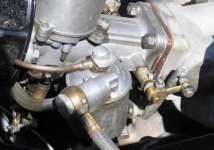
When I did my restoration from 1987 to 1990, I glass peaned all the aluminium parts such as the fuel pump, carb exteriors, thermostat housing etc. Glass peening is like sandblasting but I used tiny glass beads. For the one I did recently I used a fine alumina grit in a blast cabinet. The parts come out looking like new like you saw at those car shows. Now after 16 years, mine still look like that. About 3 times a summer, I go to a coin car wash and use the foam followed by the high pressure water blast to clean under the car and all the stuff you see in the engine compartment. It only failed to re-start one time and then I found that the high pressure water spray had knocked the hi-tension lead out the top of the coil. A second later it was running normally. And it's still as clean as it was 16 years ago, even with 94,000 miles since I glass peened them.

At TRA, last June in Ohio, I took 2nd in class in the judged concours. It's easy to keep clean once you know how. See to attachment as to how my carbs look now after all this time and 94,000 miles since it was restored.

 

Attachments

  • 277450-CarbFrontLink.jpg
    277450-CarbFrontLink.jpg
    43.8 KB · Views: 184
Thanks for the info and the pic Don. I have the equipment to what you are talking about, don't think I have any glass beads at the moment. Will get some. I was reluctant to use the blast cabinet because it tends to be too powerful for delicate stuff so I'm glad that someone with the experience spoke up. Congratulations on the 2nd place in Ohio.
Tinkerman
 
The auto restorer that I know uses a walnut shell blast medium on all of the aluminum, where you'd get that I have no idea but it sure comes out beautifully. I need a blast cabinet.
 
Any kind of modern blasting sand will do. The grit I last used was Number 7 - whatever that means. It costs about $10.00 a bag if I remember correctly. It may have been fine alumina sand or it may have been a synthetic epoxy sand. As long as it's not coarse sharp sand.

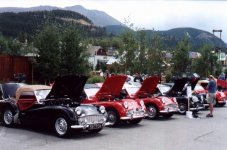
Thanks for the congrats. I've taken home lots of plaques from VTR and TRA concours over the years. I know there are owners who say they don't want a concours car when they are restoring it, but I wanted mine to be correct - as it was originally. And I wash it only about 5 times a summer. And it stays original. It doesn't take any longer to restore a car properly. Mine is my concours car but it's also my driver. Like the time I did Montreal to Portland Oregon for VTR and took second (7250 miles round trip in 2000) and to VTR in Colorado in 2001 (2nd again - round trip 5225 miles) but I don't mind second. The guy who beats me has usually just finished a professional restoration and trailered his in a closed box trailer 200 miles from home so he won't damage it. HA ! See attachment at Breconridge Colorado.
 

Attachments

  • 277584-ConcoursTRs.jpg
    277584-ConcoursTRs.jpg
    49.2 KB · Views: 158
Don:

Just to confirm...the picture you attached of the float bowl was blasted with glass and not sand.

Any recollection of what pressure where you shooting at or the size size nozzel?
 
Hi,

Soda blasting is also a good method. It removes grease as well.

Never use real sand in blasting. Silicosis is a very nasty disease!
 
Ya know you just can't go blasting away with just any thing. Blast media has different kinds of grit for different jobs. If you have or buy a blast cabinet the company that you bought it from can give you all the info about the different media available and its uses. I tried the walnut hulls on some brass blow torch parts and it had too many sharp corners and did a lousy job. Anyhow do some research before you start blasting. I usually use 80 lbs of air pressure to knock rust off but on these aluminum parts I'm going to drop it down to about 60.
Cheers, Tinkerman
 
The TRA manual on judging standards states that "Carb bodies, float chamber lids, piston covers are natural alumininum, sometimes mildly polished." I'm happy to say that a combination of glass bead blasting and semichrome polish mixed with that special greas that Bill mentioned produces just that affect. I did have to go to 80 psi to get the desired result. Actually I think I use about 90 psi when I'm knockin off rust.
Cheers, Tinkerman
 
My 2 cents.... I also use glass-beads at anywhere between 60-90 psi (80 usually is the best) on carbs, and other parts.. Works splendedly.
Only word of caution is dont blast the insides of the carbs, except maybe the float bowls to get the crud out, and clean and double clean all the parts. you don't want ANY media left behind.
I tend to use Mothers aluminum and mag polish if I want to take the finish a bit beyond the satin that the glass beads leave.
 
I might be a little late on this one...But my TV has alot of aluminium bits...I am not high tech enough for a blaster, so I polishing them with some steel wool to get the worst off, then I use a cloth buffer on a bench grinder to polishing every peice to a brilliant shine...Then I get some Duplicolor wheel clear coating and clear coat them so they stay nice and shiney. *Do not clear coat anything that comes in contact with fuel, or any other carb parts(except maybe the bell housing)*
 
If you want the intake to look semi-shiny forever get it ceramic chrome plated. It costs about $125 and the shop takes care of the prep prior to plating. The ceramic also reduces heat in the manifold. JCM in House Springs MO did my TR3 and it never needs cleaning.
 
You should not use steel wool on aluminum. Little bits of steel will get imbedded in the aluminum and cause galvanic corrosion, which we used to call dissimilar metal corrosion.
 
Thanks for the info Twosheds. My bought my basketcase from a chap in Maryland in 1989.

Regards, Tickerman
 
Back
Top