• Hi Guest!
    If you appreciate British Car Forum and our 25 years of supporting British car enthusiasts with technical and anicdotal information, collected from our thousands of great members, please support us with a low-cost subscription. You can become a supporting member for less than the dues of most car clubs.

    There are some perks with a member upgrade!
    **Upgrade Now**
    (PS: Subscribers don't see this gawd-aweful banner
Tips
Tips

TR6 TR250 Ignition Switch in my TR6

jjbunn

Jedi Knight
Offline
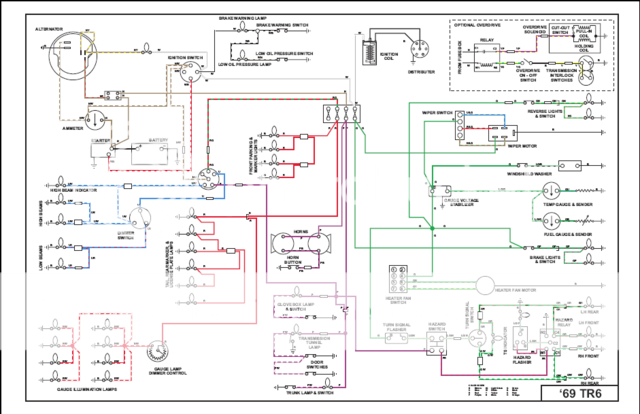
The subject says it all. I was puzzling over the wiring to my ignition switch, which has only four connections, comparing with the wiring diagram in the Haynes manual. Nothing made sense. So I looked at the TR250 wiring diagram, and that's what I have: every detail matched.

So my Belgian TR6 appears to be wired as a US TR250 ?!
 
Julian needs to be introduced to Dan Masters.

69Skimatic.png
 
Where does that diagram come from?

It also has the five connector switch. Mine is 4 connector.
 
Julian :

I seem to be missing something. The only difference I see around the ignition switch between a TR250 and a 71 TR6 is that the 71 TR6 has two brown/white wires at the switch (using the switch as a tie point), while the TR250 has a separate junction somewhere else. Is that the same difference you are looking at ?

At this late date, it's hard to say where the various oddities about your car came from ... might well be that some of them were original but not documented by the factory (seen any Belgian documentation ?). Or they could have been done by whoever put the carbs on or whatever.

But I wouldn't assume from that one inconsistency that your car is totally wired as a TR250. More likely it's a mixture (plus a few horrors never perpetrated by the factory).

BTW, Dan Masters is a retired Electrical Engineer and TR6-V8 owner. He got rather frustrated with the lack of accurate electrical documentation, so created those wiring diagrams with the best information he could find (including his own car) for US-spec cars. He also founded Advance Auto Wire (but I understand it's mostly run by his son these days).

Dan is still around, but spending less time on Triumphs and more time with his grandkids these days. AFAIK he's not on BCF or any of the other Triumph mail lists any more.
 
Hi Randall,

The switches themselves are different between the TR250/5 and TR6 ... I'm looking at the wiring diagrams in the Haynes manual.

My ignition switch has four terminals, three of which are connected with wires coloured red/white, blue/brown and white. The fourth terminal is for a radio (not fitted). These are the same wires as shown on the TR250 wiring diagram p186 in the Haynes manual, where the depicted switch is also a four terminal (and also the TR5 diagrams preceding it).

The TR6 ignition switches are all five terminal switches, and have different colour wires coming to the switch (e.g. brown/blue, red/green, blue, brown, blue/white).

However, my car *does* have the wiring for the transmission tunnel lamp, which the TR5/TR250 does not.

The harness looks original, so I am at a bit of a loss to explain this. Maybe I need the Dan Masters book? But I can probably figure it out myself.
 
Hmm, your Haynes must be a different version than mine.

Anyway, the 5-terminal switch didn't come in until 1973. The 5th terminal provides power to the anti-runon solenoid when the ignition is off. And I would guess it was only found on US-spec cars (since they were the only ones with the ARS).

Dan's diagrams are definitely more accurate, at least for US-spec cars. Since yours was originally fuel-injected, there may still be some differences.

BTW, if you double-check, I think you'll find that those wires are white/red and brown/blue, not red/white and blue/brown. Believe it or not, there actually is a method to the madness, with the body of the wire color telling you which major section the wire is associated with, and the tracer being for particular circuits.
https://www.dimebank.com/LucasColours.html
 
Yes ... you are right, I have the colours inverted!

Now I am increasingly confused since I looked in the other workshop manual I have and found similar diagrams to the Haynes.

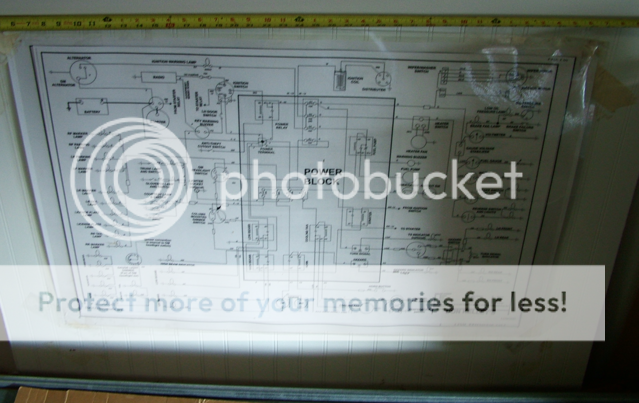
I think I will print off a large version of Dan's diagram in colour, and take it out to the car to check along.

BTW any suggestions on what I might check next for my rough idle problem (described in another thread)?
 
I have found the Haynes and Autopress manuals to be less then accurate across the time span the TR6's were built and do not reference them anymore.
 
jjbunn said:
I think I will print off a large version of Dan's diagram in colour, and take it out to the car to check along.

Take it to kinko's and blow it up
Schematicpic.png
 
jjbunn said:
BTW any suggestions on what I might check next for my rough idle problem (described in another thread)?
You mentioned the chokes were way out of synchronization (which is inconsistent with "running fine when parked") ... have you tried to check that the throttles aren't out of whack as well ? You can get a reasonable estimate by just listening to the hiss at each carb (with the air cleaners off).

Personally, I'd gap the plugs to .025", just to be sure the wide gap isn't a problem. Also, if they look the least bit worn or glazed, put new ones in. Probably not the problem, but if it is, you're going to kick yourself for putting all this time into it and not springing for $20 worth of spark plugs.

You've already changed points, rotor & condensor, right ?

Save the old parts, and if you want, you can put them back in when you get it running right (and save the new ones for your next tune-up). But it also never hurts to have a set of "known pretty good" spares for the (hopefully rare) occasion when the new parts are bad.

Another test I'd try is to feel the radiator as the engine warms up (being careful to keep your hands out of the fan, of course). The body of the radiator should stay cold longer than the engine does, then suddenly get quite warm when the thermostat opens. As soon as that happens, look at the temp gauge. If it is higher than 1/3 scale, then it's wrong for some reason and most likely your engine hasn't really been overheating.

How much can you change the point gap by moving the shaft from side to side (not turning it, just moving side to side) ?

Hmmm, come to think of it, I wonder what cam that engine has in it ? Did you ever figure out if it's the original PI engine ? Others will know better than I, but ISTR reading that the early PI engines had enough cam to lope a bit at idle. And it's entirely possible a DPO has put an even hotter cam in there.

Is there some way you can confirm the tachometer reading ? Old mechanical tachs sometimes read rather high ...

Have you checked the valve clearances yet ? One of our club members even went so far as to buy new carbs, before figuring out his problem was valve lash.

And FWIW, being recently rebuilt with nice shiny parts is no guarantee of no carb problems. I visited someone once who couldn't get his professionally rebuilt carbs to idle ... turned out the rebuilder had forgotten to tighten some of the nuts. Centering the jets and clamping them down (SU carbs, not ZS) made a world of difference.

 
Thanks Randall: this gives me plenty of things to investigate this weekend.

Coming back to the ignition switch and wiring, I have been looking more closely, and comparing with the Masters diagram. I removed the switch and worked it with some deOxit contact cleaner.

The switch is a four position switch: 0, I, II, III. There are three connections made to the switch: one is the +ve feed from the battery, another is the connection to the starter motor, and the other is the connection to "everything else".

The way it is wired is that in position 0, everything is off, then in position I everything is still off, then in position II everything is on, except the starter motor, and then in position III the starter motor gets power, and everything else is turned off while the switch is held in that position: when it is released it returns to position II, as per standard ignition switch behaviour.

This all seems fine and correct, except I would expect that position I would be used to power everything except the fuel pump and ignition.

I'm coming to the conclusion that I have a newer switch with older wiring.
 
jjbunn said:
The way it is wired is that in position 0, everything is off, then in position I everything is still off, then in position II everything is on, except the starter motor,
That all sounds right. Position I is only for the radio (when fitted) and you have no radio so it does nothing.
<div class="ubbcode-block"><div class="ubbcode-header">Quote:] and then in position III the starter motor gets power, and everything else is turned off while the switch is held in that position:[/QUOTE]I don't believe that is correct for any of the Triumph ignition switches. The ignition circuit (what you're calling "everything else") should continue to get power in the III (start) position.
 
Back
Top