• Hey Guest!
    British Car Forum has been supporting enthusiasts for over 25 years by providing a great place to share our love for British cars. You can support our efforts by upgrading your membership for less than the dues of most car clubs. There are some perks with a member upgrade!

    **Upgrade Now**
    (PS: Upgraded members don't see this banner, nor will you see the Google ads that appear on the site.)
Tips
Tips

TR% Air to Fuel Ratio

The little gauge above the driver's right hand is an A/F gauge. It's in the 12.5-13 through the power curve under full throttle. We also do real plug chops as well.

(change to best quality and you can see the position of the needle. 13 is at the 12 o clock position)
weSaS3o" type="application/x-shockwave-flash" wmode="transparent" width="425" height="350"> </embed></object>

Really the only way to properly do this is on a chassis dyno. Charlotte has become the epicenter of US auto racing, there should be a lot of chassis dynos around. The trick is finding a good tuner. Not all are equal or know Webers (most high end race shops are dealing with efi or Holley carburetors).
 
I have this config:

G5.jpg


DSC02625.JPG


DSC02630.JPG
 
It's all in the chassis. Engines in the top MGBs are healthy (180-190bhp range with redlines of 7800rpm (~160whp)) but are no match for an extremely well developed bigger and better flowing TR engine in a straight line. There's no replacement for displacement and 8 port cylinder head (vs the 5 port on the B engine).

The chassis on a MGB is much more advanced than the TR. While the TRs have the same build dates as the MGB, the chassis on a TR4 goes back much earlier to the TR2. Just look at pictures of the two side by side and you can see the TR has a narrower footprint than the MGB, which hurts it in fast sweepers. The chassis on the Triumph in the video has been maximized per rules, so what you're seeing is difference in tires and chassis design of the base model car.

You can read about that particular MGB here (Dave Headley)
https://classicmotorsports.net/articles/rivals-speed-mg-vs-triumph/

Lastly, the MG exploited a rule loop hole and was on much better tires (Kumho V700s) vs bias ply tires everyone else was on. Things have been evened up since then and the Triumph is much faster for it and should be very close or even to it. For reference on how fast Dick's car is, George Wright, who has a very fast car, was some 5 seconds per lap slower than Dick's TR4 at NJMP last fall. This on a relatively small track (1:36 lap times). A big track like Watkins Glen or Road Atlanta the differences are greater.

For reference, that MGB (and the fastest Porsche 356s and Alfa Duettos) turn faster lap times at Watkins Glen and Road Atlanta than the TR250K, despite have a substantial power disadvantage. While not apples to oranges (different days) , those cars also turn the same lap times as what Jon Wood turned in Keith Files' TR6 at VIR. The cars you see in that video are some of the best of their respective marque/models in vintage racing in the US.

Here is video of the fastest Porsche 356 in the country on the dyno:
sL3jlbw" type="application/x-shockwave-flash" wmode="transparent" width="425" height="350"> </embed></object>

<div class="ubbcode-block"><div class="ubbcode-header">Quote:]1620cc 4000 rpm to 8200 rpm 148 hp 124 lbs of torque[/QUOTE] at the rear wheels
 
I have an AF meter in the car now, thats how I have the numbers I have as posted, I have googled every combination of dyno. dyno chassie testing, etc for charlotte and as of yet have not found anyone, doesnt mean they dont exist. Just because we are the nascar capital of the world doesnt mean we have tons of chassie dynos on every corner. most race car shops probably have an engine dyno in their shop but not for outside use and probably would not chassie dyno their car at a public place for word spreading out what they have. Now as far as HP ratings on my engine, I did a dyno on the break in and keep in mind without proper carburator jetting, it ran lean at first and we drilled out the jets and it ran in the 10 AF, just so I wouldnt burn a piston. so I got to get at least 10 percent more power if the carbs were set up right.. My engine came in at 189 HP, 187 Ft/lbs of torque at 5500 rpm, You can see the run on Wishbone classics website, so Its got to be getting at least 150 to the wheels. I figure I know more about webers than any dyno shop around since I have read, re-read the weber manual and all the information I can find on the Net, they are really pretty simple things and not hard to master, all I need is a machine and about 4 hours to really dial it in, I can do it on the street but with the road moving and not the car it really helps in changing out jets and doing another pull really quickly and with a complete set of micro drill bits I can drill out jets as needed, just cant go smaller. So you guys google it too and see if you get any better results, I can drive 2 hours away but would like to find some one with in 30 min of my house

sincerely
Hondo AKA (Keith)
 
I see PC beat me to it. There are also shops in Huntersville, Catawba and Conover.
 
svtmikey said:
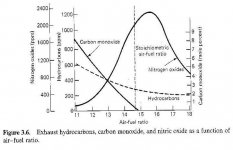
The 14.7 to 1 is the stoichiometeric figure for a gas and air mixture. It is the ideal air to gas mixture for complete burning of such a mixture. To my knowledge this provides best power

Nope. First of all, 14.7 is only for certain fuels, not necessarily what comes out the pump these days. But more importantly, maximum power is always to the rich side of stoich. And best fuel economy is usually to the lean side.

"Best emissions" is a really complicated topic, kind of depends on whether you consider a gram of NOx to be better or worse than a gram of CO. Rich lowers NOx, lean lowers CO. Cars with cats of course have to deal with feeding the cat what it needs to burn, but that is presumably not an issue here.

Most modern cars use a cheap (relatively) O2 sensor that is only accurate very close to stoich. But when you floor it, they ignore the feedback from the sensor and go "open loop" with a richer mixture.
 

Attachments

  • 29216.jpg
    29216.jpg
    42.7 KB · Views: 352
sorry I missed the links, but the first one I get redirected, not sure if my browser has been hacked, the second one I get somewhere, thanks I will call them and see what they say

Hondo
 
This is from a respected efi tuner posting on a forum popular with racing engine builders:

<div class="ubbcode-block"><div class="ubbcode-header">Quote:] For one thing, you're using one sensor to monitor 8 cylinders' of AFR, if your engine is in perfect balance you'll be lucky to have the cylinders be within 1.5 AFR points of each other. FOr another thing, you're likely using a $60 or $110 sensor which are extreme entry level, there's a reason they sell $6000 single channel wideband O2 systems - you're lucky if the sensor you are using is accurate to within 1.5-2.0 full AFR points... The engine always tells YOU what the proper AFR is, not the other way around. [/QUOTE]

While we do use a wideband, the driver still does full throttle plug chops during practice sessions. You need to look at the base ring for jetting and at the porcelain for detonation (really, you need a small magnifying glass to do this properly). This isn't as effective with modern pump gas as it is with leaded fuels (race gas). The wideband will get you really close, but reading spark plugs will tell you what is going on in each individual cylinder.
 
Yea I think its an art more than science, especially with cars running carburators, but at least with an AF monitor I can get it a lot closer than with out one.

Hondo
 
Interesting perhaps, but considering the inconsistant, irregualar profiles of the ZS carb needles, not much more than a curiosity.
 
<div class="ubbcode-block"><div class="ubbcode-header">Quote:]but reading spark plugs will tell you what is going on in each individual cylinder. [/QUOTE]

Early Americana A/F Ratio meters. One for each cylinder of the engine.
 
thank god they make AF meters now for aftermarket carburators going on engines that are one in a kind. then the spark plug rule applies

smiling as I write this

Hondo
 
I agree with those who have said you want to be around 13:1 air to fuel ratio. This is based on my discussion of this subject with Jack Drews a few years ago, though the computer all our emails were on crashed some time ago.

There are significant amounts of ethanol and possibly other compounds in most modern "gasolines" which may affect the ideal ratio.

I would be more concerned with A/F ratio at WOT and high revs as that is where the greatest potential for damage to your engine lies if the mixture goes lean- just my opinion!
Simon.
 
From having personally dyno-tune and remap the EFI on modern 2.0L engines making roughly 260bhp and more recently a Megasquirt EFI converted turbo audi, I will agree with everyone on the 13:1. 14.7 is a textbook ideal but not something that comes into play when tuning for performance. If these were EFI'd tunes, you'd shoot for as lean as possible at idle (15:1 or higher) and you want to see that number go down at WOT or high loads.

The general way the needle moves is more power the leaner your AFR, however at the consequence of detonation/preignition (bad!). Staying in the high 12's to 13's depends on the car, but that's where you want to be at WOT. Those Subaru's someone quoted with the black smoke on their bumper is a result of guys running very high boost and ensuring they stay on the rich side of things to eliminate the possibility of detonation.

That being said, I haven't yet tuned a carb'd engine and can't wait to see what a challenge it is compared to EFI!
 
Challenge can be an understatement......you'll see soon enough
 
Back
Top