Hey Guest!
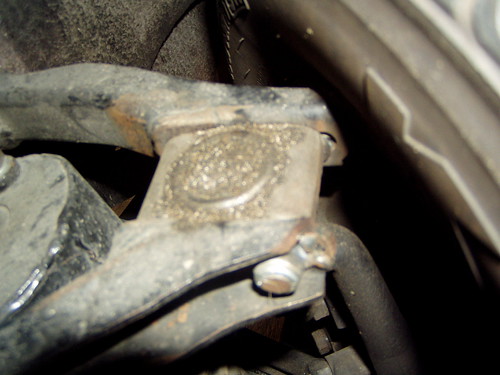
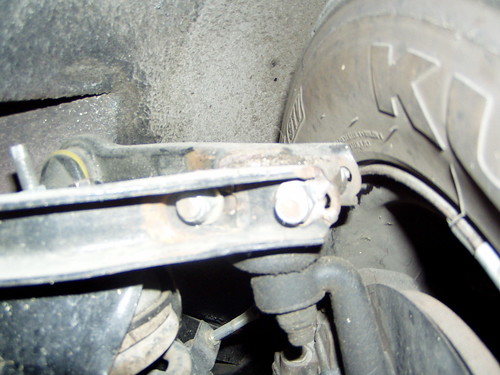
Greetings from sunny Arizona. I'm the guy who's upper A-arm was sliding out over the bushing/washer/nut. Well, the washers used were WAY too small, and I guess too much hard driving caused the problem (although after 35000+ miles). A new bushing and several new(larger) washers and that's no longer a problem.
However, as I had mentioned earlier, I'm planning to modify the front suspension somewhat to improve it's road-holding for autocross and fast road use. In an article in Classic Motorsports magazine a couple of years ago Tim Suddard described several ways that the TR3 set-up can be modernized/improved to better make use of modern radials, as well as adding a little adjust-ability to the TR3's non-adjustable suspension i.e. caster and camber.
With that in mind, I acquired a late TR6 front suspension set-up, complete except for springs. For now, I'm just looking to use the upper A-arms with the newer style ball joint. If you've read the article you know what I mean... I may even go with the Jag XJ6 ball joint with shims, but that depends on just how far I need to go.
This leads me (finally!) to my question for you racer-types out there. I can see that the TR6 A-arms are distinctly "sided" compared to the TR3 units, which I presume will result in some positive caster. What is the amount of caster and camber in the stock TR6 configuration? How far can I or should I go with regard to camber and caster?
I presume someone out there has already done the math. I need to know the formula to determine how much camber change results from "slotting" or otherwise bringing the ball joint inward? Like, you know, .5" at the A-arm equals 1.75 degrees negative camber. I suppose I could get some exact measurements of the length of the A-arms and the height of the kingpin, and apply trigonometric formulas to come up with the relationship of the length of the hypotenuse to the degrees of the opposite angle, but as I said, someone out there must already know answers (and my high school math is a little rusty). Can anyone help??? Thanks
However, as I had mentioned earlier, I'm planning to modify the front suspension somewhat to improve it's road-holding for autocross and fast road use. In an article in Classic Motorsports magazine a couple of years ago Tim Suddard described several ways that the TR3 set-up can be modernized/improved to better make use of modern radials, as well as adding a little adjust-ability to the TR3's non-adjustable suspension i.e. caster and camber.
With that in mind, I acquired a late TR6 front suspension set-up, complete except for springs. For now, I'm just looking to use the upper A-arms with the newer style ball joint. If you've read the article you know what I mean... I may even go with the Jag XJ6 ball joint with shims, but that depends on just how far I need to go.
This leads me (finally!) to my question for you racer-types out there. I can see that the TR6 A-arms are distinctly "sided" compared to the TR3 units, which I presume will result in some positive caster. What is the amount of caster and camber in the stock TR6 configuration? How far can I or should I go with regard to camber and caster?
I presume someone out there has already done the math. I need to know the formula to determine how much camber change results from "slotting" or otherwise bringing the ball joint inward? Like, you know, .5" at the A-arm equals 1.75 degrees negative camber. I suppose I could get some exact measurements of the length of the A-arms and the height of the kingpin, and apply trigonometric formulas to come up with the relationship of the length of the hypotenuse to the degrees of the opposite angle, but as I said, someone out there must already know answers (and my high school math is a little rusty). Can anyone help??? Thanks