• Hey Guest!
    British Car Forum has been supporting enthusiasts for over 25 years by providing a great place to share our love for British cars. You can support our efforts by upgrading your membership for less than the dues of most car clubs. There are some perks with a member upgrade!

    **Upgrade Now**
    (PS: Upgraded members don't see this banner, nor will you see the Google ads that appear on the site.)
Tips
Tips

TR2/3/3A TR 3A Steering wheel.

Tinkerman

Darth Vader
Offline
For some strange reason the steering wheel that came with my 100,000 mile car is in great shape. No cracks, one little ding on the underside that can be fixed.
Has anyone painted their steering wheel? If so, would you recommend doing that and what kind of paint did you use?

All thoughts and comments greatly appreciated.

Tinkerman
 
I wouldn't paint something that gets handled like a steering wheel does. It won't take long to wear through paint and make it look funky.

The plastic of the wheel rim should buff up nicely, if you want to spend time making it look nicer. I wrapped mine in a Wheelskins leather cover. Less time than buffing, covers the cracks (minor though they were) and looks very nice. Also, not a huge extravagance, price-wise.
 
Moseso said:
I wrapped mine in a Wheelskins leather cover.
:iagree:
Plus it just feels good.
 
My buddy got one of those steering wheel restoration kits from Eastwood. He used it on his adjustable wheel...they have a habit of really going bad. It came with an epoxy filler, some cleaner, and a plastic adhesion promoter. Then he just painted it. I don't recall what type of paint he used, but it was rattle-can stuff. The wheel still looks great after two years, and none of the paint has come off yet. Perhaps the adhesion promoter is all that's necessary. Eastwood sells it separately.
 
Restored mine using pc7 and used Rustoleum Plastic paint. Looks good. Can not comment on wear, but I can always touch it up.

Paul
 
I have used sn SEM plastic paint and it held up well. Since that time Krylon and others have come up with paint for plastics. Can also use a product you spray on to increase adhesion on plastic (Bulldog is one brand).

FWIW -- the wheel on my TR4 has the original finish and though most of it looks shiny, it is definitely scratched & worned at the 10:00 position where the PO's wedding ring would have been. I like it fine just like that.
 
I recommend and use personally a painted wheel done as though it were a plastic bumper cover for a modern car.the ureathane with flex additive and clear coat is the bomb for no cracks and long wear.In fact we are doing one at the shop for a tr4 right now.
MD(mad dog)
 
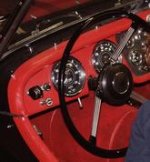
In May, 2007, I had the steering wheel for my 1958 TR3A sprayed black when I was getting everything else sprayed (all parts separate from the tub). The painter had never heard of this, but I insisted and he did it. It was also off the car.

The steering wheel came out better than new. It is still like new after driving 8,000 miles since may 2007.
 

Attachments

  • 19843.jpg
    19843.jpg
    8.1 KB · Views: 220
What was it painted with Don?
How did you treat the control head?
 
I taped the support rods from the center hub to the rim with masking tape. I took the control head apart, removed the chrome ring in the center (very carefully) and had these two parts sprayed at the same time.
The paint was the same 2 part black paint he used to spray all the separate body panels and the tub.
 
Peter,

After reading your post I went to the Wheelskins' site. Did you have to special order your Wheelskins cover based on rim diameter and thickness or is there a hidden classic car category I missed.

Photo 703
 
Sounds good Don. I think I will go that route. Do you have any tips, suggestions or technique ideas on the re-assembly of the control head. As you know, there are multiple parts that have to be compressed and held in place so that it can be put together. I'm thinking clamps, using thin wire as a hold down, so would be interested in hearing how you did it.

Tinkerman
 
Photo703 said:
Peter,

After reading your post I went to the Wheelskins' site. Did you have to special order your Wheelskins cover based on rim diameter and thickness or is there a hidden classic car category I missed.

Photo 703
Not Peter, but I ordered a custom size from them. O.D. = 16-7/8" Grip dia. = 2-5/16" Works like a charm.
Also... I ordered it from an ebay seller. I can't find their ebay name, but they are called Brand new Auto.
Maybe, search Wheelskins on ebay?
It was a significant discount over Wheelskins' direct price, and arrived SUPER quickly -- custom size and all.
 
The cover to fit the TR3 steering wheel is a special order at Wheelskins. Look for their auctions on eBay, the prices are significantly lower than the 'list' price you will pay through their web site, but the covers are the same. Moss also sells a custom-fit cover that fits and lasts very well, but with their usual markup on the price.

Never did get around to writing the tech article on control head assembly. But with care and steady hands, you don't need clamps or wires. All the springs will stay in place long enough to put the halves together.

Here's one method:
Load the spring & contact plate into the movable Bakelite arm. Bend the sides of the contact plate slightly, if necessary, so it will stay on the arm by friction. Now load the spring, plunger and roller into the arm, and push the arm into place with the rear trunnion through the hole in the backplate. Hold it there with your left thumb (assuming you are right handed) while you insert the curved wire through the slot in the arm, then load the flat washers and springs onto the curved wire. Continue to hold the arm with your thumb, while you lift the other end slightly so the curved wire can be folded down, the springs compressed and the ends laid into their grooves. Once it's in place and everything is pushed to the bottom of it's groove, it should stay there long enough to put the cover into place (but hold the two firmly together while you insert the long screws & nuts.

Here's a shot of the backplate, with all the springy bits in place
DSCF0020.jpg
 
Dick --
No clamps, wires or other special tools required. It's difficult to describe, but the only real "trick" was getting the two springs onto that curved rod and in place in their slot. To use a technical term, I dicked with it until it went together. After a couple of tries it seems easy.
 
Gotcha, understand completely. Thanks to both you and Randall for the technical explanation and the technical term.
 
Eric, interesting that you mention that one. I had downloaded and printed it out some time back. It truly was quite a bit of help. Also one other article is one by Craig Landrum that explains the operation of the turn indicator mechanism so its understandable.
I am happy to say that with the aid of those two articles and the help of Moseso, Randall and others I was able to take it apart, clean it up and put it back together. All without major mental trauma AND I didn't lose a single part, yea.

Gotta love the forum, thanks to all!

Tinkerman
 
My stator tube is undoubtedly broken and hope to soon replace and repair the whole lot.
 
Back
Top