So it's time to pull the pan and put in a fresh gasket as the PO overtightened it and it's squeezing out all over the place and hopefully the root of my leak. Is it better to Shellac (Indian Head) on both sides, pan side, or no sides? Does it remain pliable over time or will it get hard and hence not great to use?? I remember my dad using this stuff back in the '70's when reassembling engines...


-
 Hey Guest!
British Car Forum has been supporting enthusiasts for over 25 years by providing a great place to share our love for British cars. You can support our efforts by upgrading your membership for less than the dues of most car clubs. There are some perks with a member upgrade!**Upgrade Now**
(PS: Upgraded members don't see this banner, nor will you see the Google ads that appear on the site.)
You are using an out of date browser. It may not display this or other websites correctly.
You should upgrade or use an alternative browser.
You should upgrade or use an alternative browser.
To Shellac or Not to Shellac, that is the question
- Thread starter F1LOCO
- Start date


Offline

martx-5
Yoda
Offline
My take on this is a bit different. I feel that it's the gasket that does the sealing, and if installed properly, there should be minimal leakage. First of all, after the pan is off and cleaned up, you will want to flatten out the pan where the bolt holes are. Over tightening them causes them to bulge up. A flat dolly under the lip of the pan with a hammer will take care of that. Then, what I do is glue (using whatever you like) the gasket to the pan and let it dry. The glue is just used to hold it in place. Then I smear a light coat of heavy grease on the gasket and install it.

dklawson
Yoda
Offline
And my opinion is somewhere in between. I agree that the gasket should do the sealing but I suspect even after performing body work on the pan to make sure its flange is flat there will still be waves and ripples that prevent a good seal. However, I don't like RTV if it will make the part hard to remove later. So in an application like this I would opt for getting the pan as flat as possible and applying a thin film of Aviation-Form-A-Gasket as the sealant. It is a bit messy but it is non-hardening and can be removed with alcohol.

waltesefalcon
Yoda
Offline
Me personally I also make sure the pan is flat, then apply a thin coat of blue Permatex stick the gasket on and let it dry, and then I just bolt it up I've never had any problems using this method and the Permatex usually scraps off pretty easily when you have to change the gasket again.

TR3driver
Great Pumpkin - R.I.P
Offline
dklawson said:So in an application like this I would opt for getting the pan as flat as possible and applying a thin film of Aviation-Form-A-Gasket as the sealant. It is a bit messy but it is non-hardening and can be removed with alcohol.
Ok, I took the question to be about Indian Head shellac in particular, and I have no experience with it. But I do have experience with Aviation Form-A-Gasket (which is a shellac rather similar to Indian Head) and I don't like it. Despite the description on the can, it does set up over time (possibly with exposure to heat and so on) into a rock-hard substance that can be nearly impossible to remove. I have literally had to chip it off with a wood chisel! On pan gaskets and such, the only way to get the pan back off is to tear the gasket in half lengthwise, which can be really hard to do without damaging the pan.
RTV (which I assume is what Walter means by "blue Permatex") is OK if you can apply just a tiny bit of it in a thin smear. But it is really easy to use too much and/or install the part before the RTV is dry enough and squeeze out a "bead" of it inside the joint. The bead can later break off (with vibration and so on) and roam around until it clogs something. Not necessarily likely, but not a chance I want to take. (The heater in my Buick got clogged up with the strings from where a shop had used RTV on the water pump gaskets. Bout froze our buns when we visited the Grand Tetons in November!)
Side note : I was watching them build Harley engines on Discovery Channel the other day. They had a robot applying a perfect but tiny (like 1/8" or less) bead of RTV to the castings before assembly. A perfect gasket, and yet how can you hope to replace it in your back yard?
So, +1 on beating the flange until it is as close to the original shape as possible. Use a straight edge to check in all directions that the sealing surface is flat.
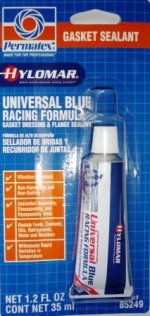
And +1 on Hylomar. Hylomar really does remain soft forever (well, at least for 10 years which is about how long I've been using it) and seals just as well as the others.
New lockwashers every time, and make sure you have the correct bolt lengths. My PO had apparently installed several of them that were too short and pulled the threads out, then installed longer ones that bottomed in the hole before clamping on the pan!
Also check for any damage to the threads, especially the aluminum sealing block at the front (which takes a 5/8" bolt instead of the 3/4" bolt in almost all the other holes). I had to install repair inserts in several of them.
https://www.use-enco.com/1/3/recoil-thread-repair-kit

Got_All_4
Luke Skywalker
Offline
I'm with Walter. First of all Hylomar is not RTV silicon. It is a permanently elastic compound that has high adhesion and permanently seals parts even under high vibration. Developed by Rolls Roice and will fill gaps to 0.15 mm. Any extra that could ooze out will not harden and fall off. I have seen that with RTV and it was stuck on the pick up screen for the oil pump.
I use it a lot. In fact may years ago I had to replace the oil pan gasket in my wifes 240 Volvo and used it on it. Years after that I had to replace the oil pump seals and the last bolt I took off the pan and it just fell off. Never a leak and the pan comes off that easy. Also the gasket just pealed right off. Amazing stuff. Also no down time because you can put into service immediately. The lack of oxygen cures it.
Do your best too to straighten the pan first if it is distorted. Clean and polish all mating surfaces. Then apply.
I use it a lot. In fact may years ago I had to replace the oil pan gasket in my wifes 240 Volvo and used it on it. Years after that I had to replace the oil pump seals and the last bolt I took off the pan and it just fell off. Never a leak and the pan comes off that easy. Also the gasket just pealed right off. Amazing stuff. Also no down time because you can put into service immediately. The lack of oxygen cures it.
Do your best too to straighten the pan first if it is distorted. Clean and polish all mating surfaces. Then apply.
TR3driver
Great Pumpkin - R.I.P
Offline
Got_All_4 said:First of all Hylomar is not RTV silicon.

But "Blue Permatex" might be


CJD
Yoda
Offline
As for shellac...there are much better options today. It was good at the turn of the last century, will work, but why not use a modern sealer when they are available?
On another side, like Art, I normally let the gasket material make the seal. I have a few exceptions to my rule, though, and the oil pan is one of my exceptions. The problem with the pan is it has to seal over several different parts that may have slight ridges (front and rear caps), so it goes beyond the ability of a plain gasket. A bit of sealer will save infinite grief later.
John
On another side, like Art, I normally let the gasket material make the seal. I have a few exceptions to my rule, though, and the oil pan is one of my exceptions. The problem with the pan is it has to seal over several different parts that may have slight ridges (front and rear caps), so it goes beyond the ability of a plain gasket. A bit of sealer will save infinite grief later.
John