Hey Guest!

PatGalvin
Jedi Warrior
Offline
Hey Guys
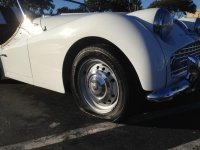
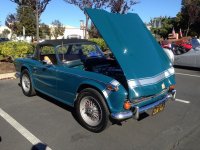
So, I get up early Saturday and sponge bath the TR3A and fill all the tires up to 31 psi. My powdercoated stock steel wheels seem to lose a few pounds of air after a few weeks so I have to top them off before a significant trip. I was heading to Blackhawk (Northern California) and had a 110 mile trip door to show. I hit the road at 6:30 AM and took the freeway and was doing about 75 to 80 mph for the first hour and 15 minutes of driving. Then, I noticed my steering was getting really heavy and uncomfortable so I slowed and pulled off. My front tire was flat. I changed to the spare and dropped the flat off at the tire store for a fix. Then, when I arrived at the show, I noticed my PS rear tire was low - it only had 13 psi. And another wheel was at 23 psi. So, I topped off all the tire inflations and went back after the show and picked up the flat-fix tire. Tire shop said that there was no problem and it held 50 psi all day. As info, I often take drives of up to an hour but not the high speed touring of this trip. I've never had a sudden tire inflation problem like this.
The puzzler? What could cause the tires to deflate at high speed? I have had one rim repaired recently. A wheel shop welded a pinhole shut to repair the rim. But, I can't understand what is occurring at extended duration high speeds that would cause the tires to deflate? The tire shop guys thought maybe the wheel weight clamps might be laying across the tire bead and affecting sealing. But, all my wheels have weights and it's never been a past problem.
Any ideas? I'm thinking of just having tubes installed in all, but would really like to understand what could be happening here.
Pat
So, I get up early Saturday and sponge bath the TR3A and fill all the tires up to 31 psi. My powdercoated stock steel wheels seem to lose a few pounds of air after a few weeks so I have to top them off before a significant trip. I was heading to Blackhawk (Northern California) and had a 110 mile trip door to show. I hit the road at 6:30 AM and took the freeway and was doing about 75 to 80 mph for the first hour and 15 minutes of driving. Then, I noticed my steering was getting really heavy and uncomfortable so I slowed and pulled off. My front tire was flat. I changed to the spare and dropped the flat off at the tire store for a fix. Then, when I arrived at the show, I noticed my PS rear tire was low - it only had 13 psi. And another wheel was at 23 psi. So, I topped off all the tire inflations and went back after the show and picked up the flat-fix tire. Tire shop said that there was no problem and it held 50 psi all day. As info, I often take drives of up to an hour but not the high speed touring of this trip. I've never had a sudden tire inflation problem like this.
The puzzler? What could cause the tires to deflate at high speed? I have had one rim repaired recently. A wheel shop welded a pinhole shut to repair the rim. But, I can't understand what is occurring at extended duration high speeds that would cause the tires to deflate? The tire shop guys thought maybe the wheel weight clamps might be laying across the tire bead and affecting sealing. But, all my wheels have weights and it's never been a past problem.
Any ideas? I'm thinking of just having tubes installed in all, but would really like to understand what could be happening here.
Pat