• Hi Guest!
    If you appreciate British Car Forum and our 25 years of supporting British car enthusiasts with technical and anicdotal information, collected from our thousands of great members, please support us with a low-cost subscription. You can become a supporting member for less than the dues of most car clubs.

    There are some perks with a member upgrade!
    **Upgrade Now**
    (PS: Subscribers don't see this gawd-aweful banner
Tips
Tips

TR2/3/3A Timing and temperature

TRclassic3

Jedi Trainee
Country flag
Offline
I’ve been chasing an issue with my 3A where the car is running hot when driving at higher rpm (say around 3000). The needle creeps up to about half way between 185 and the next line. I would not say it’s overheating but it is a bit concerning. Being that it’s only occurring at higher rpm I’m wondering if it could be timing. That said I have found statements that too advanced can cause this as well as statement that too retarded can cause. Which is correct, or are both statements true? As I side note I don’t see evidence of running too lean. If anything a bit rich.
 
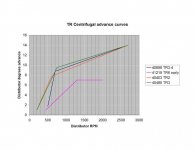
Well, if you suspect a timing problem, it's easy enough to check. You should check for initial advance and make sure you're getting the right advance at 3000 RPM.

It might just be time for a radiator flush and replacement of the coolant. I've used the Prestone radiator flush stuff, and it seemed to get a lot of crud out of the radiator, so something like that might be in order. Of course, check for the usual things: blocked radiator, collapsed hose and so on.

In any case, the temperature gauge is not terribly accurate, so the absolute numbers matter less than any changes from what you've been seeing. And, of course, you should expect higher readings at higher engine speeds in warmer weather.
adv curves.jpg
 
Check your fan belt tension

M.
 
High RPM's makes for greater water flow limited by restriction, that being said bad thermostat step one. Some Rad hose have a spring inside to keep hose from collapsing at high flow step two check if top hose is to soft from age. If you do not have a thermostat step three replace same water need time in Rad controlled by thermostat. As stated Rad flush good start EPA and all that with old fluid.
How I tell members to check cooling system. Start car with Rad cap off you should see no water flow ( thermostat is closed ) when motor temp gets to thermostat rating you will see flow and steam. check temp meat therm or laser temp tool. all at idle. A motor should hold operating temp for 10 minutes at any outside temp 50 deg to 100 deg. If it does not you have a problem, fuel mix timing to adv. wrong grade of fuel 87 may not be correct high fuel number slower burn rate and more power per stroke and cooler burn. Some simple mistakes to many grill badges. oil cooler blocking Rad. old Rad fluid, Fan on backwards Fan belt on to tight. And last weak oil pump not getting oil to top of head add a oil line to head easy check. At temp and idle remove oil filler cap look for oil flow at rockers. Stay cool Madflyer
 
Thanks all for the advice. Couple of things. Gauge rebuilt by Nisonger two years ago. This is when I started having issue. Last year, thinking problem might be t-state I swapped out sleeved for a 165 from TRF. Also at that time I plugged the bypass with copper fitting with hole drilled. Also replaced upper hose. Water pump was new in 2014 when motor rebuilt. Checked belt tension. It’s to spec. With regard to some temp checks I am getting anywhere from a 20 to 40 degree drop between top of rad and bottom. Not completely confident of actual readings as my ir gun is acting up. With regard to looking for coolant movement with cap off, should this still be evident given the neck arrangement on the 3?
 
You might get some indication of movement looking into the neck but nothing reliable IMO.You can check the gauge by removing the bulb and putting it into a container of hot water with a thermometer in it. Compare that with the needle on the gauge in the car. It should be close and consistent.
The temp drop seems normal to me but you can't really measure it at speed.
I'd still suspect a clogged radiator. You could flush it yourself but better to get it flow checked and cleaned by a radiator shop. Also can't rule out timing unless you've checked that and you certainly should before you go to the trouble of flushing the radiator.
My 2p.
Tom
 
Also you should see steam if not movement. What is the pressure rating on Rad cap 9 to 12 ponds ? I do not know your elevation above sea level but at sea level water boils at 212 deg. The purpose of the pressure cap is to increase the boiling point to above 212 deg. this stabilizes Rad water temp for cooling replace cap won't hurt I forgot about your long neck sorry Also I run a 185 deg. thermostat for the heater in late fall in Reno Nevada. Madflyer
 
I went through this last year. Running about the same temperature you are seeing.

Do you have the cardboard shield in place?

I did a number of things and in the end it seemed to be the thermostat. I had started out with a 195 thermostat (did not realize it at the time) Changed to a 160 thermostat and I was running at about 150 to 160 so I got a 185 thermostat and I am staying around that temperature now or just below 185. In traffic it will creep up a bit but comes back down quickly as I get moving.

I did open up the front grill a bit as I had read that the opening size had been reduced on later grills and people had found that a problem. It seemed to give me about a 5 degree reduction in temperature.
Modified grill.jpg
The grill openings around the crank hole are the original size.
The tool I used.
Grill tool.jpg
David
 
The body work below the grille blocks 1/3 of the air flow from reaching the rad. If you look at pictures of TR3 race cars you will see an air vent or several 3" holes cut into the body below the grill to aid in cooling. I did that to my TR3 as I wasn't concerned about a stock look and I removed the bumper as well. Also you could try a 15%"water wetter" ,35% antifreeze and 50% water mix that racers use. Of course the rad has to be in top shape.
 
The most common cause of reduced cooling at speed is the lower radiator hose collapsing at highway speeds. A restricted radiator can also contribute to both the collapsing and the overheating.

Advanced timing will in all cases cause pinging prior to overheating. A reduced timing can cause overheating, usually accompanied with a "sluggish" feel of the engine response.

The airflow issues in our TR's...from the restricted grill and poor air ducting, is usually most noticeable sitting at stop lights and at very low driving speeds. Usually there is ample airflow everywhere at higher speeds.

Sadly, all these things are cumulative. Our TR's in stock form have marginal cooling at best, so anything not completely up to par will cause overheating. It's best to start with the most probable and work through the system one item at a time.
 
At one point during my hot engine issue I mads a deflector/scoop to mount on the frame below the radiator. It did not seem to make much difference.

David
 
Thanks again to all for your input on my issue. Much appreciated.
John, Is it possible to determine if lower hose is a problem while at rest Check for deterioration or softness or???
The car does not ping and definitly not sluggish so I'm think I have timing close.
Ive been running the TR6 fan for years with no issue so I doubt that is it.

One more question concerning the following test I performed today. The object was to verify the gauge reading. Removed radiator cap and started car. I used a digital probe type thermometer to check the coolant temperature at the neck and compare to the gauge. after about 10 minutes or so the gauge hit 185. The thermometer in the neck read 176 I continued to let the car run until the gauge was reading where it tends to end up at speed, about half way between 185 and next line. The thermometer read 184.Makes me wonder about the calibration of the gauge, but not sure how much difference between those two points would be expected anyway.
 
With the car cold, remove the radiator cap and then squeeze the lower hose. If you can pinch it in a measurable amount, then it is suspect.

The temp gage is mechanical, and not really known for extreme accuracy. What's more, if you ever boil over the radiator, it stands a good change of springing the gage out of whack. It can be fixed after that, but it must come apart to re-calibrate it.
 
Back
Top