• Hey Guest!
    British Car Forum has been supporting enthusiasts for over 25 years by providing a great place to share our love for British cars. You can support our efforts by upgrading your membership for less than the dues of most car clubs. There are some perks with a member upgrade!

    **Upgrade Now**
    (PS: Upgraded members don't see this banner, nor will you see the Google ads that appear on the site.)
Tips
Tips

TR4/4A Timing and Distributor Bushing Question

ghawk16

Jedi Trainee
Country flag
Offline
I'm in the process of rebuilding my engine and had a couple of questions:

1. The machine shop took out the distributor bushing and I'm in the process of putting it back in. It's taking quite a bit of force to put it back in. Is it supposed to be TIGHT or is it supposed to just slide down in the hole? I notice that there are slots in the top that correlate with the oil holes in the side. I'm assuming those are to be orientated so they fall in line with the oil gallery?

2. Silly question, but I'll ask anyway...is there a way to time the engine without the head on? I bought a new HD chain, cam sprocket and crank sprocket so starting fresh. Figured it might be easier since I can see the crank, camshaft end, cams and the bottom is still open as I had to buy some .005" thrust washers as my crank end float was .014'. <waits for parts>
 
Hello Gary

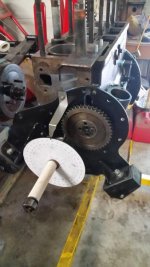
There is a system called degreeing the cam shaft. (I think that is the term.)

It involves a plate bolted to the top of the block with a screw in it to prevent the N0.1 piston coming to TDC. A degree wheel bolted to the crank shaft and sprung loaded bolts to ride in the No.1 cylinder cams.

I think Macys site has a complete write up.

David

Degreeing cam shaft..jpg
 
Interesting...Thanks. I wonder if it's easier to do it this way or just wait till the head is on. I noticed he said that with an aftermarket cam it is worthless to use the factory manual procedure so I'm thinking this would be better. But, I don't really have all the tools to make a plate like that. Hmmmmm...

 
The bushing has a wide groove around it (at least mine do) so orientation is not critical. No matter which way it's turned, oil can get to the gallery through the big groove.

Timing the valves and timing the ignition are two different things. Both can be done with the head off (using the static timing method).

Most aftermarket camshafts are still symmetrical, meaning you can time them using the workshop manual method. If you bought a performance (non-stock) camshaft, it should have come with a timing card and information on how to time it.

Degree wheels are readily available from any number of vendors, prices vary a lot. I got a plastic one from Moss years ago that worked well enough (until I tried to leave it in place while I drove and melted the plastic).
https://www.mossmotors.com/Shop/ViewProducts.aspx?PlateIndexID=32555&SortOrder=10

I replaced it with a larger metal one from Crane Cams that was only $15 or so (probably twice that today). Or, with just a little bit of computer savvy, you can draw one and print it, then paste the printed page to a sheet of cardboard or thin plastic and make your own.

The TDC plate is just a piece of steel with some holes poked in it. I can't quite imagine not having a drill; but if you don't, maybe you should consider buying one. I got one of those "20v max" Li-ion ones from DeWalt as a birthday present last year, and I really like it. But even a cheap corded drill will do the job.

But IMO all of that is not necessary. The factory timing marks may not be perfect, but they are close enough for the job. It ain't rocket science; for a street engine a few degrees just isn't going to make much difference. And unless you've fitted an expensive aftermarket timing gear, valve timing adjustments are only available in (approx) 4 degree steps anyway.

And you can always go back and redo it later.

PS, my experience has been that the lifters move easily enough that no extra spring is needed. Just the light spring in the dial indicator, plus gravity, is enough to hold the lifter down against the cam. But you can always push lightly on the indicator stem to be sure the lifter is all the way down.
 
Great. Thanks for the feedback Randall. I definitely have a drill...too many to be honest! HAHA The plate should be easy to make an what's another trip to the hardware store for material. They know me all too well! But like you mentioned, I was just going to drop the lifters down and put the rods down in and put my dial on top of those. Or buy some cheap pieces of aluminum rod to use with a flat surface. Would rather get the bottom timed before putting the head on. Why? I don't know. Like you said, it ain't rocket science but I'm thinking like it is. Being overly cautious. Kind of like the piston sleeves that have to be proud .003-.005. C'mon...these engines can't be THAT sensitive. But...I'm close!

As for the bushing...is it one that should fall right in to the block/hole or does it take a lot of force to get back in? I was hitting it with a plastic dead blow handle and it didn't want to go in. Maybe I'll sand it down just a tad so it's snug.

The bushing has a wide groove around it (at least mine do) so orientation is not critical. No matter which way it's turned, oil can get to the gallery through the big groove.

Timing the valves and timing the ignition are two different things. Both can be done with the head off (using the static timing method).

Most aftermarket camshafts are still symmetrical, meaning you can time them using the workshop manual method. If you bought a performance (non-stock) camshaft, it should have come with a timing card and information on how to time it.

Degree wheels are readily available from any number of vendors, prices vary a lot. I got a plastic one from Moss years ago that worked well enough (until I tried to leave it in place while I drove and melted the plastic).
https://www.mossmotors.com/Shop/ViewProducts.aspx?PlateIndexID=32555&SortOrder=10

I replaced it with a larger metal one from Crane Cams that was only $15 or so (probably twice that today). Or, with just a little bit of computer savvy, you can draw one and print it, then paste the printed page to a sheet of cardboard or thin plastic and make your own.

The TDC plate is just a piece of steel with some holes poked in it. I can't quite imagine not having a drill; but if you don't, maybe you should consider buying one. I got one of those "20v max" Li-ion ones from DeWalt as a birthday present last year, and I really like it. But even a cheap corded drill will do the job.

But IMO all of that is not necessary. The factory timing marks may not be perfect, but they are close enough for the job. It ain't rocket science; for a street engine a few degrees just isn't going to make much difference. And unless you've fitted an expensive aftermarket timing gear, valve timing adjustments are only available in (approx) 4 degree steps anyway.

And you can always go back and redo it later.

PS, my experience has been that the lifters move easily enough that no extra spring is needed. Just the light spring in the dial indicator, plus gravity, is enough to hold the lifter down against the cam. But you can always push lightly on the indicator stem to be sure the lifter is all the way down.
 
I can vouch that liner protrusion is important. Got to have that force on the gasket around the cylinder, or eventually it will start leaking.

Bushing is a tight fit. It's been too long, I don't recall the details now, but ISTR making some sort of mandrel and whacking it with a BFH. Last few times, I've just left it alone.
 
The bushings are tight and a block of wood and the BFH has often been my method. You can put the brass piece in the freezer and that it should make it go in a little easier. Look at the brass piece closely and see if the machine shop did put a dimple on it by knocking it out from underneath. They come out that way but go back in from the top.
Peace out
 
Back
Top