• Hey Guest!
    British Car Forum has been supporting enthusiasts for over 25 years by providing a great place to share our love for British cars. You can support our efforts by upgrading your membership for less than the dues of most car clubs. There are some perks with a member upgrade!

    **Upgrade Now**
    (PS: Upgraded members don't see this banner, nor will you see the Google ads that appear on the site.)
Tips
Tips

TR4/4A Throwout sleeve 4A/6

TR Tom

Senior Member
Country flag
Offline
Due to a lack of high quality clutch kits available for the TR4 these days I’ve decided to upgrade to a 4A diaphragm style LUK brand clutch kit. I’m also going to spring for the new aftermarket brass throwout sleeve.

Here’s my question:
My original 4 style sleeve was brass, and had no pin to keep it from spinning on the clutch fork. The later 4A/6 style steel sleeve that I will need to use has a pin to keep it from spinning. The new brass 4A/6 ones don’t appear to have a pin. It was suggested by someone more knowledgeable than I about these things that I may want to pin the new aftermarket brass one.

Anyone have an opinion on this, or experience with these new brass retainers?

Thanks
Tom
 
There are still guys around who rebuild p/ps and reface discs. If you can find one near enough that is what I would do. You can also replace the t/o bearing by number with a Timken or National retaining the original sliding part (make sure it is real - too cheap or amazon or Ebay probably means fake).
Bob
 
Thanks for the response Bob,
Unfortunately, nobody near me that does that kind of work anymore, so I’m now committed to doing a diaphragm clutch swap.

Which brings me back to my original question. I have ordered a late style bronze sleeve, but still getting conflicting advice about using a pin with it…Anyone have an opinion?
 
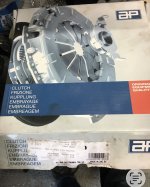
I had the later clutch fitted to my 3a years ago and it was AP parts that have proved to be very good in competition abuse.
I’m not familiar with the brass sleeve or pins
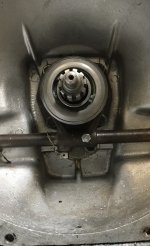
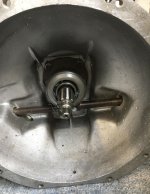
Is this the release bearing ?
Mine is free on the fork and is designed to spin on its bearings.
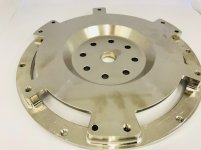
Since changed to a light weight racing flywheel.
 

Attachments

  • IMG_4787.jpeg
    IMG_4787.jpeg
    485.1 KB · Views: 19
  • IMG_4788.jpeg
    IMG_4788.jpeg
    412.8 KB · Views: 17
  • IMG_4789.jpeg
    IMG_4789.jpeg
    329.7 KB · Views: 17
  • IMG_4790.jpeg
    IMG_4790.jpeg
    140.5 KB · Views: 16
On my TR6 / TVR Eaglegate conversion, the sleeve had the pin. There was very minor wear on the sleeve where the clutch fork engages.

I just drilled another hole for the pin 90* off from the original, and reused the pin (it’s really a hardened roller from a needle bearing.

There’s a lot of information on clutches out there.


This one gave me pause. After reading it, I decided to stick with my original pressure plate.

I used the Toyota Landcruisrr throwout bearing (against the recommendation in this document). It works fine.

I’ve had no issues so far.

Rocky
 
Last edited:
Thanks for the input, and the Buckeye link was especially interesting.

I posed this question to BPNW, who sells the bronze sleeves. They don’t recommend using the pin on that type, due to the fact that the steel fork pin would wear into the softer bronze if it was always in the same place in the collar. I looked at a stock steel collar and there was a groove where the fork would ride, just as Rocky observed on his. I imagine that could be a real problem on a softer bronze one. They are designed to rotate to a different spot every time the clutch is pressed, just like the TR 2-4 original style brass ones were designed to do. In all my years of TR 3 and 4 ownership, I’ve never had a problem with this style. For this reason I’m going with BPNW’s advice, and not installing a pin.

I am curious though, does anyone know why Triumph changed from a brass to steel sleeve with the 4A? Was this a cost cutting move, or was it considered an improvement?
 
Note that my sleeve was steel. I hadn’t thought about it before, but I would share your concern about much more wear if a brass sleeve / fork was limited to operating in a single spot.

Good point.

Rocky
 
Back
Top