
• Hey Guest!
    British Car Forum has been supporting enthusiasts for over 25 years by providing a great place to share our love for British cars. You can support our efforts by upgrading your membership for less than the dues of most car clubs. There are some perks with a member upgrade!

    **Upgrade Now**
    (PS: Upgraded members don't see this banner, nor will you see the Google ads that appear on the site.)
Tips
Tips

This is What my Friend Rob Does for a Living

Thank you. I enjoyed the video of the Corsair restoration. I watch a lot of his videos.

Amassing the skill on display in the video and when you consider those aircraft were built in the 1940s with no 4 axis milling machines just the machine operator following drawings winding handles.

David
 
Beautiful airplane. Now I know why the inverse “gullwing”!
 
That's awesome!
 
Remarkable effort! Really liked seeing the old photos, too. Thanks for putting that up, Doug.

And I'd never seen so many Cleco fasteners in one place!
 
Seen several Corsairs at Bridgeport Airport. They were built by Sikorsky in Bridgeport. Better use plenty of right rudder on takeoff or you can flip upside down they had so much torque.
 
thanks Doug. My favorite WWII plane, fell in love with them watching WWII Victory at Sea(?) stuff on the tv.I bought a small model at the TX Healey Round-Up in New Braunfels, TX and a bigger one at the WWII Museum in New Orleans. if you like WWII stuff the museum is really neat.
 
Both Dad and Mom worked for Pratt & Whitney in E. Hartford building the Double Wasp engine that powered the Corsairs. Every time I see a picture of one, I wonder whether my parents helped build the engine.

:thumbsup:

Insight into your predilection for things that go: "click-buzz-whirrr..." !!!
 
I had an unbuilt Corsair model kit I inherited from my Dad that I sent to Rob,
figuring it was where it should go.
 
:thumbsup:

Insight into your predilection for things that go: "click-buzz-whirrr..." !!!
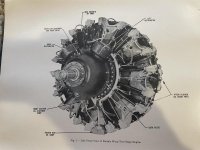
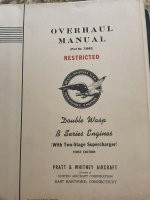
If you think your Austin-Healey Service Manual is detailed, you should see this. More than 1800 pages on how to overhaul the Double Wasp. I still have Dad's manuals in the event I need to do a rebuild some day.

Webp.net-resizeimage (4).jpg

Webp.net-resizeimage (5).jpg
 
Interesting about the distributor nomenclature. "Left" and "right" as opposed to "front" and "rear"... does that mean the engine was further separated left and right for ignition? I'd have thought it would be better to fire all eight, each in one dizzy, front and back.

But what do I know. Just curious.
 
Interesting about the distributor nomenclature. "Left" and "right" as opposed to "front" and "rear"... does that mean the engine was further separated left and right for ignition? I'd have thought it would be better to fire all eight, each in one dizzy, front and back.

But what do I know. Just curious.

No expert, but each distributor had a magneto. 18 cylinders in total, so nine front, nine rear. Dual distributors in front could have been for ease of maintenance and redundancy. One failed or got shot up and you still had half an engine to limp home on.
 
But firing on half the 18 divided left or right would seem more a syncopated running, as opposed to nine front or rear? Again, I'm just wondering what the logic was for left/right vs. front/rear. And a magneto is a given considering the technology of the times. Easiest and most reliable means of generating the juice and "embolden the electrons".
 
Usually, but not always, the right and left mag is determined by looking forward and at the back of the engine, the mags are to your right and left, reason for their designation. I have seen a couple antique engines where the mags were up front, but still right and left. Here's a simple diagram for a flat four, one of the most popular engines today in light aircraft. PJ
Mags & Ignition flat apposed 4.jpg
 
I get that, Paul. Familiar with dual-plug ignition in most modern light aircraft, and the left/right nomenclature as determined from the pilots' (or with cars, drivers') position. But it still doesn't figure how dividing the rotary 18 cylinder engine into firing on half its cylinders either right or left sided, as opposed to firing on nine front or rear in case of an ignition failure.

I gotta be missing something... P'raps both dizzys are firing all 18 cylinders, with dual plugs?
 
I gotta be missing something... P'raps both dizzys are firing all 18 cylinders, with dual plugs?

I think that's what Paul's diagram shows.
 
Back
Top