

-
 Hey Guest!
British Car Forum has been supporting enthusiasts for over 25 years by providing a great place to share our love for British cars. You can support our efforts by upgrading your membership for less than the dues of most car clubs. There are some perks with a member upgrade!**Upgrade Now**
(PS: Upgraded members don't see this banner, nor will you see the Google ads that appear on the site.)

Tips
- We have a special forum called "Member Articles" where you can submit actual articles for consideration for publication. Learn More
- Don't have an Avatar? If not, your avatar will default to the 1st character in your username. Go into "Account Details" to change your Avatar.
- Some basic forum navigation info: click
 Hey - did you know if you click on the title of a thread it will take you to the first unread post since you last visited that thread?
- Hey Guest - Is your British Car Club in our Clubs database? If not, send me a PM - Basil

- Looking for a local club? Click the "Clubs" tab above and browse hundreds of clubs world-wide.
- Add Android or iPhone APP: click
- Did you know - any picture or video you add in your posts in any marque-specific forum will also get added to the Media Gallery automatically.
- A few more tips about posting and replying: click
- Hey there Guest - be sure to keep your profile page up to date with interesting info about yourself: learn more
- More tips and tricks on Posting and Replying: click
 but were afraid to ask:
  STOP!! Never post your email address in open forums. Bots can "harvest" your email! If you must share your email use a Private Message or use the
  smilie in place of the real @
- Want to mention another member in a post & get their attention? WATCH THIS

- So, you created a "Group" here at BCF and would like to invite other members to join? Watch this!
- Hey Guest - A post a day keeps Basil from visiting you in the small hours and putting a bat up your nightdress!
- Hey Guest - do you know of an upcoming British car event?
 Pretty Please - add it to our Events forum(s) and add to the calendar! >> Here's How <<
- Hey Guest - you be stylin' Change the look and feel of the forum to fit your taste. Check it out
- If you run across an inappropriate post, for example a post that breaks our rules or looks like it might be spam, you can report the post to the moderators: Learn More
- If you would like to try some different "looks" or styles for the site, scroll to the very bottom, on the left and click the Style Selector.
You are using an out of date browser. It may not display this or other websites correctly.
You should upgrade or use an alternative browser.
You should upgrade or use an alternative browser.
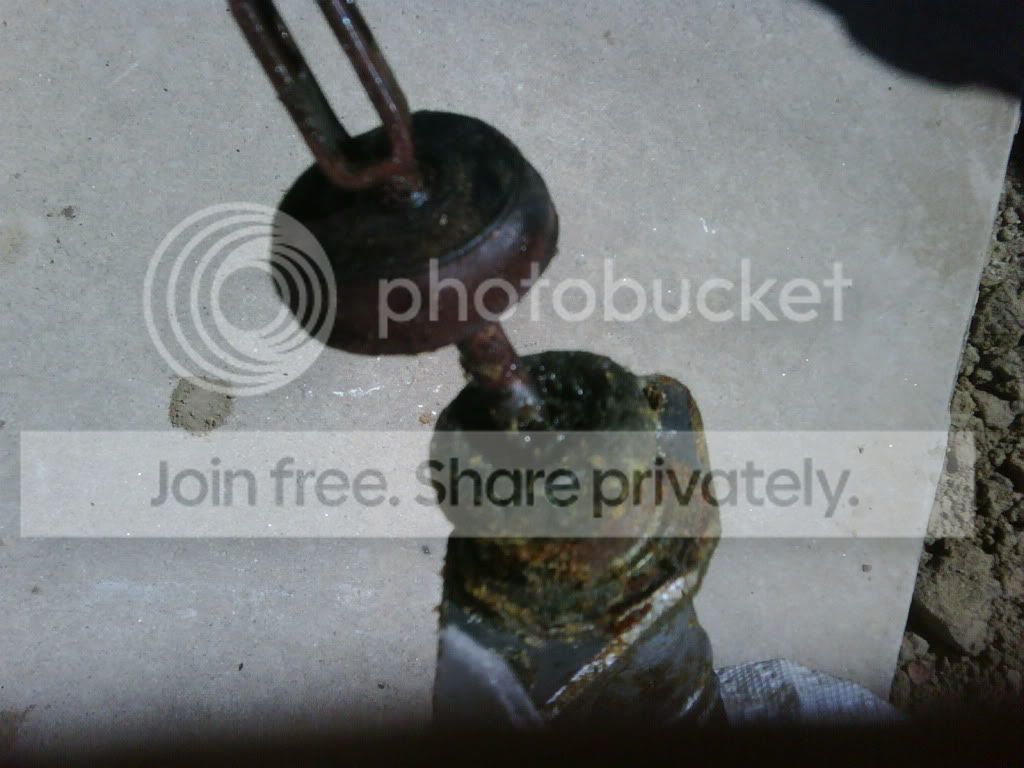
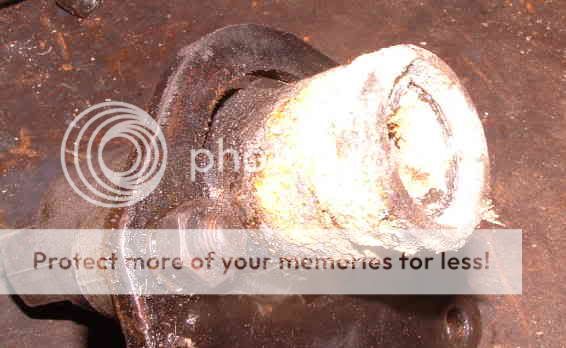
Think this explains my wet foot?
- Thread starter tdskip
- Start date



TR3driver
Great Pumpkin - R.I.P
Offline
Check out the article at:newguy said:What about silicone brake fluid? Pro's and con's!
https://www.buckeyetriumphs.org/technical/Brakes/Fluid/Fluid.htm
To me, the biggest pro is that it actually acts as a preservative to paint and hydraulic components; rather than actively removing paint and promoting corrosion (as seen in the photos above). I once made the mistake of filling some brand new rear brake cylinders with Castrol LMA and putting them back on the shelf ... when I finally got around to taking them down some 20 years later, they were totally ruined!
The only "cons" that I've experienced is that it is rather expensive and hard to find (TRF has the best price I've found); plus it can interefere with painting (causes "fish eyes"). It also is very slightly more compressible than conventional fluid, and so the brake pedal goes a bit lower under hard braking. I find that converting to 'Teflon' soft lines brings the pedal back up, though, so that hasn't been a problem for me.
Lots of other things that others have pointed out (see Nelson's article for a further discussion), but they have not been an issue for me.
But I do take a break (rather than a brake) after adding fluid to the MC; give the bubbles time to rise to the top.
PS, just for clarity, "DOT 5" is another name for "silicone brake fluid". The "synthetic" sold in many stores is NOT the same thing.

Geo Hahn
Yoda

Offline
TR3driver said:...it is rather expensive and hard to find...
But getting easier. I saw the other day that O'Reilly (Checker/Kragen/Schucks) have it on the shelf. Same brand as sold by TRF (North American?) but only in a pint bottle. I did not compare price. Amazon also has it.

HerronScott
Darth Vader
Offline
Believe it or not, JC Whitney was my source back in the early 1980's. Cheapest place to get it then and never had a problem. Looks like they are selling AGS brand now - $18.00 for the quart size.
Is it all still purple or was that just the brand they were selling back then?
Scott
Is it all still purple or was that just the brand they were selling back then?
Scott
TR3driver
Great Pumpkin - R.I.P
Offline
Still purple AFAIK. I think that's actually part of the DOT specification.HerronScott said:Is it all still purple
Interesting that other sources are starting to carry it; I've never seen it on Kragen/OReilly's shelf but I also haven't looked in a few years.
D
DougF
Guest
Guest
Offline
I have had the best results with Dot 5 when using TRF cylinders or rebuild kits.
Geo Hahn
Yoda
Offline
Was in Checker today and looked at their price on DOT5 -- $7.99 for a 12oz bottle. Not too bad.
IMO, you can just flush the clutch hydraulics until the new purple stuff comes out. That's what I did 10 years ago, no problemo. But others may have different opinions & experiences.
IMO, you can just flush the clutch hydraulics until the new purple stuff comes out. That's what I did 10 years ago, no problemo. But others may have different opinions & experiences.
I would blow a little de-watered compressed air through at a relatively low pressure to get the existing stuff out of the lines and then bleed through. I would think traces of the old stuff would still exist but that's probably the best you can do under the circumstances.
TR3driver
Great Pumpkin - R.I.P
Offline
I have done several vehicles now by just filling and bleeding until I get clean purple fluid at all the bleed valves. It does leave traces of the old stuff in the system, but as yet they have not been a problem for me.
Just one example: My 1980 Chevy had a caliper start leaking in 1988. I installed a rebuilt caliper and converted to DOT 5 by just bleeding as above. I finally junked the car in 2005, with some 250,000 miles on it without ever touching the hydraulics again!
Just one example: My 1980 Chevy had a caliper start leaking in 1988. I installed a rebuilt caliper and converted to DOT 5 by just bleeding as above. I finally junked the car in 2005, with some 250,000 miles on it without ever touching the hydraulics again!
TR3driver
Great Pumpkin - R.I.P
Offline
Only if you know, without a doubt, that there is no water in it. Silicone fluid is a LOT cheaper than brake failure.cheseroo said:Compressed air is cheaper than expensive silicon fluid.
Bugger!
So started doing the rebuild - which is really easy BTW - and noticed that my spring was a bit funky. Hard to see in this picture but the spring wasn't entirely straight, it was bowed out on one side where the two coils were jammed together closer than the rest.
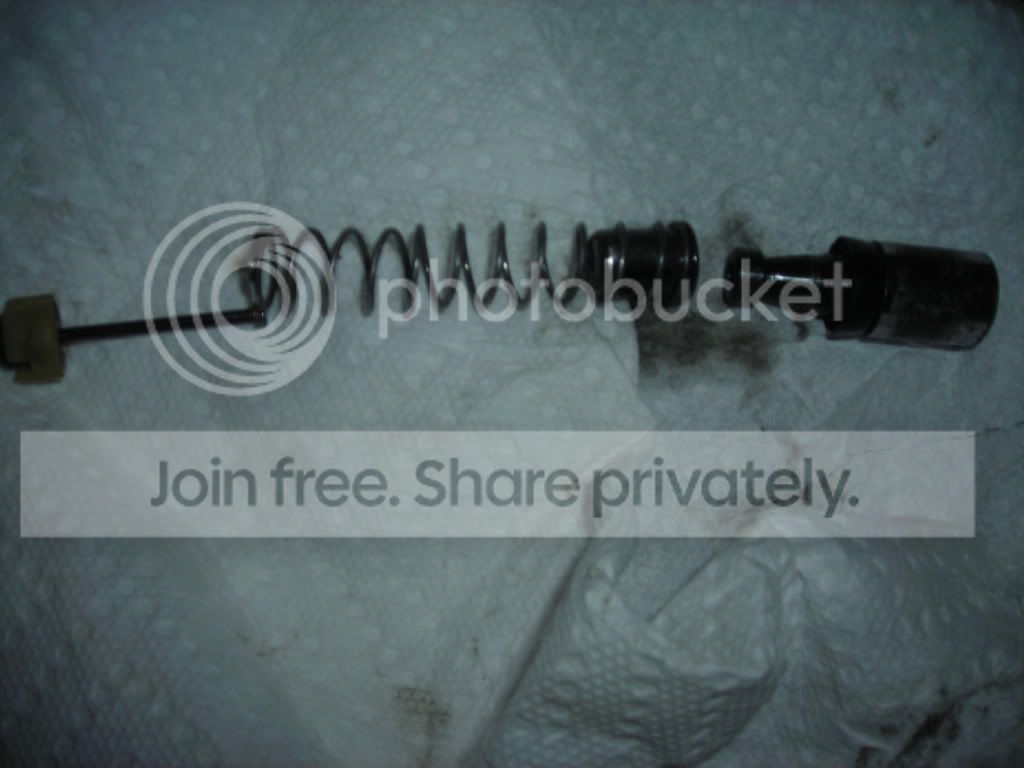
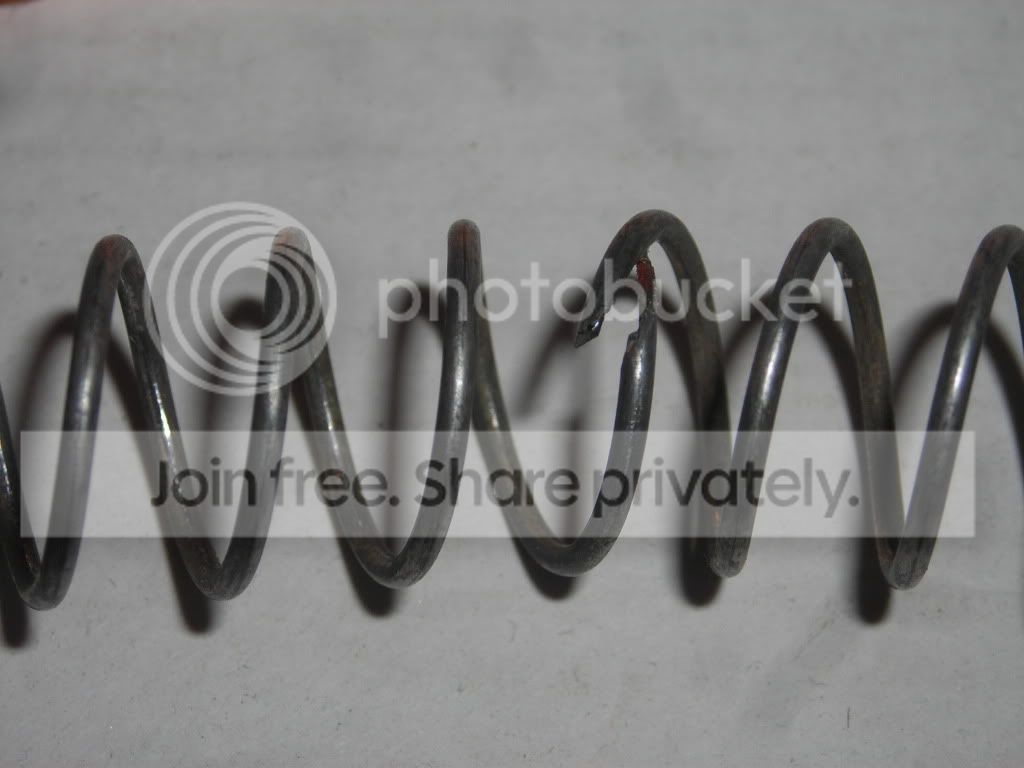
So I tried to straighten it since it was bowed out far enough it would have gouged the bore and look what happened;
So started doing the rebuild - which is really easy BTW - and noticed that my spring was a bit funky. Hard to see in this picture but the spring wasn't entirely straight, it was bowed out on one side where the two coils were jammed together closer than the rest.
So I tried to straighten it since it was bowed out far enough it would have gouged the bore and look what happened;


hondo402000
Darth Vader
Offline
well guys I hate to tell you but nothing last forever, and as I recall you should flush your hydrolic systems every 2 years, driven or not, brake fluid is hydroscopic, ie it absorbes moisture, so flush the breaks and the clutch every 2 years and most likely that wont happen. I do it on all my cars. old or new
Hondo
Hondo