• Hey Guest!
    British Car Forum has been supporting enthusiasts for over 25 years by providing a great place to share our love for British cars. You can support our efforts by upgrading your membership for less than the dues of most car clubs. There are some perks with a member upgrade!

    **Upgrade Now**
    (PS: Upgraded members don't see this banner, nor will you see the Google ads that appear on the site.)
Tips
Tips

The Ethanol dilemma

PeterK

Yoda
Offline
With the addition of 10% Ethanol and more to come, the only way to get the octane we need is to drain the tank each spring. I parcel it out to the modern cars, a little at a time and also use it for the lawn machines. Trouble is, my Kubota is diesel so can't use it there.

I've had mixed results with Sta-Bil (gummed up the carbs on some lawn equipment) even though some swear by it.

My Audi has an ECU that adjusts for the loss in octane that occurs over winter storage. I still try to fill it with premium first thing in the spring but that's now only 91 octane here.

But the 3A likes octane and pings until I change it out.

So ... question is:
Is there a stabilizer for gasoline containing ethanol that also prevents it from destroying the rubber seals in the older fuel systems? Sta-Bil has a new marine fuel stabilizer - is that a better product for our vintage engines?
 
I don't believe there is anything that will stop the ethanol from attacking seals that are old enough to not be compatible. It's also worth noting that you can easily back off the timing a bit on the TR while you run out a tank of gas.

But I can't help with the stabilizer question, I've never used the stuff myself.
 
Not the answer you are looking for, but you could drain it once the snow hits and not have to worry about the octane. Fill a gas can when you want to take it for a spin on a nice day.
 
I add 4 oz of Marvel mystery oil to every tankful. Here in Canada, the best I can find is labelled 91 octane, but the gas pumps don't say if there is any ethanol added. To weeks ago, I filled up at a Shell in Vermont and that pump had a sign "10% Ethanol added". It was 93 octane. I added the 4 oz. MMO and have had no stalling or stuttering in the last 250 miles on this tankful.
 
I'm with Tom. I put the TR3 in the garage sometime in November. Start it up again sometime in March and it just works. I run it all spring/summer/fall on 89 octane "mid-grade." It neither misses nor pings. And -- all motor fuel in Minnesota is 10% ethanol, except the stuff that's 85% ethanol (which I don't use).
 
I never used to pay attention either. But the gas is rumoured to be getting more ethanol as time goes on which is less stable than non-enriched gasoline. Because the ethanol does what ever it does or doesn't do over time, the octane goes down, Or so I've read on the internet.

My experience changed this year. I normally fill up my tanks before storage, use a little Marvel M.O. once in a while for upper cylinder lubrication too. But this spring, the 3A had a slight ping and went away after I changed out the old gas.

The topic of Ethanol in our gas has also been on the local news lately as a big problem for boaters this year. They are recommending Sta-bil Marine all the time and a complete flush between seasons.
 
Stupid question of the day. How do you guys safely drain your tanks? Have you installed some sort of manual drain valving arrangement or do you suck it out through the gas cap?
 
The problem you could be experiencing with E10 gas (10% ethanol) is phase seperation due to water absorbtion... The ethanol (alcohol) is highly hydroscopic (absorbs water) and its subject to "phase separation". This can reduce the fuels overall octane rating by several points.

Bottom line, E10 does not store well. Even the gas companies will tell you that its "shelf life" is only 2 to 3 months... after that it starts to deteriorate... especially if you are in a humid environment. I've had good luck using Sta-bil... I add the proper amount then fill the tank (this reduces condensation on the inside walls of the gas tank)... I'll also run the engine for a short time to make sure the treated fuel gets through the entire system... fuel pump, carbs, etc...
 
There's a drain plug in the bottom of most TR3 tanks.
Extinguish all smoking materials. Jack up the rear. Undo the plug while arranging the funnel and gas can to catch the fuel. Wipe up the, hopefully small, spill. I have a 5 gal. gas can. I make sure to have less than that in the tank before attempting this. If a little extra driving is required to assure this, I don't regard it as a great hardship. :smile:
 
Moseso said:
There's a drain plug in the bottom of most TR3 tanks.
Another alternative is to use one of the little Facet electric fuel pumps as a transfer pump. You can power it with a battery charger and, if you have enough hose on hand, pump the fuel directly into another car's tank.

The Facet also makes a good spare to carry on long trips, IMO. It's much easier to press it into use than to try to R&R the stock mechanical pump on the side of the road.

I wonder, though ... seems like most of the problems with E10 are because it is exposed to the atmosphere. I wonder if sealing off the tank vent (and running the float bowls dry) would alleviate the problem?
 
I used to love the cool burn that gas gives you as it runs up your armpit from underneath the car.

But, now I use a suction pump from HF through the filler hole into 5gal gas cans.
 
I store my 1958 TR3A is my dry, heated garage from the end of October till April. I leave almost no gas in the tank. I'm not concerned about humidity or rust because the garage is heated and I had the interior of my tank coated with epoxy "slush" in 1991. In the spring, Ifill up with new gas of the highest octane and if there is a bit of old gas left there it would be diluted by the new gas.

But, a few months ago, because of the suspected problems which might arise with the added ethanol, I have added a drain valve to the bottom of my gas tank - just in case. From now on, I plan drain the tank in November of that last half gallon or so and leave it empty till April.
 
I would add to Don's procedure that it might also be wise, after draining the tank, to run the carbs (and the lines) dry as well until the engine stalls.
 
I do use Sta-Bil. I also use a lead substitute. To stop the pinging...the last tank of gas is premium. 3/4th full. No trouble in the spring with starting or gumming.
 
Rick Patton owns a couple of NAPA stores in Maine and he recently told me that there's new "rubber" gas hose available that doesn't react/degrade from Ethanol. I think he even said it's green in color.......

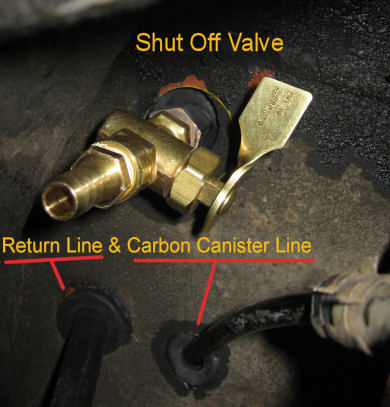
As for draining the tank. I put in an inline shut off valve right where the gas line exits the tank. SO I basically shut off the fuel flow, remove the fuel line and let the gas empty into a container. It makes working around gas so much easier.

Shut%20Off%20Valve.jpg
 
Down south the gas goes bad quickly, the XKE won't last but a couple of months before it spits and sputters. The TR3 is even worse. I keep the tank drained on it most of the time. I did start using Sta-bil this spring and the XKE is running okay. I do like the valve idea as well.

Marv
 
Back
Top