• Hey Guest!
    British Car Forum has been supporting enthusiasts for over 25 years by providing a great place to share our love for British cars. You can support our efforts by upgrading your membership for less than the dues of most car clubs. There are some perks with a member upgrade!

    **Upgrade Now**
    (PS: Upgraded members don't see this banner, nor will you see the Google ads that appear on the site.)
Tips
Tips

TDC Check - Old Idea w/ a New Twist

Geo Hahn

Yoda
Country flag
Offline
Based on a recent comment by Randall I got inspired to make a piston stop to precisely locate TDC on the TR4. I have always had to set the timing well retarded from the book setting and wondered if this was due to engine mods or just a timing mark that was not in the right spot.

The suggested approach was to bang the ceramic center out of a spark plug and thread the innards to accept a long bolt. I used a lock nut to set the length of the bolt extending into the cylinder:

PistonStop.jpg


For a 4 cylinder 'TRactor' motor a length of 1.125 beyond the plug seemed about right.

Once the stop is in place (and all plugs are out) the engine is manually rotated against the stop in each direction and the location of the TDC mark is noted each time. True TDC will be midway between where the marks sit on each stop.

The usual method calls for measurement &/or marking of the location to determine true TDC but instead I used a digital camera to take a pair of photos from the same position (right below the water pump pulley). I was then able to create a composite photo showing both stop positions in one view:

TDC.jpg


Wellsir, looks like the timing mark is spot on as the stopped positions are equal distance each side of the pointer. Still, good to be sure.

BTW -- probably best to have the battery disconnected during the procedure just to be double-darn sure the engine doesn't get cranked while that stop is in place.
 
Are you saying the stopped positions are the two holes drilled in the pulley. Because I always thought TDC was the notch on the back side where the pointer isn't pointing.
 
The hole in the pulley is supposed to be TDC.

With the piston stop in place the piston touches the bolt with the mark not quite to pointer in each direction. If all is well the distance from the pointer will be equal when as the piston reaches the stop in each direction.

If the distance were not equal then true TDC would be the midpoint between the position of the 2 holes.

The little notch on the back of the pulley looks about right for advance 'by the book' though I have never relied on that.
 
Hmm, I'll have to look. I don't think my pulleys have that little notch. As noted, the hole is supposed to be TDC (according to the factory books).

Geo, are you saying you have to run your timing retarded from 4 BTDC? Have you checked (with a light) that it moves as expected when you rev up the engine?
 
TR3driver said:
...Geo, are you saying you have to run your timing retarded from 4 BTDC? Have you checked (with a light) that it moves as expected when you rev up the engine?

To eliminate pinging I end up with 0° advance static. All in (around 3000K RPM) I have 32° total advance. I think the engine has a compression ratio of 9.2:1 due to having an 87mm bore (stock is 9:1 and 86mm bore).

My math (assuming the combustion chamber is unchanged and the only change is the bore): 2189 / (2138/9) = 9.2

What confuses me now (as opposed to all the things that have confused me before?) is that the 32° total advance seems about right for an engine with a static advance of 4°. So it is as if my distributor has too much advance. Not sure what would cause that.
 
Geo Hahn said:
What confuses me now (as opposed to all the things that have confused me before?) is that the 32° total advance seems about right for an engine with a static advance of 4°. So it is as if my distributor has too much advance. Not sure what would cause that.


Is that 32 with our without vacuum advance?

It could be the wrong vacuum unit (if it is with it connected). If not, wear on the stops/weights that control the advance is the only thing I can think of (aside from the wrong dizzy).

-Darrell
 
That's kind of what I was thinking, too. FWIW, when I got TS13571L, someone had cut out the advance stop in the distributor. No idea why, but it caused the same sort of problem.
 
TR3driver said:
...when I got TS13571L, someone had cut out the advance stop in the distributor...

Uh oh -- that is something I should look at. I never knew there was something there (or not there) that must limit advance.
 
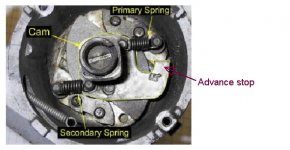
And in that picture that Randall posted, you can see the 15 degrees stamped on the arm, indicating that this distributor should have a max of 15 degrees of distributor advance (30 degrees at the crank).
 
Right, but note that probably is not a TR3/4 distributor in the photo. Marcel was writing about a classic Mini.

It depends on the distributor model, but most TR2-4 would have had a 14 degree stop (for 32 crank degrees total advance with 4 degrees initial).
 
TR3driver said:
Right, but note that probably is not a TR3/4 distributor in the photo. Marcel was writing about a classic Mini.

It depends on the distributor model, but most TR2-4 would have had a 14 degree stop (for 32 crank degrees total advance with 4 degrees initial).

RIght, I just meant that Geo could take a look at what was in his distributor.

There should also be a stamp on the vacuum advance. Something like N-N-N, where one number tells the amount of advance, and the other two I think tell you how much vacuum it takes to start movement, and to get the max advance.
 
Not sure if this is common, but if the springs are weak or that mechanism needs some cleaning perhaps you are never getting back to a full retard position when static timing is set. Worth a look underneath to just check it out.
 
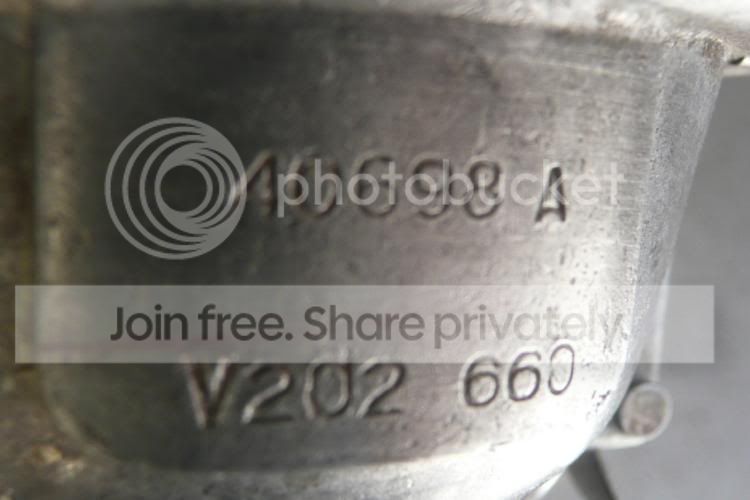
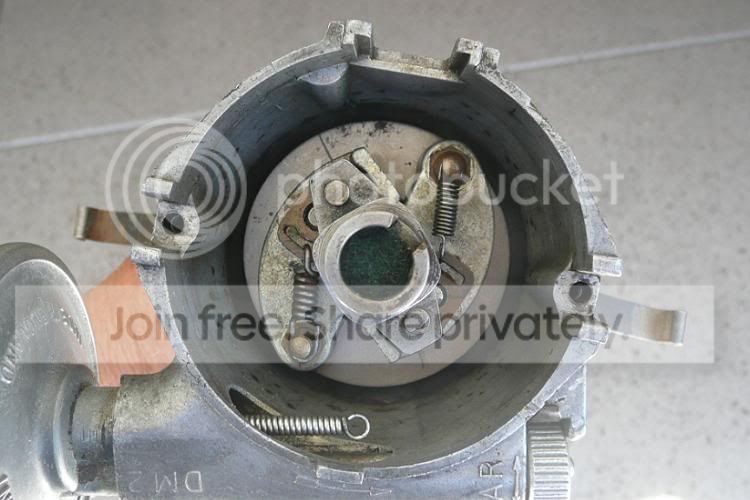
Okay, have out-of-town guests due to arrive this afternoon so I have to hold off opening up the distributor in question but did take a peek inside my spare. I do not see the 'arm' or 'stop' described in Marcel's article, though just eyeballing the advance it seems about right:

40698A.jpg


40698AWeights.jpg


Well, something stops the movement of the weights.
 
Just tidying up my TR4 engine rebuild and played with timing some more - I need to check what I have, but on my TR4 I'm not near the total advance you have. I can't, or don't think I can static time since I run pertronix. But I'm sitting at around 4 btdc at idle, running up to 3000 rpm I'm at 21-22 degrees. My book says the TR4 would have been 11 degree distributor/22 degree engine for mechanical advance.
 
Geo Hahn said:
I do not see the 'arm' or 'stop' described in Marcel's article,

You have a DM2 there, while the article and photo was for the later 25D. I forget offhand where the stop is for a DM2; have to go look at one.
 
Re: TDC Check & Distributor Info

TR3driver said:
Geo Hahn said:
I do not see the 'arm' or 'stop' described in Marcel's article,

You have a DM2 there, while the article and photo was for the later 25D. I forget offhand where the stop is for a DM2; have to go look at one.

Okay -- just to tie up a loose end should anyone care now or search later...

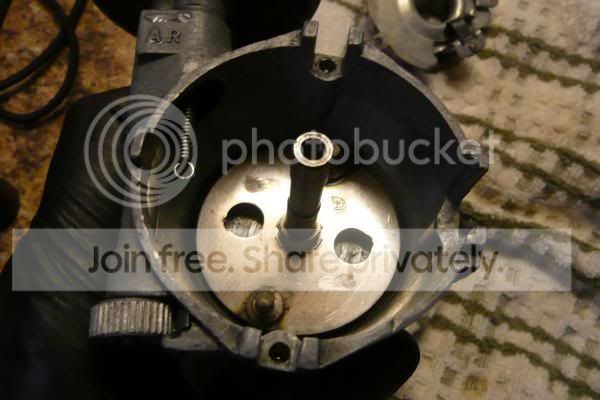
The weights in a DM2 distributor have a short peg under them that sits in a much larger hole in the plate below. Their swing (and thus the advance) is limited when that peg runs into the edge of the hole.

You can see a slight 'dent' in the edge of the holes where each is hit by a peg.

DM2.jpg


I don't know if that 'dent' is a result of years of running or is original and the depth of it used to control the amount of the advance. Alternately, the size of the hole itself may determine total advance.
 
Back
Top