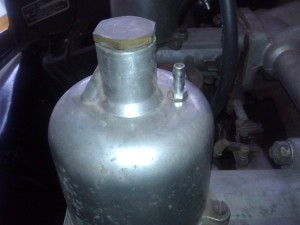
Anyone seen these before? Can't upload pictures now for some reason, so it is here https://triumphtr3b.wordpress.com/2013/04/09/su-carbs-have-vacuum-fittings-on-chambers/


-
 Hey Guest!
British Car Forum has been supporting enthusiasts for over 25 years by providing a great place to share our love for British cars. You can support our efforts by upgrading your membership for less than the dues of most car clubs. There are some perks with a member upgrade!**Upgrade Now**
(PS: Upgraded members don't see this banner, nor will you see the Google ads that appear on the site.)
You are using an out of date browser. It may not display this or other websites correctly.
You should upgrade or use an alternative browser.
You should upgrade or use an alternative browser.
SU Carbs have strange vacuum fitting
- Thread starter Bruce100
- Start date

trrdster2000
Luke Skywalker
Offline
This could get interesting!! What in the world could that purpose accomplish?
Wayne
Wayne


Offline
What the....dickens is THAT doing there? :rolleye:

TR3driver
Great Pumpkin - R.I.P
Offline
My guess is that someone was trying to get some visibility into what the piston was doing while driving down the road. Not particularly effective I would think, but the vacuum inside the chamber should vary a bit with position, due to the action of the spring.


Geo Hahn
Yoda
Offline
...maybe you drop a couple of bits of straight wire of equal length into these and see how the pistons rise?
Except -- would they rise? Since they are lifted by vacuum I suspect an opening up there would mean no vacuum = no rise.
Offline
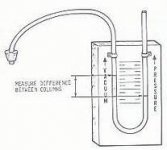
...or, now that I think about it, hooked up a vacuum gauge either temporarily for tuning or permanently for viewing somewhere on or under the dash?The fitting looks like it's made to accept a small diameter hose tube. I wonder if someone was trying to control the amount by which the pistons rose....
TR3driver
Great Pumpkin - R.I.P
Offline
That was my point. Thing is, it wouldn't show manifold vacuum at all. As long as the engine is running, the vacuum in the chamber is just enough to support the weight of the piston plus whatever force the spring supplies. Obviously the piston remains the same, and the spring is pretty light. I doubt you'd get even 1 psi difference between idle and full throttle....or, now that I think about it, hooked up a vacuum gauge either temporarily for tuning or permanently for viewing somewhere on or under the dash?

Keith_M
Jedi Knight
Offline
That was my point. Thing is, it wouldn't show manifold vacuum at all. As long as the engine is running, the vacuum in the chamber is just enough to support the weight of the piston plus whatever force the spring supplies. Obviously the piston remains the same, and the spring is pretty light. I doubt you'd get even 1 psi difference between idle and full throttle.
The vacuum is created by the venturi effect from the air passing through the carburetor. As far as I understand it, it has nothing to do with manifold vacuum.
Here's another thought: I wonder if the DPO hooked these two connectors together with a tube in a (I think) misguided attempt to auto-balance the two carbs. It certainly would make the pistons rise to the same height, but that height is supposed to be determined by how fast air is rushing through the carb. I'm not sure how effective it would be.
Offline
Hey, I never said it was a good idea. :glee:That was my point. Thing is, it wouldn't show manifold vacuum at all. As long as the engine is running, the vacuum in the chamber is just enough to support the weight of the piston plus whatever force the spring supplies. Obviously the piston remains the same, and the spring is pretty light. I doubt you'd get even 1 psi difference between idle and full throttle.
Keith_M
Jedi Knight
Offline
You got it wrong, Keith.
Putting it simply, if it weren't for a depression ("vacuum") in the manifold there wouldn't be any air movement over the jet. The same depression draws the air valve upward.
Agreed. The point I meant to make is that the two values are not necessarily correlated. For example, under hard acceleration there is actually very little vacuum in the manifold, but there is high flow and high vacuum in the top of carb. Conversely, at idle, the vacuum in the manifold is actually fairly high (because the butterfly valve is restricting flow), but the flow is low and vacuum in the carb is low.
I think this is right, but as has been proven before in this forum, I can occasionally be wrong (but don't tell my wife).

TR3driver
Great Pumpkin - R.I.P
Offline
You got it wrong, Keith.
Putting it simply, if it weren't for a depression ("vacuum") in the manifold there wouldn't be any air movement over the jet. The same depression draws the air valve upward.
Nope, not the same depression. The chamber over the piston is open to the venturi, so it "sees" roughly the same depression as the venturi, which is more or less constant. (That's the constant depression in "constant depression carburetor".) The manifold vacuum is on the other side of the throttle plate.
If you put manifold vacuum on top of the piston, it would simply slam to the top as soon as the engine started. Normal idle is around 18" Hg, roughly 9 psi below ambient. The piston in an H6 is about 3" in diameter, so has an area of about 7 sq in. 9 psi times 7 sq in would be 63 pounds of force pushing the piston up.
Think of it like washing your hands. The pressure inside the water pipes is what pushes the water out, sure, but it is much higher than the pressure at your hands.

poolboy
Yoda
Online
Perhaps I should have said the "source" of the vacuum was from the manifold, for the sake of simplicity if not technically precise either.
When I said "same" I did not intend it to be interpreted as equivalent or to expand into the whole 4 stoke cycle or Bernoulli principal.
I understand your desire expand the concept, though, so I've still left plenty of room to do so, Randall or anyone else.
When I said "same" I did not intend it to be interpreted as equivalent or to expand into the whole 4 stoke cycle or Bernoulli principal.
I understand your desire expand the concept, though, so I've still left plenty of room to do so, Randall or anyone else.