• Hey Guest!
    British Car Forum has been supporting enthusiasts for over 25 years by providing a great place to share our love for British cars. You can support our efforts by upgrading your membership for less than the dues of most car clubs. There are some perks with a member upgrade!

    **Upgrade Now**
    (PS: Upgraded members don't see this banner, nor will you see the Google ads that appear on the site.)
  • When posting a classified ad, you MUST select a prefix from the drop-down next to the subject line. If you don't you will get an error and your ad will not be posted!
Tips
Tips

stupid human tricks mechanical advance

glemon

Yoda
Bronze
Country flag
Offline
Is is possible to put the mechanical advance on so that it acts backwards on a Luces distributor, my TR250 gets initial advance from what appears to be a properly functioning vacuum advance, then as the revs rise it starts to retard back down, I don't have enough hands and eyes to say at exactly what RPM, but the initial advance it pretty quick, then it drops back down as revs climb, only to pop back up as I ease off the throttle and revs decline again, then back to starting point.

Can the mechanical advance be put on backwards? Or maybe I have a leak in the vacuum advance somewhere.

Latest Pics, great fun to drive, nice torque, thinking it will be even better if I figure the advance thing out.


tr250side.jpg


tr250frt.jpg
 
Great looking car. Got any pics of the distributor and the inner workings that we can see? Anything is possible, if installed incorrectly, but it's hard to tell without seeing it.
 
I did a quick read of Haynes before I posted and it didn't have much. Paul, that is a good and legitimate question, but I was hoping to get the definitive answer before I tore everything apart!

Thanks for the nice words on the car too, I have not driven it a lot due to wanting to settle the problems like the advance.

I will see what the book says, but I have looked at many other vacuum advances under a timing light and they didn't act like this one.

BTW, I DO NOT have the vacuum retard connected, in case someone was thinking that might have something to do with it.
 
I looked, it should work as it is supposed to, i.e. the weights spin out it advances the timing, so on to more checks on the vacuum advance.
 
you could send it to Advanced distributors, Jeff, he rebuilt mine and did a great job and the car runs better.

Hondo
 
It sounds to me like it's functioning as it's supposed to. The vac advance decreases as the throttle is opened so the timing should drop.
 
Put a timing light on it and see what the advance is really doing as you rev the motor up. Not sure what the advance curve on a TR6 should look like, but on the TR8s, we like to start at 10* at idle and have full advance of around 34* at 2700 RPMs or so. Tweak those numbers slightly based on cam and carb choices.
 
Just a thought, is there any chance that you've got the vacuum advance connected to a retard port on the carbs? Normally I believe, a TR250 wouldn't have a retard port, but it's possible someone has swapped in later carbs that do (maybe in order to get the mixture adjustment).

HF has a Mityvac clone that can be useful. I've only used mine a couple of times, but it seems to work well. And being made of metal, hopefully it won't fall apart with age, like my previous genuine MityVac did.
 
Glemon,

I was asking so we could see before you tore anything apart as well.
 
Randall, now that is an interesting question, the TR250 actually does have a vacuum retard, but I have later carbs, I thought inlet vacuum was inlet vacuum, the tr250, had a mechanical switch which was acted on by throttle position I believe to determine weither you were getting vaccum to the advance or the retard side of the distributor.

I will have to check the carb diagram, I am using the port under the back carb I think it is straigh manifold vacuum, but had thought to find another port to experiment with that idea.
 
Ports on the carbs are frequently not simple manifold vacuum. The original TR250 setup had an advance port (on top of the front carb, I believe), which only showed manifold vacuum when the throttle is open slightly (so no advance at idle).

I'm pretty sure that the port underneath the rear carb is for the vacuum retard, and is 'timed' so that it only supplies manifold vacuum when the throttle is closed. Having that connected to the vacuum advance would explain your symptoms perfectly.

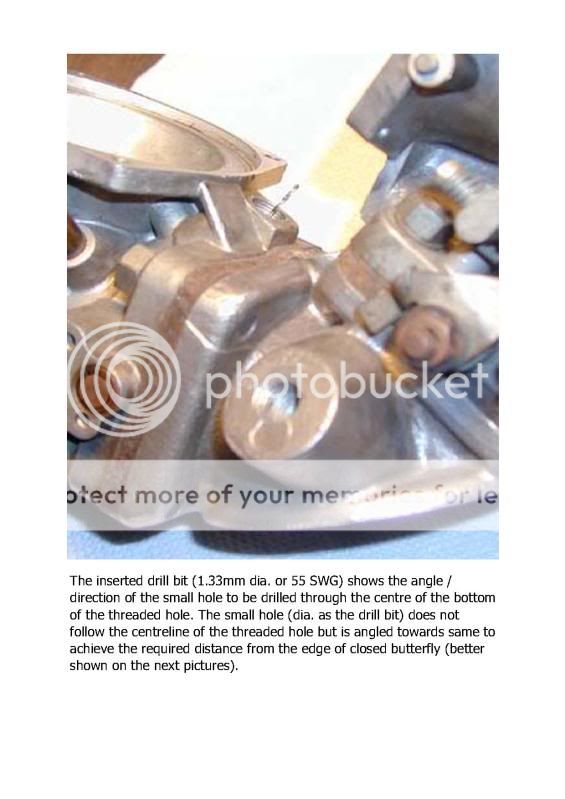
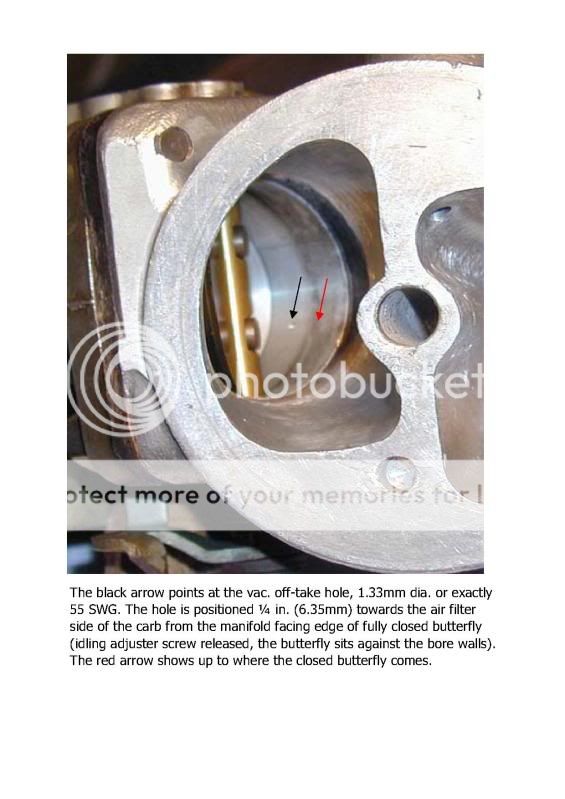
TR6 (and Stag) after 1971 did not have the advance port, on top of the front carb. If you want to make your advance functional, you'll need to either implement a valve (like the original retard setup except only supply vacuum when the throttle is open); or drill & tap the front carb for the port. Here's some photos taken by a fellow Stag owner (Miki Stojanovic) showing some of the port details:

VacOff1.jpg


VacOff2.jpg
 
Geez - what a I missing here? The vacuum advance only is in effect at idle (depending on the set-up) or at low power crusing speeds. When the throttle is opened up, the vacuum goes down, the vac advance goes away, and the centrifugal advance takes over. You let up on the throttle - it comes back. When looking at the car at idle conditions giving 'gas' will cause the timing setting to decrease.
 
Stupid Human Tricks Part II, so simple I am kicking myself, checked the advance with the vacuum hose detached, works as it should.

The vacuum advance provides significant advance at idle, estimated about 10 degrees, then another 15 degrees or so at very light throttle, goes down to lower advance than at idle as the throttle opens more, that is the part I thought was weird, I thought you wanted more advance at higher RPM in theory due to the slight delay in time it takes from spark it full detonation.

I just looked at the Moss catalog diagram that shows the various TR250-6 carbs, I have the 250 distributor (vacuum advance and retard) and 72-73 TR6 tr6 carbs, vacuum retard only, at the risk of being politically incorrect maybe I am the vacuum retard, sounds like Randall is the winner identifying the problem and solution, don't really want to to drill the carb, but given the situation seems the most viable alternative.
 
Or you could have a specialist recurve the distributor with centrifugal advance weights and springs for a distributor without a Vacuum Advance unit,
 
SkinnedKnuckles said:
Geez - what a I missing here? The vacuum advance only is in effect at idle (depending on the set-up) or at low power crusing speeds. When the throttle is opened up, the vacuum goes down, the vac advance goes away, and the centrifugal advance takes over. You let up on the throttle - it comes back. When looking at the car at idle conditions giving 'gas' will cause the timing setting to decrease.
Not correct, Brent. Although there are a few cars that do apply vacuum advance at idle, TR2-6 (and Stag) are not among them. Instead, the vacuum advance (when present, 72-on had no vacuum advance at all) was connected to "ported" vacuum, a special carb port that only produces vacuum when the throttle is partway open. Thus the timing at idle is as slow as it gets.
 
But not using vacuum advance will always cost you something in terms of decreased fuel economy and part-throttle responsiveness, no matter how well the centrifugal advance is curved.

This is part of the reason that mid-70s cars have such a bad reputation for poor fuel mileage (on top of the lowered compression, EGR, etc)

Of course, some people don't care about such things, but some of us do. My Stag was intended as a long-distance driver, so when I get back to working on it, I definitely intend to add vacuum advance.

(LE2013LBW has a 73 Stag motor in it, and is noticeably more sluggish than LE1473L with it's 71 Stag motor, even though LE1473L needs rings & bearings.)
 
Thanks all, at this point I just want to get it running somewhere close to right, althouh right is a little more nebulous with right dizzy and wrong carbs, I will probably eventually go to the correct strombergs for the TR250 or or 4A pre0emmision control stombergs or SUs, and will also send the dizzy in to Jeff, but right now the bits needed to complete the restoration have eaten into the budget quite a bit.
 
TR3driver said:
SkinnedKnuckles said:
Geez - what a I missing here? The vacuum advance only is in effect at idle (depending on the set-up) or at low power crusing speeds. When the throttle is opened up, the vacuum goes down, the vac advance goes away, and the centrifugal advance takes over. You let up on the throttle - it comes back. When looking at the car at idle conditions giving 'gas' will cause the timing setting to decrease.

Not correct, Brent. Although there are a few cars that do apply vacuum advance at idle, TR2-6 (and Stag) are not among them. Instead, the vacuum advance (when present, 72-on had no vacuum advance at all) was connected to "ported" vacuum, a special carb port that only produces vacuum when the throttle is partway open. Thus the timing at idle is as slow as it gets.

That's what I meant by "depending on the set-up". The special port for vacuum advance was again for emissions. With no advance at idle the timing was retarded - but not as much as with the vacuum retard module. Anyway - my advance works fine.
 
Back
Top