• Hey Guest!
    British Car Forum has been supporting enthusiasts for over 25 years by providing a great place to share our love for British cars. You can support our efforts by upgrading your membership for less than the dues of most car clubs. There are some perks with a member upgrade!

    **Upgrade Now**
    (PS: Upgraded members don't see this banner, nor will you see the Google ads that appear on the site.)
Tips
Tips

Stripping Aluminum Threads

BobbyD

Jedi Knight
Offline
Cross Post Time!
Last week I "upgraded" my TAs with KeenSerts and got to thinking about what it takes to strip various thread sizes and threaded inserts from aluminum sooooooooooooo................here's my very unscientific study results. Yea...I know....get a life....do something productive like get the CVJs actually installed! :wink:
 
Thanks for going through all the work in developing the jig and testing the threads to failure. While cast aluminum probably fails at lower values, the keensert can only help improve over the 5/16-24 that is in the stock TA.

At least this is one expense I can truly justify to my wife as a safety improvement that along with new seat belts. The other 99% of my budget not so much :wink:
 
Very interesting Bob. I'm not familiar with keenserts are they competitors to Helicoil? How are they price wise? I just got through recently putting a bunch in my transmission cover base. I think I put in four or five and just did the same with the intake header. Pricey little buggers but they really do the job.
I kinda suspect that your billet is probably better than the cast stuff in our cars.

Good job! Cheers, Tinkerman
 
HeliCoil is just the threads in a coil. Works pretty well. KeenSerts are a fully enclosed insert. Quite stout. There are others as well. Zerts come to mind and Marson has a line of 'em, too.

I really like the "Destructive Testing" approach, Bob!!! Abuse it 'til it fails! That's the only way to truly quantify stuff. I did it with SEM's panel bonding epoxy. It took extreme torture before it showed any signs of failure. The test pieces it was bonding looked like they'd been hit with shrapnel.

Waay fun, too! :devilgrin:
 
Tinkerman.......I went with KeenSerts on the advice of a few people who favored them over Heli-coils and I had never used anything like this before. From what I've been told they both do the job when installed properly.

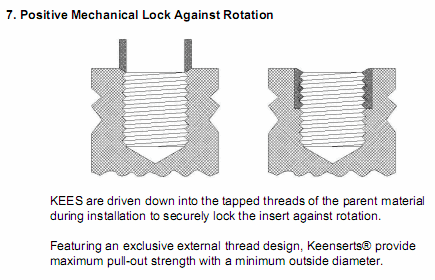
The KeenSert have these 4 locking tabs that get driven into the TA after you've screwed the insert all the way in.

Keenserts-Heavy-knhm12%20heavy%202.jpg


Here's how the locking tabs work

KeenSertTabs.gif
 
My thanks to both you and the Great Pumpkin. As I said I put in some helicoil ones. Used them because I didn't know any difference. I had known they were around for a number of years, but never had the need or inclination. Worked fine for me so far.

Thanks, Tinkerman
 
Nice job Bob, as usual. Great documentation.
 
Tinkerman,

HeliCoils will work fine with your application.

Keenserts are probably 2-3 times the price(a guess), and are great where torque is necessary and/or safety is a factor. There are heavy and light duty Keenserts available. Light requires a smaller hole and would be adequate with our cars. A kit would include the inserts and an installation tool.

In billet aluminum, a 1/4" grade 8 (150,000 lbs. tensile strength) bolt will break before the insert moves inside the aluminum. I've never done the demonstration with anything larger than 1/4".
 
BobbyD - Nice effort!

You wrote:

"For this test I put used a socket larger then the KeenSert diameter so I could draw it up into the socket. I slipped the bolt through a grade 8 washer and into the socket and started tightening in 5 pounds increments. When I hit 60 lbs of torque, the only thing I had accomplished was to suck the washer into the head of the socket to the point were I had very little bolt head left to grip"

<span style="color: #990000">This test procedure most resembles a true ASTM pull-out
test, except the screw is pulled vertically until it "pops"
at failure.

I suggest you use a longer shank screw, put a piece of 1/4" steel plate under the socket to more evenly distribute the load. A hole slightly larger than the diameter of the insert should be drilled.

Allow the bolt head to extend above the socket. Again, a piece of 1/4" steel sits on top of the socket with a hole
drilled only large enough for the bolt shank and thread to pass thru. Place a Grade #8 washer between bolt head and steel. Grease everything so the rotational friction is taken
out of the procedure as much as possible. Make sure your test bolt is long enough to pass thru all the pieces and embed the depth you desire into the aluminum.

Torque at 5# intervals until the bolt "pops", ie your
torque will drop to zero.

Just my take from doing hundreds of fastener pull-out tests.
We use a device manufactured specifically to pull screws.
The socket method will get you in the ballpark.

regards,

dale</span>

 
Did you convince Al to loan you one of his trailing arms for further testing?
 
BobbyD-
If you get your hands on an old trailing arm;

I can walk you thru a procedure that will give
you a more accurate pull-out test than the socket
and washer.

You need to pull the bolts vertically with NO rotation
whatsoever. I can help you build a device at home.
In brief- similar procedure but the bolt head rests
on the bottom of a small steel U clip. The top of the
steel clip is pulled upward thru the socket by a long bolt
and torques from the top. This pulls the T/A bolt up
without rotating it.

Regards,

Dale

PS: now give me a little help with my distributor thread!!
 
BobbyD said:
Dale..... I see what you mean on the pull test and I did respond in the distributor thread. :driving:

<span style="color: #990000">cool!!!

A shame the various folks in the world cannot do the same.
You and I disagree on a few general things but agree to help
each other in general. Is THAT so difficult?

And I hope yer t/a upgrade is a wild successs.
I'll be front of the line after 12 months of field testing!!
(if no wheels fall off!!!)

:yesnod:

later gator,

dale </span>
 
<div class="ubbcode-block"><div class="ubbcode-header">Quote:]And I hope yer t/a upgrade is a wild successs.
I'll be front of the line after 12 months of field testing!!
(if no wheels fall off!!!) [/QUOTE]

By whatever measure, SAE, ASTM, FAA... inserts are a legit way to anchor threaded fasteners. particularly into alloy housings. Somehow I doubt there will be anything LIKE a catastrophic failure of those inserts anytime soon. The "field testing" is already done. May as well order 'em up and install 'em in the OTHER trailing arm while ya wait for the dizzy to return. Good insurance.
 
In installed new studs in my trailing arms today using the Rick Patton jig. Quite a piece of machinery! That said, I had Rick make up a jig for me to use HeliCoils (I was gonna use Recoils but found that they are really flimsy) and decided to only replace the most crusty of my studs. Four out of six on one side and none on the other side. My opinion of HeliCoils has changed somewhat. I applied the requisite 16+ lbs of torque, and I used some Red Loctite, and felt they were "giving". Have never used KeenSerts but they have got to be better after reading the results of the above treatise. Helicoils are OK, but I just felt there was too much "give" when I torqued down. Of course, I used my magic "muscle torque by feel" torque because my wrench won't go down that low accurately.
 
Bill.....even with the KeenSerts, you can't crank the nuts down past the 14-16 lb Haynes range. The industry recommended torque for Grade 5 5/16-24 is 14 lbs and for Grade 8 it's 20 lbs. I first did mine by "feel" and when I checked it with a torque wrench I was at 16 lbs.
 
Bill,

The February Hemming's S&E magazines are at Borders today. I picked mine up tonight, so I'm going to sign off and go read all about BobbyD!!
 
Back
Top