Follow along with the video below to see how to install our site as a web app on your home screen.
Note: This feature may not be available in some browsers.
Hey Guest! British Car Forum has been supporting enthusiasts for over 25 years by providing a great place to share our love for British cars. You can support our efforts by upgrading your membership for less than the dues of most car clubs. There are some perks with a member upgrade!
**Upgrade Now** (PS: Upgraded members don't see this banner, nor will you see the Google ads that appear on the site.)
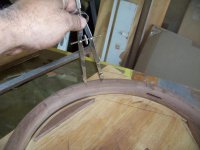
Finger grooves - layout:I looked at (and grabbed) allot of steering wheels to come up with a layout. What I decided on was 1 1/8" centers, 3/16"s deep. The arc would be my 1 1/4" hole saw, wrapped in 80 grit. Like Mitch, I would skip the spokes. I used the plywood I had cut out the rims with, and it still had the centers screwed in place. So I broke off a piece of the outside scrap, and found I could make a kind of clamp, by pressing it into the wheel, and clamping it down. I could spin the wheel, but there was good resistance. Next I took that outside piece of scrap, and glued a bit more scrap under it, making it thicker. I then sanded that piece until it sat precisely 3/16" lower than the top of the wheel. I had my depth gauge.
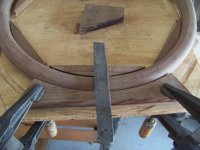
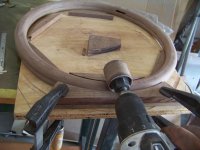
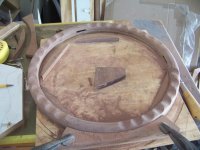
Finger grooves - shaping: I used a file to start the grove. The idea was to rotate the wheel so the line pointed strait at the center hole. Then, just had to keep the file pointed straight, and made a pilot groove. Next I grabbed the drill, with some force, and followed the pilot down, until the sandpaper just hit the "guide". Rotate the wheel to the next mark and repeat. When it was done, i lightly ran the drum sander over all the grooves, in both directions, knocking down the sharp edge where they started.
Pic 1 Spacing the finger grooves Pic 2 Starting the grooves with a file Pic 3 Drum sanding the grooves Pic 4 Grooves cut
Final shaping: After the finger grooves were done, I could really get a since of how the wheel sat in my hand. I thought it was just a bit too squared off. So I took some 100 grit, tore it into strips long wise. Added some duct tape (for strength) to the back, and went to work knocking off the corners. I clamped it down well, and gave it a good going over, top and bottom. This was the final shape. When I was satisfied, I hit it again, with 220. She was ready to be glued.
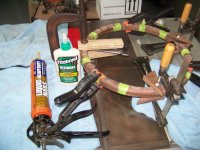
Glue, and other sticky stuff: My approach here was based on the strength concept I had used when I decided to skip the splines. I was going to assemble the thing upside down - so the rim would be touching the top, and lay flat. I laid a heavy bead of Liquid Nails in the groove of the top, going a bit lighter around the spoke openings (to prevent any pushing out those openings). Then I put about 4 beads in the groove for the bottom (going on top now). I figured that would bond the steel wheel to the wood, taking up any dead space, and taking all the force. Next I applied Tightbond wood glue to the areas the Walnut would touch Walnut. I clamped it, tapped it, and clamped it some more. Its important to run a damp paper towel around the joints, cleaning off any glue, Stain does not color glue, all the glue will have to be sanded off (its 100 times easier to wipe it off wet than sand it off dry). Then went to bed.
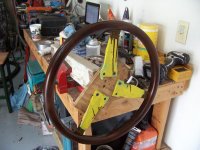
Color and finish: After a quick going over with 220, just to be sure I didn't leave any glue, and taping up the spokes that were clear-coated, it was time for color. Matching the dash and shift knob, I already new the recipe. For compatibility, the line would be MInwax. First conditioner, for about 15 minutes, then wiped clean. Next was a 50/50 mix of American Walnut / Gun Stock. I let that sit for about 10 minutes before it got wiped down. I gave it a day or 2, just to be sure it was ready. I used spray Polyurethane, gloss. It goes on slow, but, there is much danger of a run with all the curves, and the aerosol helps with that control, compared to a brush that tends to puddle. You can see the rig I used in the vice. To be sure I got every angle, I held it and rotated it as I sprayed. I laid down about 6 coats, gave it 3 days to cure, then sanded it down with 220 - until all the shinny was gone. It then got 3 more coasts (The can ran dry at some point, I needed a second to finish it). I sanded it with 440, again until the shiny was gone. The last coat was fairly heavy, and I put it on slow so it wouldn't run. Probably took about 15 minutes to complete the last coat. Then back in the vice - for 3 days. We peeled the tap, and mounted the wheel.
The push button and surround: The UV rays had really grayed up the rubber and plastic. I used some automotive "Back N Black" on the doughnut, and hit the horn button with the polisher. They didn't come back midnight black, but were a good spot better.
This was a fun job. I can not say how many hours I have in it, not too many, they were just broken up over a week or so. The cost of the wood was $14, and I had everything else, so I am not sure what the true cost would be, probably around $50, doing it this way - if you had all the tools, or could borrow them. I did go through allot of sandpaper in all grits, dressing up the spokes.
Feel free to ask questions, or comment below.
Matthew
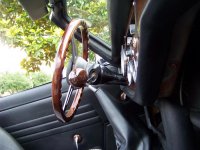
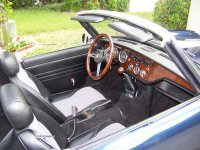
Pic 1 - Gluing it together Pic 2 - Adding some color Pic 3 - The finger groves Pic 4 - Matching dash, Steering wheel, Shift knob, and Escutcheons
This site uses cookies to help personalise content, tailor your experience and to keep you logged in if you register.
By continuing to use this site, you are consenting to our use of cookies.


 Hey Guest!