• Hey Guest!
    British Car Forum has been supporting enthusiasts for over 25 years by providing a great place to share our love for British cars. You can support our efforts by upgrading your membership for less than the dues of most car clubs. There are some perks with a member upgrade!

    **Upgrade Now**
    (PS: Upgraded members don't see this banner, nor will you see the Google ads that appear on the site.)
Tips
Tips

Steering Question

Crisis

Jedi Hopeful
Offline
Time to start thinking about my car again after a long winter, and I was reminded of a steering problem the car (73 TR6) had after I rebuilt the suspension etc. I replace all bushings, ball joints, trunnions, sway bar links, tie-rod ends etc. Before the work the steering wheel was perfectly centered-straight up and down. After the work, while driving straight down the road, the wheel would be slightly turned to the left. Not a big deal but now the spoke blocks the temp gauge ( the one I like to watch) and I have to move my head to read it. Like I said, no big deal as the car goes straight when hands taken off wheel. When I changed out the tie-rod ends I was carefull to not move the locking nut and I thought that would mean the exact same position would be achieved. Any thoughts? Do I still have correct alignment? How can I get that wheel straight again?
Thanks.
 
You could simply readjust each tie rod end by the same number of turns (probably only 1 or 2 at most). Or you could remove and replace the steering wheel. If you choose the latter, loosen, but don't REMOVE, the nut, then pull the wheel. It usually can be done while you pull on it and an assistant uses a suitable drift and hammer on the end of the column (which, for risk of damage to fragile threads, is why you don't remove the nut at this point).

R&R of the steering wheel does run the slight risk of the turn signal canceling cam now being slightly out of place and not always functioning ideally. I believe that cam can only go in two places, each 180 degrees from the other, so that can be a bit of a problem.
 
Thanks Andrew. I think I'll try adjusting the rods since that was how I put it out of line. Any idea which way to turn the ends? Only one or both equally? I'm guessing counter clockwise for the right (strictly a guess, never done it). Thanks.
 
Personally, I would want to check the toe-in first, and then adjust the tie rods to get straight tracking with the wheel straight ahead.

Obviously, your new tie rod ends were not exactly identical to the old ones or else something moved during the process of changing them. Either way, what are the odds that it didn't alter the toe-in? I wouldn't even have assumed it was correct before, since wear in tie rod ends usually changes it to some extent.
 
Are the toe-in specs listed in the manuals? I have the Haynes and the Bentley. I suppose an alignment shop could set the toe-in and adjust the tie-rods?
Thanks.
 
You need to be aware that toe-in is somewhat dependent on the type of tires that were specified.
But
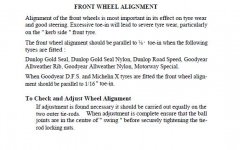
For standard front suspension set up the tracking for between parallel to 1/8" toe in. Q.E.D.

Also this from "Practical hints for the maintenance of the Triumph TR3", Instruction Book,Part #501528:
 

Attachments

  • 15783.jpg
    15783.jpg
    43.7 KB · Views: 113
Here is a link to a site with DIY instructions: https://www.skidmore.edu/~pdwyer/amc/align.htm

He is doing it on a Rambler, but the procedure is the same.

Do-It-Yourself Alignment Guide

By George Beasley


(From a posting to the AMC-List electronic mailing list, July 7, 1998)

For materials you’ll need a long string and a sheet of Masonite. Cut the Masonite into squares. Use two squares under each front wheel, polished side to polished side. This allows the wheels to move around and not bind up when you make adjustments.

Set camber, caster and toe-in in that order, because each affects the others in that order. With a power steering car, crank in as much positive caster as possible with the strut rods. Then, according to how sportingly you drive, you can set the camber.

Anchor the string at the back end of the car somewhere. The string needs to be at a height equal to the center of the axles and parallel to the side of the car. Make sure that it is parallel. Measure from the sidewalls of the rear tire to the string; it should be the same. Now you are ready to see what you’ve got.

You can check the camber now. Use a stick or a board 90 degrees to the ground (straight up) at the string. Measure from the top of the wheel to the stick and then from the bottom of the wheel to the stick. If there is a difference, it is camber. If the top of the wheel is closer to the stick, it’s positive camber. If the bottom is closer to the stick, it’s negative camber. By measuring the distances, you can mathematically calculate the degrees of camber. You adjust camber with the eccentric bolts on the inner end of the lower control arms.

At the front of the car, measure from the rear of the front tire sidewall to the string. Write that measurement down. Now, measure from the front sidewall to the string and write that measurement down. Compare the two measurements. (And you are going to have to do this to both sides of the car, so don’t get carried away on one side.) If the front measurement is greater than the rear measurement, you have toe-in. Some toe-in is good. There should be about 1/16” difference between the measurements. If there is a huge difference, that is probably your problem. You have to adjust the tie rods to make it change.

The tie rods, if it has been a long time since it had an alignment, will probably need to have their threaded parts well lubricated with WD-40 or some penetrating lubricant. Then the clamping bolts that hold the adjusting sleeves have to be loosened. Get things loosened to where you can rotate the sleeves with a pair of pliers or even your hands. Make your adjustments. Also check to see if something is bent under there. Alignments usually don’t change all by themselves. Anyway, do half of your adjusting on one side then go through the same procedures on the other side of the car and make what adjustments are necessary to get about 1/8” toe-in total for both sides.

Once you string your car, you may never go to an alignment shop again.

 
Back
Top