• Hi Guest!
    If you appreciate British Car Forum and our 25 years of supporting British car enthusiasts with technical and anicdotal information, collected from our thousands of great members, please support us with a low-cost subscription. You can become a supporting member for less than the dues of most car clubs.

    There are some perks with a member upgrade!
    **Upgrade Now**
    (PS: Subscribers don't see this gawd-aweful banner
Tips
Tips

TR2/3/3A starting scuttle repair

Frank Canale

Jedi Warrior
Country flag
Offline
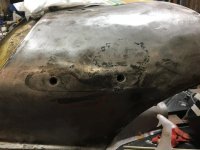
Time to start the scuttle repair. The PO was not very kind to this area.
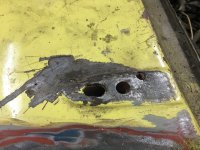
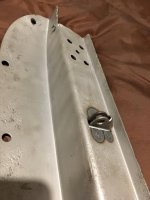
passenger plinth damage.jpg Passenger side raised plinth damage.

passenger side plinth support damage.jpg
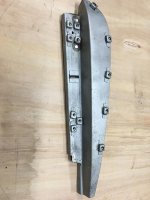
This is the plinth support bracket. It needed to be removed to do all the repairs.
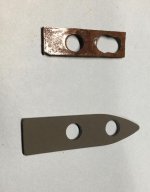
plinth filler  original and new filler piece (1).jpg
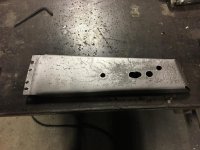
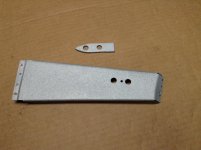
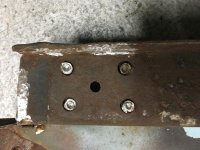
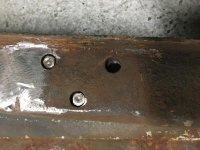
The raised plinth has a steel spacer between the plinth and the support bracket underneath. The spacer is 1/8" (.125") thick.
This shows the original and the one I made. I made the new one a little larger for additional support. Maybe I was over thinking this.
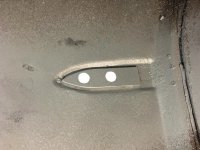
passenger side plinth reinforcement spot welded inside.jpg This picture is a little deceiving.This is the underside view. The new plinth spacer is plug welded in the recess of the plinth from above. This area has a coat of self etching primer and a coat of cold galvanizing primer before the support bracket gets welded in. Could not get rid of double picture.
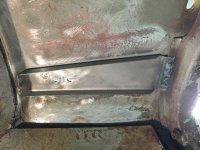
passenger side plinth reinforcement spot welded inside.jpgpassenger side scuttle support brace welded back in.jpg
The support bracket has been repaired and welded in. Between the bonnet hinge mounting holes is a plug weld to the plinth spacer just like the top side. Originally this was spot welded with a single spot weld between the mounting holes
I don't have a giant spot welder like they did so plug welds will do.
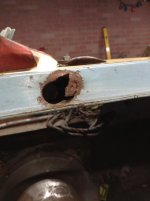
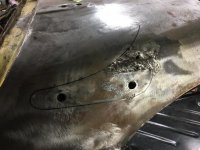
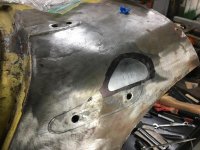
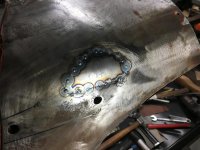
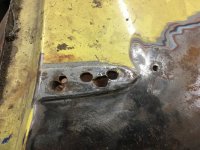
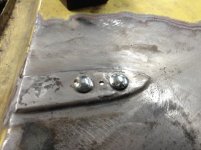
scuttle vent rod hole.jpg I got ahead of myself on this one. I needed to take a picture of the damage. The PO enlarged the scuttle vent rod hole with a chisel. I have no idea why. The damaged area has been pulled out. Access to the back side is limited to the hole behind the damage. the area was stretched so as I worked it back together I used a dremel cut off wheel to trim and work the pieces back together. Tack it together as it is worked back to the original shape. finish welded , hammered flat using a piece of rod from the back side to help flatten the area. The original hole needed a little filler metal welded to close up the hole diameter then used a rotary burr to bring it back to the correct size. blocked flat with some 100 grit sand paper and that is done. On to finishing driver side plinth repair today. Frank
 
Looking good Frank, when fiddling with one of those vents and the linkage, the destructive force made by the chisel is understandable. Many ways to turn the hands inside out there, it took me years, but now I put the linkage in by splitting the leakage into 2 piece half on each side then insert the clevis pin and snap ring at the center. Might drop a few snap rings, but with good plyers not too bad.

steve
 
driver plinth damage.jpg Driver side raised plinth damage.

driver plinth spacer plug weld.jpg Driver side raised plinth ready to plug weld spacer in place.

driver scuttle support bracket.jpg Driver side support bracket repaired.

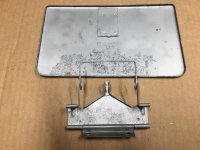
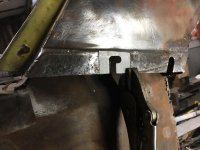
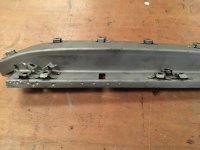
scuttle vent cover damage.jpg Scuttle vent cover with broken lift bracket.

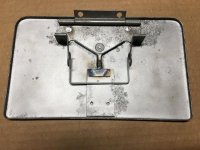
scuttle vent cover repaired.jpg scuttle vent cover repaired. Frank
 
I have been putting off the repair to the driver side of the scuttle. A lot of second or maybe third rate repair work. a lot of built up weld metal, areas ground paper thin, and then covered up with bondo. I knew it was bad so no surprises. All but one bolt had to be drilled to get the door hinges off long ago. The bottom hinge was welded in place. Removing the A post was done just like the passenger side. I decided to try a new drill bit to drill the spot welds that the side wall attaches to the A post. I used a Milwaukee red helix titanium drill bit. Size is 7/32 closest the Ace hardware had to 3/16 and I was surprised at how good it worked.The bit cost $6.00 and well worth it.

driver side A post damage.jpgDriver side A post damage.

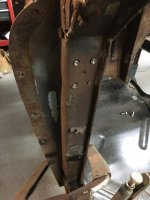
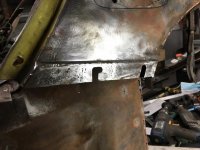
driver side lower scuttle damage.jpg Driver side lower scuttle damage. cracked from the middle of the back slot up to the radius and across to where the scuttle meets the A post. The front of the front slot has been ground paper thin.

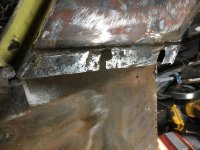
driver side lower scuttle repair at the back slot.jpg The crack at the rear slot has been welded and the paper thin area at the front slot has been removed. This is the process to decide the repair method for the front slot. I believe I am going to reproduce the entire slot and cut the entire slot out and weld in the repair piece.

driver side check strap damage.jpg Check strap bracket damage. This is spot welded in and will be removed. A new one that I have already made will be spot welded in.

driver side upper hinge bolts.jpg upper hinge nuts to be replaced
driver side lower hinge bolts.jpg lower hinge nuts to be replaced. The shiny area is where the lower hinge was welded to the A post. Frank


I found a lot of the spot welds holding the front of the scuttle to the fire wall had come apart so I drilled them out and plug welded them back together. I think this is where the condition scuttle shake originates from so its important this is area is secure. One other thing to look out for is where the rearview mirror mounts on the scuttle, I found when I went to refit the mirror that there were no captive nuts or threaded plate for the screws to thread into and I don't know what was in there originally whatever it was was long gone ?
I can't imagine what the previous owner of your beast was trying to achieve with the hinge mounts but you are getting on top of it good work.

Graham
 
Brings back memories...You start a new area and the thoughts are just, "Uuuhhgg". Then you get going one section at a time and it's done before you know it. You're doing great and we are enjoying following along!
 
Thank you John, sometimes I wonder if everybody gets tired of my post , welded patches on and on. Hopefully someone will find it useful working on their car as I have found your post and pictures very helpful.

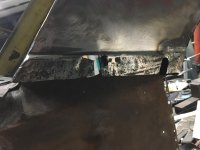
driver side lower scuttle repair.jpg Driver side lower scuttle. L shaped slot cut out and ready to be welded.

driver lower scuttle repaired.jpg Driver side welded and finished.

driver side A post cage nuts removed.jpg Driver side A post with cage nuts removed. To remove the 2 inner cage nuts at the top you have to drill out one spot weld on each one to get the nuts out. The inner one at the bottom can be gotten out with a little fiddling to get the flap opened up but it does not have to be drilled. The check strap bracket has been removed. 4 spot welds get drilled from the back side.

IMG_0149.jpg This is my favorite bracket to form up so far. It is a difficult bracket to form due to its shape. I formed the new brackets out of a little heavier sheet metal. This is a difficult bracket to replace once the car is finished. Hope i never have to replace these.

driver side A post check strap bracket.jpg Check strap bracket spot welded, good as new.

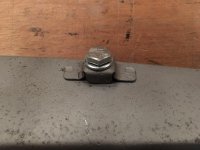
cage nut forming process.jpg This is how I close up the cage nuts. Once the nut is in the cage I thread a bolt and washer in from the back side and tighten the bolt up. this supports the back of the cage as the flap is hammered down slightly then you can finish forming the flap with a pair of vice grips to form the cage around the nut. One thing to mention that modern day nuts are not as big as they used to be. I made all my new nuts to match the size of the originals. The originals are 1/2" x 1/2" x .200" thick. I cut mine out of 1/2" square stainless bar then drilled and tapped them. It may have been over kill at first but has payed off being able to keep the original cages.

driver side A post repaired new cage nuts installed.jpg Driver side A post repaired and ready to go back on the car.

I have clamped the A post back in place and taken some time to re check some measurements, the front wings have been on and off a couple of more times. I thought I had a problem with the driver side wing. Front to back location is very good the vertical fit is a little snug at the bottom but the bottom mounting flange is new and with a little adjustment I think it will loosen up like the passenger side. All and all I am encouraged that things are lining up well enough that as it starts to be tacked and welded I will be able to make minor adjustments with out having to rework parts. Frank
 
Looking good. Very nice work on the "A" post.

I did find the cages you get from the usual suppliers need some work so the nuts will not fall out. Wish I had made my own nuts when I was at that stage. SS is a good choice and the Next rebuilder in 2050 will thank you.

David
 
Well done with the check strap bracket and the hinge mount captives, I purchased a replacement A pillar from Moss but I had to return it. It was so poorly made i couldn't even mount one hinge, no matter how hard I tried nothing would line up and the check strap mount didn't look anything like the original. I made a template for the check strap mount and repaired the rest of my original A pillar, keep up the good work

Graham
IMG_1867.jpg
 
Thank you, Graham. I thought it would be easy, I did exactly what you did. Flattened the original cut out a blank and then realized it is hard to hold and form. I struggled with the first one and wasn't happy with it so I made a forming die and made for good parts. Nice that you have included the dimensions for others to use in the future. Frank
 
If I had to do it again...I would go to you for the parts. I swear you are fabbing them from scrap much better than what is available out there! Also impressed with your speed. Once you get to work you really crank.
 
Just to be clear I did not remake the A post. I bead blasted the original removed the old rusted nuts replaced the nuts and replaced the check strap bracket that I already had made from the passenger side repair, so I had a little practice and this side has gone better. I have a scribe line on the A post and the spot welds that were drilled out to get the A post back in place and seems to line right back up. Making the decision to start cutting ids the hard part once the decision is made it goes pretty good. Frank
 
I understand...I was mainly impressed by the door strap brackets. As with all your parts, works of art.
 
Frank nice bead blasting, what brand beads do you use in your bead blaster? Around here sand has become a problem to get. They only sell marble sand and that is abrasive; it seems the little chunks are different
 
Great work Frank...and don’t worry about posting too much stuff....we can’t get enough :wink-new:

Cheers,
Tush
 
Thanks Steve, It is harbor freight 80 grit glass beads, I don't really know what grit it is now because it is several years old and is sifted from time to time and is very fine. I don't use it for heavy rusted pieces because it is very slow but it leaves a very nice finish on painted pieces or parts with surface rust. I have a bag of black diamond coal slag that I got from tractor supply that i plan to use in a portable blaster to clean the rust from the rear closing area once the weather gets better. I plan on doing that outside then a coat of epoxy primer before closing that area in. Frank
 
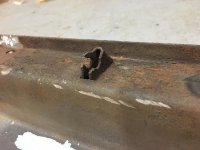
5D3E53E5-D365-462F-8278-139BAE91F37F.jpg Driver side scuttle damage.

15CEF6C1-847B-4D24-A957-6D1170D4F85B.jpg Damage cut out, repair patch fitted ready to tack in place.

310EAD4D-43EA-4336-A39A-86976B060BA2.jpg Patch tacked ready to weld and finish.

AA250286-F518-4B1D-899A-6F6336D6B661.jpg Patch welded and finished. Still a little bit of hammer and dolly work as the repair is a touch low and will need to be stretched to raise it. This is slow because access is very limited to the back side. I had to make a dolly out of 1/4” bar to reach in between the scuttle and inner side wall. Frank
 
sometimes I wonder if everybody gets tired of my post , welded patches on and on. Hopefully someone will find it useful working on their car

I am another one who is watching with great interest, as the bottom 6 inches or so of my car can best be described as "ghastly". A PO made extensive use of fiberglass, plywood(!), and slapped-on bits of galvanized sheet metal. Rusted sills covered up and reinforced with angle iron. Frame covered in buzzed-on patches. Probably best to consider it a parts car although I do enjoy metal work and plan to get into it someday and I'm sure I will be poring over your posts when that time comes.

And in fairness to whoever did the work, it looks OK if you don't get too close, and I've been driving for 25 years without any real problems, knock on wood (which is in the footwells).
 
I think I had to pull back the inside to reach some of that area. You did great with limited access.
 
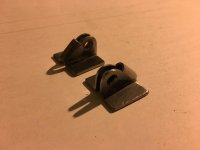
If there is any interest, I have a batch of freshly cut bits to build new lever mechanisms for the scuttle lift(assembly required).
As these are no longer available, DIY is an option
MD(mad dog)
 
Back
Top