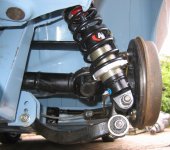
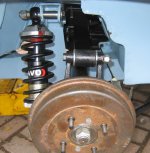
Adam,
The chroming process causes hydrogen embrittlement. Do what you want. It's your car. It's your life. I just don't advocate chroming springs. It's a bad idea. Here's some more info from the NHRA website.
Racing Technology
All that glitters
by Wayne Scraba
If you have considered chroming a bunch of parts on your race car, give this some thought: Chrome plate may be hazardous to a racer's health.
Almost any metal can be chrome plated, and that includes antique "pot metal," common carbon steel, even aluminum. Prior to plating, the metal must be completely cleaned. In most cases, this involves immersion in a hot alkaline solution. Components that were previously plated, such as bumpers, have to be "unplated" — a process that involves immersion in a tank containing sulfuric acid. Direct current is applied, and the old plate is drawn into a lead cathode. If the part is rusty, it's placed in a tank containing hydrochloric acid, sometimes referred to as the "acid pickling" tank. Unfortunately, the extensive use of corrosive and caustic chemicals can have a drastic effect on diecast components. If handled without care, they simply disappear into the acid bath.
Following the various stripping processes, the component is buffed. The buffing procedure smoothes the surface, removing high and low spots and giving the surface a high luster or sheen. This is the key to good chrome plating; if the buffing job lacks detail, so will the final chrome plate.
After the buff job, the component is copper plated, or, more properly, copper "electro-plated." The part requiring plating is centered in a special tank that contains a mixture of cuprous cyanide, sodium cyanide, and sodium thiosulfate. Heated to precisely 104 degrees Fahrenheit, the tank is charged with DC current. Depending on the construction or condition of the part, it must remain in this environment for approximately 20 minutes (longer if it is heavily pitted or previously corroded). The part is then removed from the tank, completely rinsed, and repolished. The buffing or polishing stage is critical. If the finish is not perfect, the final product will be flawed.
The nickel-plate job
The next stop for the part is the nickel tank, where it will spend approximately 30 minutes. The most common bath, called Watts Composition, is a mixture of nickel chloride, nickel sulfate, boric acid, and other small composites. Repolishing is not necessary and is usually not possible at this stage because the nickel plate is very thin (about .001-inch). The part is rinsed and readied for a final bath in the chrome tank.
Generally, the part will look perfect after leaving the nickel tank. The use of chrome is only for protection; it prevents the nickel from tarnishing. The chemical solution in the chrome tank includes sulfuric acid and chromic acid — another not-so-pleasant combination! The final chrome plate is extremely thin (approximately 40-millionths of an inch), but, as mentioned, it is necessary to prevent the nickel plate from tarnishing.
The decorative-plating dilemma
Unfortunately, all is not bliss with chrome plate, and this is particularly important when it comes to race cars. Decorative chroming creates a by-product called hydrogen embrittlement. Due to the use of various forms of acid during the cleaning stages of chrome plating, a hydrogen by-product is released into the tank which is then absorbed by the metal part being cleaned. Additionally, some theories regarding the problem revolve around the electrolytic process. When a current is applied to a parent metal, it too can create brittleness. As the name implies, hydrogen embrittlement causes the parent metal to become brittle, and eventually it can crack under stress.
Heat treating
Some methods of heat treating lessen the chance of hydrogen embrittlement, but they are only Band-Aid fixes. The most common heat-treating process involves baking the chrome-plated part in a special oven at approximately 375 to 400 F for a predetermined time. Theory has it that the heat pulls the free hydrogen atoms from the metal pores, reducing the chance of embrittlement.
With this in mind, it becomes very clear that chrome plating of load-bearing members isn't too desirable. Springs, stressed suspension components, steering parts, and so on should never be chrome plated. Leave the suspension flash to the modified show cars and consider spending your hard-earned dollars on other areas of the race car.
An inexpensive alternative
If you need some form of tough external protection for various pieces on your race car, consider powder coating. Powder coating, which involves the use of special plastic or epoxy powders that are sprayed onto a subject component with a special spray gun, is a good example of aerospace technology trickling down to the auto enthusiast. As the powder is discharged through the spray gun, it receives a positive electrical charge. The part is given a negative charge, or grounded. Once applied with the powder coat, it is baked in a proprietary oven at 300 to 400 F for approximately 25 minutes so that the powder solidifies.
Obviously, the part must be spotless prior to the powder coat. Stripping it with Redi-Strip, sandblasting, or glass beading will produce a squeaky-clean surface for the powder to adhere to.
The strength factor
The real beauty of powder coating is its inherent durability. With the exception of brake fluid, powder coatings are pretty much impervious to automotive chemical spills. They resist stone chip damage and are considered bullet proof. The only drawback to powder coating is that it cannot be used on a part that will not withstand the baking process. Anything else is fair game. Just remember that the baking process can distort certain critical machined surfaces, so those items may have to be remachined after powder coating.
In terms of color, powder coating is available in a full spectrum, likely extending into the thousands. Custom-mixed colors, including candies, can be made for color-coordinating powder coating with your existing paint scheme or having various chassis and accessory components coated to match factory colors.
You get what you pay for
Just as you would when choosing a painter to spray the finish on your race car, carefully select the outfit that does your powder coating. Some shops skip a few critical steps, like the various chemical baths necessary before the coating. Leaving out a step or two makes for a quicker turnaround; it also makes the coating job more vulnerable to chipping and flaking.
Another point to consider is the finished product. I've found that some powder-coating jobs have plenty of orange peel. Usually it boils down to the integrity of the shop.

 Hi Guest!

 Hey - did you know if you click on the title of a thread it will take you to the first unread post since you last visited that thread?
 but were afraid to ask:
  STOP!! Never post your email address in open forums. Bots can "harvest" your email! If you must share your email use a Private Message or use the
  smilie in place of the real @
 Pretty Please - add it to our Events forum(s) and add to the calendar! >>