 but were afraid to ask:
 First the good news. I didn't have a missing spoke - just a bent one. A few light taps with a hammer and the problem was cured. Now the bad news. I started the TR6 for the first time in about a week and it started fine and suddenly developed a severe problem, shaking and running on maybe 2 cylinders - or at least it seemed that way, idling like a Harley. It was also making loud noises from the valve train. I checked all the usual suspects; coil, replaced the condenser, points regapped, timing fine & plenty of gas. I pulled the valve cover and watched the valves do their thing - all seemed normal, no broken springs or broken rockers. This is the first real problem I've had in 17 years of owning this car. Maybe I was overdue for some trouble. It ran like a top last week when I took it out to check the new Michelins. Any ideas what this might be? Anything I overlooked?


-
 Hey Guest!
British Car Forum has been supporting enthusiasts for over 25 years by providing a great place to share our love for British cars. You can support our efforts by upgrading your membership for less than the dues of most car clubs. There are some perks with a member upgrade!**Upgrade Now**
(PS: Upgraded members don't see this banner, nor will you see the Google ads that appear on the site.)

Tips
- We have a special forum called "Member Articles" where you can submit actual articles for consideration for publication. Learn More
- Don't have an Avatar? If not, your avatar will default to the 1st character in your username. Go into "Account Details" to change your Avatar.
- Some basic forum navigation info: click
 Hey - did you know if you click on the title of a thread it will take you to the first unread post since you last visited that thread?
- Hey Guest - Is your British Car Club in our Clubs database? If not, send me a PM - Basil

- Looking for a local club? Click the "Clubs" tab above and browse hundreds of clubs world-wide.
- Add Android or iPhone APP: click
- Did you know - any picture or video you add in your posts in any marque-specific forum will also get added to the Media Gallery automatically.
- A few more tips about posting and replying: click
- Hey there Guest - be sure to keep your profile page up to date with interesting info about yourself: learn more
- More tips and tricks on Posting and Replying: click
 STOP!! Never post your email address in open forums. Bots can "harvest" your email! If you must share your email use a Private Message or use the
  smilie in place of the real @
- Want to mention another member in a post & get their attention? WATCH THIS

- So, you created a "Group" here at BCF and would like to invite other members to join? Watch this!
- Hey Guest - A post a day keeps Basil from visiting you in the small hours and putting a bat up your nightdress!
- Hey Guest - do you know of an upcoming British car event?
 Pretty Please - add it to our Events forum(s) and add to the calendar! >> Here's How <<
- Hey Guest - you be stylin' Change the look and feel of the forum to fit your taste. Check it out
- If you run across an inappropriate post, for example a post that breaks our rules or looks like it might be spam, you can report the post to the moderators: Learn More
- If you would like to try some different "looks" or styles for the site, scroll to the very bottom, on the left and click the Style Selector.
You are using an out of date browser. It may not display this or other websites correctly.
You should upgrade or use an alternative browser.
You should upgrade or use an alternative browser.
Sick engine
- Thread starter pdplot
- Start date


Offline
Hi PD - so it ran fine until you left it a week ago. Then today it starts fine, but immediately goes into disaster mode.
And you didn't touch the car over that week, right?
I'm thinking crud in fuel line and/or carb(s), and/or loose wire(s) at the coil and/or distributor.
Tom
And you didn't touch the car over that week, right?
I'm thinking crud in fuel line and/or carb(s), and/or loose wire(s) at the coil and/or distributor.
Tom

Geo Hahn
Yoda

Offline
First...suddenly developed a severe problem, shaking and running on maybe 2 cylinders...
I would verify that both carbs are getting fuel. One quick test is to feel the temperature of the exhaust manifold soon after start up -- if one end (2 cylinders) are still pretty cold when the other end (2 cyl) are getting warm that would be a clue.

go_inbroke
Senior Member
Offline
I agree with Geo Hahn....sounds like fuel delivery. I had a similar issue a few years back. Removed the tops of the float bowls, cleaned the needles, and off I went.
Geo Hahn
Yoda
Offline
...if one end (2 cylinders) are still pretty cold when the other end (2 cyl) are getting warm that would be a clue.
Of course if this is one of those rare TR6s with 6 cylinders then you may read '3' and '3' into the above.
I guess I just can't deal with more than 4 cylinders at a time.
I'm leaning towards a fuel problem - perhaps one carb is not producing so its running on 3. When I get a minute (I'm still working at age 79 1/2) I'll disconnect the front 3 plugs then the rear 3 and see what gives. I hope that's the problem and not a valve/camshaft issue and that the valve noise I heard was due to dead cylinders. Eventually the head will have to come off to replace the valve guides and install new seats.

Here's the latest. I took a compression test. 125, 120, 0!, 115, 100 & 125. Last Fall, all cylinders were between 165 & 170. Cylinder no. 3 was dead. No compression at all. Dipstick clear - no sign of oil & water mixing so head gasket is probably ok. OK guys - I know the head will have to come off - what do you think I'll find?
Offline
Glad you found the problem! But wouldn't that spring have caused problems at the end of that "check the Michelins" run last week? especially if you hadn't driven it since then. Can't see a valve spring breaking while the car was sitting.
Thanks for keeping us in the loop.
Tom
Thanks for keeping us in the loop.
Tom
I think it broke just after startup. It started normally after the usual bit of cranking, ran normally for about 10 seconds then went sour and making noise. I can't believe one dead cylinder could cause it to run so badly. And - I'm concerned about the lower compression readings in all the other cylinders. I'll pour some oil into the spark plug holes and see if the compression increases. I've always had great compression in this engine but since this car is now almost half as old as I am, s**t happens I suppose. And - in the 103K plus miles this car has covered in those 42 years, I don't think the head has ever been off it which will make removal a tough job and I'll stock up on extra penetrating oil. Wish me luck.
From my little understanding, you need a special tool and you must keep the valve from falling into the cylinder when the keepers are removed. Some say stuff rope into the cylinder, others say compressed air. If any of you experts out there want to give me some further advice, I'm open and ready. If one broke, are the others ready to go too? And - is valve number 5 an exhaust or intake? Most engines I've worked on are exhaust-intake-intake-exhaust. One more thing. My Bentley manual has a huge error. It's telling me on two separate pages to make EIGHT holes in a piece of cardboard for the EIGHT pushrods. Last time I looked, there were 12. Doesn't give me a whole lotta confidence.


Offline
The Bentley people probably modified the TR4 manual for the tr6 which would create that twelve vs 8 pushrod error... If you are just replacing the broken valve spring, I wouldn't worry about removing the pushrods. Just remove the whole rocker arm assembly, leave the pushrods in their holes. I would make sure the piston is at the top in the cylinder you are working on, the valve shouldn't drop far enough to cause a problem, but stuffing some thin rope into the spark plug whole sounds like a reasonable idea if you are still worried... And lastly, there is really no way to tell if all the other springs are ready to go to. I know some folks would replace all of them as a precaution, me, I would just replace the offender.
Ok PD, here is a home made valve spring compressor. Basically just a piece of flat bar approx. 10"Lx1"Wx3/8"T drilled to fit over the rocker pedestal studs and provides an anchor to pry against. The other piece is used like a pry bar to compress the spring. Two square shank screwdrivers would also work, but an extra set of hands might be needed. In use, I start by removing the rocker assembly, install the flat bar over the ped. studs, install a couple feet of clean 1/4" poly rope in the cyl, and bring the piston up against the rope to hold the valves in place. Place the 2nd piece or screwdrivers under the flat bar and push down to compress the spring and release the keepers with a magnetic pickup tool. I should also add that all openings in the head should be covered to prevent the keepers or other bits from finding their way into the sump. I keep this tool in the car along with an extra valve spring and could probably change a spring on the road,if needed. Most likely, it will never see action. If you can't find or make one, I would be happy to send it to you. Berry
Attachments
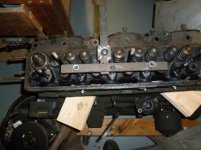
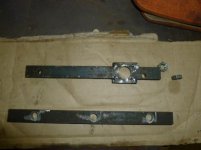
Wow - I'm impressed. Very ingenious tool. Thanks for your generous offer. But the die is cast. The head is coming off. I'm concerned about that low compression. The valves may be burnt or the seats damaged from years of E-10 no lead.And - the guides are definitely worn as well since I get some smoke on the overrun. My expert friend Randy will help me pull the head next weekend after I finish stripping off the parts and draining the coolant. My days of heavy lifting are over. Looks like I have a date with some penetrating oil. I'll report my progress as I go. Any sugggestions are welcomed.
Worked almost 4 hours today. Drained coolant,removed hoses, pulled water pump housing, removed rocker shaft & pushrods, sticking them into holes punched in cardboard, disconnected battery and removed all nuts and bolts except for a few manifold nuts that I had trouble getting to. I marked all nuts & bolts & put them in plastic bags - not like my usual repair jobs from years back where I was always left with a leftover nut or two. Only problem was one stripped heater hose clamp that I had to cut off with a cutting wheel on my ancient Craftsman 1/4" drill with the shot bearings. I also squirted liberal amounts of penetrating oil on all head studs awaiting my friend who will take off the remaining manifold nuts and then pull the head. I plan to replace all the valve springs, valve seats and guides. I also will need a new head gasket and a couple of replacement bolts and nuts that were corroded. Anything else you think I need to get?

PeterK
Yoda
Offline
Trouble I see coming is that after you tighten up the head, the bottom end might revolt. Think about changing the rings? ohoh here it comes.. might as well slip some new bearings in while your there. How the end float? Need thrust washers too? Don't forget the oil pump. . . . .

hondo402000
Darth Vader
Offline
dont even think about putting new rings in a 103K mile engine, problem is the bores wear to an oval shape and the new rings will be round and so the rings wont seat, so its leave them alone or pull the engine and bore it out and new pistons and rings, Then you will be at a doing a total rebuild. best just to do a valve job and new springs,
if you have trouble getting the head off, work some rope in the bores and rotate the engine and it will help push the head off
if you have trouble getting the head off, work some rope in the bores and rotate the engine and it will help push the head off