• Hey Guest!
    British Car Forum has been supporting enthusiasts for over 25 years by providing a great place to share our love for British cars. You can support our efforts by upgrading your membership for less than the dues of most car clubs. There are some perks with a member upgrade!

    **Upgrade Now**
    (PS: Upgraded members don't see this banner, nor will you see the Google ads that appear on the site.)
Tips
Tips

Rubber eating monster

M

Member 10617

Guest
Guest
Offline
I met another one today: a British car owner whose rubber hoses are being eaten by ethanol fuel. I don't think a week has gone by recently that I haven't met someone or serveral people whose cars (even older American cars) are leaking fuel because of rubber hoses being eaten by ethanol. And that doesn't even count those whose rubber diaphrams in their fuel pumps are being destroyed.

And now there is talk of going from 10% ethanol to 15%!

Is there anything that can be added to ethanol fuel to cut down on this destruction?

Fortunately, there are a couple of gas stations hereabouts that sell ethanol-free gas for stret use, but for how long no one knows.
 
LexTR3 said:
Is there anything that can be added to ethanol fuel to cut down on this destruction?
Nope, not really.

However, I'd like to point out that it is good practice to replace all soft lines at least every 10 years or so (including fuel, brake, etc.) and any new lines sold in the past 15 years or so should be ethanol-resistant.

Here in CA we went through all this about 15 years ago, because MTBE does the same thing (and most of CA was mandated to use either MTBE or ethanol in 1996). Biggest pain IMO was fuel pump diaphragms as it took several years for all the diaphragms to have nitrile rubber.
 
I have heard many good things about "Star-Tron" by Star-Bright. It is an enzyme fuel additive that claims to take care of ethanol problems. I have no personal experience, as I haven't been able to source it locally yet, but many of the guys on the small engines forum have had very good luck. They deal with similar problems. Older rubber parts, diaphragms,and fuel sitting for extended periods.
Looks to be sold at marinas and other boat places.
 
Go figure, Iowa has by far the largest production of ethanol by state (sorry, so very very sorry.) I go to the nearest station and like most can get regular 87, ethanol 89 or premium 91.
 
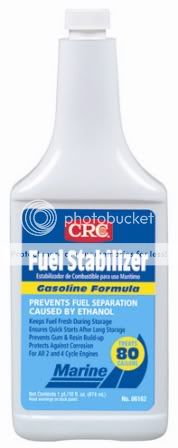
The CRC people have what we found to be the best formula to keep the ethanol mixed for storage, or left in less often used vehicles for up to twelve months. The ethanol will settle out of a stationary supply of gasoline in as short as a weeks time.
06162_2.jpg

two sizes available, both are concentrated, one(1) oz treats five (5) gallons of gas.
CRC06161.jpg

Increasing the dosage will not strengthen or extent its effective lifespan.
They also make a product called Phase Guard, and we do not have enough feedback on this to recommend it over the Marine formula fuel stabilizer.
PG4-homepage.jpg

Keeping the ethanol mixed is key, the ethanol settles down in the tank and that almost full strength ethanol is what does the damage to fuel lines, filters, and other than metal tanks.There is an ongoing test at the bike shop down the street, treated last summer and still mixed.
 
jsfbond said:
The CRC people have what we found to be the best formula to keep the ethanol mixed for storage, or left in less often used vehicles for up to twelve months. <span style="color: #FF0000"> The ethanol will settle out of a stationary supply of gasoline in as short as a weeks time.</span>
06162_2.jpg

two sizes available, both are concentrated, one(1) oz treats five (5) gallons of gas.
CRC06161.jpg

Increasing the dosage will not strengthen or extent its effective lifespan.
They also make a product called Phase Guard, and we do not have enough feedback on this to recommend it over the Marine formula fuel stabilizer.
PG4-homepage.jpg

Keeping the ethanol mixed is key, the ethanol settles down in the tank and that almost full strength ethanol is what does the damage to fuel lines, filters, and other than metal tanks.There is an ongoing test at the bike shop down the street, treated last summer and still mixed.

<span style="color: #FF0000"><span style="font-size: 11pt">Does that mean we can drain the ethanol off with a bottom tap on the storage tank? </span></span> Hmmmm. :devilgrin:
 
As I understand it, none of these treatments will stop the ethanol from
attacking older rubber hoses. The treatments simply keep the ethanol in
suspension and prevent phase separation from happening.

The better of the products will do what they are supposed to do well, but
won't help with rubber deterioration.
 
My guys believe the gasoline formulation was compromised to accept the ethanol etc. Draining off the ethanol from the bottom of a settled supply may leave you with something that will not detonate???? I think one of you sharp cookies should "seperate" some and see what it does in the snow blower...maybe get your affairs in order, just in case.
 
jsfbond said:
Draining off the ethanol from the bottom of a settled supply may leave you with something that will not detonate????
Or maybe something that <span style="font-weight: bold">will</span> detonate (detonation being a Bad Thing).

BTW, the ethanol separates because there is too much water; some of that water/ethanol will also be in the tank outlet. Seems a lot easier to me to just change the dang lines and be done with it.

Oh, and in a sealed system, it should take a lot longer for the ethanol to absorb enough water to separate. Just keep your fuel dry and separation shouldn't be a problem either.
 
This may not be practical for automotive use, but is used by some aircraft owners.

Some aircraft are allowed to use auto gas only if it is free from ethanol. Owners will put auto gas in a barrel with water. Ethanol has an affinity for water and will mix with it. They let the mixture sit overnight and then CAREFULLY pour the gasoline off the top. The can't use The Randall's suggestion to change the lines.

Might be practical for the antique gas engine guys, too.
 
TR3driver said:
BTW, the ethanol separates because there is too much water; some of that water/ethanol will also be in the tank outlet. Seems a lot easier to me to just change the dang lines and be done with it.
Correct. And, yes, It would be very advisable where practical to replace all rubber fuel system components with modern, ethanol tolerant versions. although that is not always easily done.

TR3driver said:
Oh, and in a sealed system, it should take a lot longer for the ethanol to absorb enough water to separate. Just keep your fuel dry and separation shouldn't be a problem either.

Ahh yes. But if your LBC is older than the smog regulations, then it is not a sealed system. Your TR3 for instance, unless it's been modified, has an open vent tube on the fuel tank. And saying "just keep your fuel dry" is akin to saying "just keep away from heavy objects during an earthquake".
Yes, that's what we need to do, but it's not always that simple.
 
Banjo said:
Your TR3 for instance, unless it's been modified,
Very sophisticated modification ... a golf tee driven into the vent line :laugh:
 
One vunerable rubber hose is the fuel tank overflow hose attached to the overflow pipe. Has anyone had experience replacing this with an ethanol resistant hose? If so, can it be done without taking the whole rear end apart to get to the clamp?
 
Do you mean the hose on the filler neck? The original "overflow" pipe is steel.

Replacing the hose on the filler neck is not easy with the early style filler neck (much easier with the later styles). But it can be done. It's been awhile, but ISTR I had to cut the old one in half to get it out, and then shorten the new one to get it into place.
 
Hi, Randall,

I am referring to the rubber hose that attaches to the vent pipe. It appears to extend from somewhere near the top of the gastank to a point near the rear axel, where any gas that seeps out falls to the ground. I assume it is attached to the vent pipe with a clip of some sort.
 
As far as I know, the vent pipe on a TR2-3B was originally all metal, from the banjo fitting on top of the tank, through the floor, a clip on the RH frame rail and hanging slightly below the frame.

But mine is literally plugged with a golf tee, as otherwise it dumps liquid fuel on the road in hard left turns.
 
Randall. Mine may have been metal all the way to the floor at one time, but now the bottom portion is a rubber tube/hose hanging down. Some modification by a previous owner, I suspect.
 
Back
Top