• Hey Guest!
    British Car Forum has been supporting enthusiasts for over 25 years by providing a great place to share our love for British cars. You can support our efforts by upgrading your membership for less than the dues of most car clubs. There are some perks with a member upgrade!

    **Upgrade Now**
    (PS: Upgraded members don't see this banner, nor will you see the Google ads that appear on the site.)
Tips
Tips

Repair Panels

Alphabet

Freshman Member
Country flag
Offline
So I’ve got a ‘66 BJ8 that is all there, as far as can tell. I bought it as a "project car." I was told the engine turns over but doesn’t run.

From 20 feet away it looks great, but closer up I can see that the lower portions of the right rear wing have some body filler that’s been added. This was to be expected as I’m aware of the problem with rust in the lower quarter panels. From the start I figured on building a rotisserie to be able to access everything.

So with all that said, the other night I was perusing the different body panel parts suppliers and noticed that the body patch panels come with or without a wired edge. I’ve never taken apart an original panel so I don’t know if they came with them or not. It also makes me question why there would be two different types. Is one bettter than the other, and why?

Any and all comments are welcome! TIA.
 
I believe the wired edge is how the cars came from the factory. It provides a stiffer, more rounded finish around the wheel opening. If I had a choice, I'd opt for the wired edge.
 
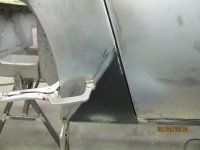
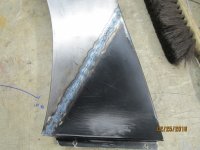
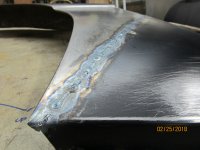
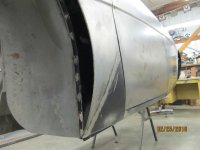
All wheel openings have wired edges to stiffen them and give a nicer visual - anything else would not look right. The option of with or without wired edges is to tailor the cost of the parts to what you need for any given repair. If you can cut away the rusted metal without cutting thru a wired edge, the degree of difficulty in welding a patch panel is exponentially easier. Picture of a rear fender dog leg where it was possible to leave the wired edge undisturbed (I did not need a wired edge on the patch panel therefore it was both much cheaper and much easier to weld).
 

Attachments

  • IMG_0988.JPG
    IMG_0988.JPG
    1.8 MB · Views: 87
  • IMG_0997.JPG
    IMG_0997.JPG
    2 MB · Views: 89
  • IMG_1000.JPG
    IMG_1000.JPG
    2.2 MB · Views: 86
  • IMG_1007.JPG
    IMG_1007.JPG
    1.8 MB · Views: 82
All wheel openings have wired edges to stiffen them and give a nicer visual - anything else would not look right. The option of with or without wired edges is to tailor the cost of the parts to what you need for any given repair. If you can cut away the rusted metal without cutting thru a wired edge, the degree of difficulty in welding a patch panel is exponentially easier. Picture of a rear fender dog leg where it was possible to leave the wired edge undisturbed (I did not need a wired edge on the patch panel therefore it was both much cheaper and much easier to weld).
Thank you so much for the pictures and the explanation - I hadn’t considered a repair that didn’t include the whole width of the panel - after looking at your repair my hope is that I’ll be able to do the same thing ( fingers crossed ! )
 
Thank you so much for the pictures and the explanation - I hadn’t considered a repair that didn’t include the whole width of the panel - after looking at your repair my hope is that I’ll be able to do the same thing ( fingers crossed ! )
Another follow up question would be; if the whole width needs replacing is it best to try and insert some of the wire from the patch panel up into the original panel for support ?
 
Hello Red 57. I see your very nice weldings. Congratulations ! I am begining a BN2 restoration, and my weldings are very different from yours. I'm not a very skilled welder, and I use to just do some points, to avoid making holes. And finally making all the points a continuous line. I think I have to lower the MIG wire speed to have a thinner weld a,d avoid too much grinding. But my question is : is it better to weld edge to edge, or with a swage libe and overlap ? I choose edge to edge up to now because final result is nicer, but wuld it be more resistant with an overlap ?
Thank you by advance for your advice.
 
Red's welds looks like they were done with a TIG welder. You don't have to use filler material like a MIG, so the welds can be more flush to the surface. You can get that kind of weld with gas too. All this to say, if you MIG, you will be grinding.
 
Hi dblmtr, Greg is right, those are TIG welds, and the two advantages are controlling the heat and minimal filler. I used 3 or 4 stitch welds to keep the panels aligned and then a series of short welds that were backstepped. Stitch welding and backstepping are ways to minimize heat in a panel to control distortion (google for examples). After welding grind the welds down to smooth and then planish (slapper and dolly) to stress relieve and help the panel stay flat.

Grinding the weld down can add a lot of heat too and one trick to avoid heating the panel when grinding welds is to use a 4 1/2" grinder with a 1/16" cut off wheel held perpendicular to the panel, moving back & forth lightly so just the edge of the cut off wheel is in contact with the weld.

I do not recommend MIG welding for body sheet metal. Another common term for MIG is "wire feed" and in order to push the wire thru the tip and to the work surface, the wire has to ne a fairly hard steel. This leaved a very hard and brittle weld that is resistant to straigheneing after the warpage of welding - prone to cracking and generally difficult to work. Oxyacetylene and TIG don't need the hard wire so you can use a much softer filler material that is much easier to planish smooth. I have done some of this by oxyacetylene but the heat affected zone is much larger and the chance for warpage is greater.

Another way to reduce warpage is to try for as uniform a heat affected zone (HAZ) as possible - if you look at my picture you can see the outer edges of the HAZ are close to parallel. If you have one area with a much wider HAZ and another area with much narrower HAZ, you will suffer more warpage and therefore more hammer and dolly time to flatten.

I'm no expert or professional although I've welded a lot over my life. I was new to sheet metal/body repairs when I started my restoration 12 years ago (only took me 10 to complete) and I spent lot of time reading blogs and watching utube videos. Since I also had a bunch of aluminum repairs to do, I bought a TIG and self-taught myself with the aid of the internet. Feel free to PM if I can help more.
Dave
 
Thank you very much Greg and Dave ! I will think about it and will not hesitate to come back to you if needed.
Christophe
 
Back
Top