

-
 Hey Guest!
British Car Forum has been supporting enthusiasts for over 25 years by providing a great place to share our love for British cars. You can support our efforts by upgrading your membership for less than the dues of most car clubs. There are some perks with a member upgrade!**Upgrade Now**
(PS: Upgraded members don't see this banner, nor will you see the Google ads that appear on the site.)

Tips
- We have a special forum called "Member Articles" where you can submit actual articles for consideration for publication. Learn More
- Don't have an Avatar? If not, your avatar will default to the 1st character in your username. Go into "Account Details" to change your Avatar.
- Some basic forum navigation info: click
 Hey - did you know if you click on the title of a thread it will take you to the first unread post since you last visited that thread?
- Hey Guest - Is your British Car Club in our Clubs database? If not, send me a PM - Basil

- Looking for a local club? Click the "Clubs" tab above and browse hundreds of clubs world-wide.
- Add Android or iPhone APP: click
- Did you know - any picture or video you add in your posts in any marque-specific forum will also get added to the Media Gallery automatically.
- A few more tips about posting and replying: click
- Hey there Guest - be sure to keep your profile page up to date with interesting info about yourself: learn more
- More tips and tricks on Posting and Replying: click
 but were afraid to ask:
  STOP!! Never post your email address in open forums. Bots can "harvest" your email! If you must share your email use a Private Message or use the
  smilie in place of the real @
- Want to mention another member in a post & get their attention? WATCH THIS

- So, you created a "Group" here at BCF and would like to invite other members to join? Watch this!
- Hey Guest - A post a day keeps Basil from visiting you in the small hours and putting a bat up your nightdress!
- Hey Guest - do you know of an upcoming British car event?
 Pretty Please - add it to our Events forum(s) and add to the calendar! >> Here's How <<
- Hey Guest - you be stylin' Change the look and feel of the forum to fit your taste. Check it out
- If you run across an inappropriate post, for example a post that breaks our rules or looks like it might be spam, you can report the post to the moderators: Learn More
- If you would like to try some different "looks" or styles for the site, scroll to the very bottom, on the left and click the Style Selector.
You are using an out of date browser. It may not display this or other websites correctly.
You should upgrade or use an alternative browser.
You should upgrade or use an alternative browser.
TR2/3/3A Rebuild generator or go w/ alternator for TR3a
- Thread starter tdskip
- Start date

D
DougF
Guest
Guest
Offline
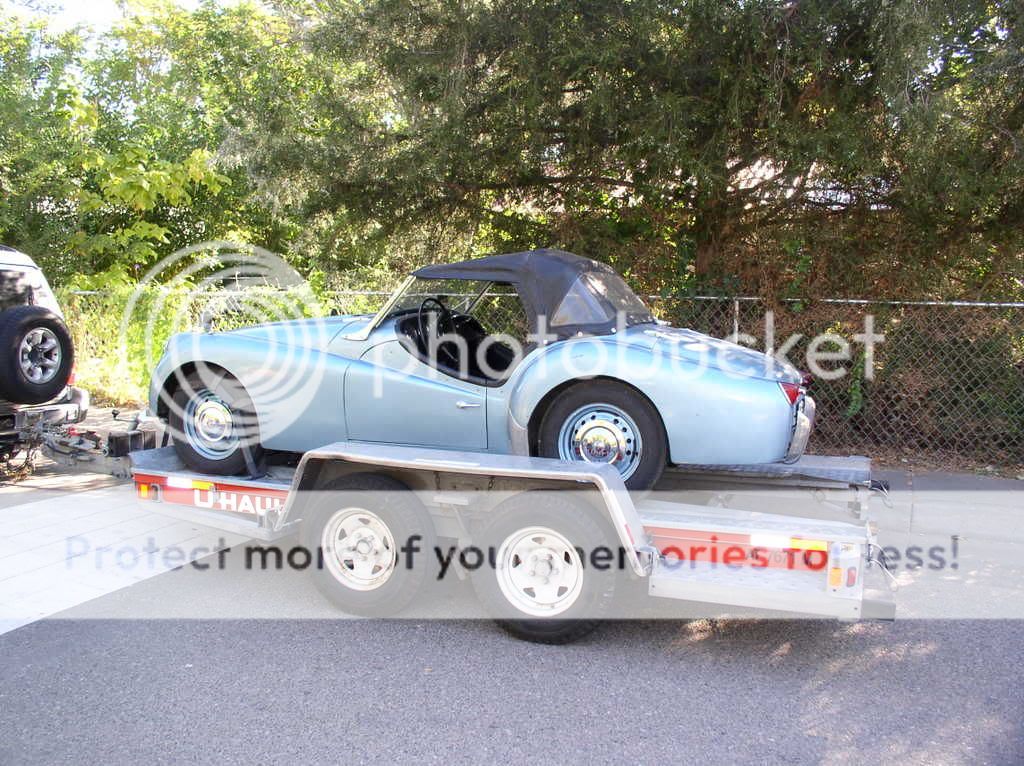
Looks like a very nice solid, straight car. It should be a lot of fun.
It would depend on what type of driving you're planning.
For a lot of long distance travels, I would go with the alternator.
For local driving, I would stay original.
It would depend on what type of driving you're planning.
For a lot of long distance travels, I would go with the alternator.
For local driving, I would stay original.

martx-5
Yoda

Offline
It might not be the generator. It could be the voltage regulator. My service manual has a procedure to determine if the generator is faulty...
Switch off all lights and accesories, disconnect the cables from the generator and connect the terminals with a short length of wire. Start the engine and run at normal idleing speed. Clip the negative lead of a voltmeter to one of the generator terminals, and the other to ground. Gradually increase the engine speed, when the voltmeter reading should rise rapidly and without fluctuation. Do not allow the voltmeter reading to reach 20 volts and do not race engine in an attempt to increase the voltage. It is sufficient to run the generator up to 1,000 rpm.
If there is no reading, brushes may be the problem. A low reading of 1/2-1 volt, the field winding may be at fault. If the reading is about 6-7 volts, the armature may be at fault. If the generator is good, then you will see the higher voltages (12-20) according to engine speed.
Find out what is wrong first, then you can better decide what you want to replace with what.
Switch off all lights and accesories, disconnect the cables from the generator and connect the terminals with a short length of wire. Start the engine and run at normal idleing speed. Clip the negative lead of a voltmeter to one of the generator terminals, and the other to ground. Gradually increase the engine speed, when the voltmeter reading should rise rapidly and without fluctuation. Do not allow the voltmeter reading to reach 20 volts and do not race engine in an attempt to increase the voltage. It is sufficient to run the generator up to 1,000 rpm.
If there is no reading, brushes may be the problem. A low reading of 1/2-1 volt, the field winding may be at fault. If the reading is about 6-7 volts, the armature may be at fault. If the generator is good, then you will see the higher voltages (12-20) according to engine speed.
Find out what is wrong first, then you can better decide what you want to replace with what.
DougF said:For a lot of long distance travels, I would go with the alternator.
For local driving, I would stay original.
Doug, what's the rationale behind that? I've driven many, many, thousands of miles with generator equipped cars, and can only recall one problem, easily fixed beside the road. Generators function perfectly fine, as long as you don't install a lot of high load accessories.
Jeff

2wrench
Luke Skywalker
Offline
Stay orig my opinion. Why? You know what you got.
You'll never be plagued with wondering, down the
road, if any other electrical issues are a chicken
or the egg problem.
Rebuilt properly functioning generator? Likely with
a elec prob, you can look elsewhere without
looking over your shoulder.
Just in my humble opinion.
You'll never be plagued with wondering, down the
road, if any other electrical issues are a chicken
or the egg problem.
Rebuilt properly functioning generator? Likely with
a elec prob, you can look elsewhere without
looking over your shoulder.
Just in my humble opinion.
D
DougF
Guest
Guest
Offline
My rationale was exactly that, to take care of the high load components that might go on the long trips.
D
DougF
Guest
Guest
Offline
It would probably be easier and cheaper to carry a spare.
2wrench said:Heyyyy, what if he did both with a switch... you know, like a backup battery switch.
And while I'm goofing.....I wonder if it could be
done....
Sounds like I need to test the output of the generator and then take it from there. I'm not planning on running a stereo or any thermonuclear fog lights or anything...


bluemiata90
Jedi Trainee
Offline
tdskip, you almost answered you own question. As stated by several other posters, if your not going to run a new stereo or upgraded lights, I'd stay original and have it rebuilt. I on the other hand, installed a new stereo and added blue lights and a fog light bar on mine, so the grounding had to be changed and a newer delco alt. had to be installed. The conversion was truly very simple and actually cheaper then having my generator rebuilt.

PeterK
Yoda
Offline
It's good to see a TR3 that is not red (like ours). Very nice color and looks like a great driver.
I switched to an alternator after my generator popped loudly and spit out some kind of wadding.
I was already running sealed beam halogens but now run H4s -nice and bright!) Also for us, a hidden radio by Custom Autosound, electric fan, and a couple of other elec devices. The stock generator puts out around 20-something amps, and the Delco alternator put out 63. Plenty of juice, cheap to replace and an easy install. And if you every do want to add some Oscars to the front, you'll have the power. Did I mention, no regulator is needed either?
I switched to an alternator after my generator popped loudly and spit out some kind of wadding.
I was already running sealed beam halogens but now run H4s -nice and bright!) Also for us, a hidden radio by Custom Autosound, electric fan, and a couple of other elec devices. The stock generator puts out around 20-something amps, and the Delco alternator put out 63. Plenty of juice, cheap to replace and an easy install. And if you every do want to add some Oscars to the front, you'll have the power. Did I mention, no regulator is needed either?
Gordo said:Would you know if your car is "Cotswold Blue"? Or is one of the others, Salvador, Winchester etc.?
Hi Gordo - I don't know what the formal color is. It was been resprayed at some point and I don't think the color they used was a formal OEM color...

SCguy
Jedi Warrior
Offline
YankeeTR said:and you'll keep you're genuine UK parts rather than bolting on a cheap substitute...
I currently am running a "cheap substitute" generator from Moss in my TR4. So far I'm not having any issues, but would be <u>really</u> interested in hearing the kinds of problems people have had with these generators.

tomshobby
Yoda
Offline
Once upon a time when all there were only generator we did not think there was anything wrong when the engine RPM's slowed and the lights went dim because the voltage output dropped.
When more and more demands were put on the electrical system it became more problematic. One big difference is that at idle a generator voltage output will drop enough that the battery will be discharging until the RPM's are increased again.
With an alternator, if all accessories are off, it will charge at an idle because it will have full voltage. At least that is the theory and not how my Lucas alternator seems to work although my GM alternators did.
When more and more demands were put on the electrical system it became more problematic. One big difference is that at idle a generator voltage output will drop enough that the battery will be discharging until the RPM's are increased again.
With an alternator, if all accessories are off, it will charge at an idle because it will have full voltage. At least that is the theory and not how my Lucas alternator seems to work although my GM alternators did.
martx-5
Yoda
Offline
The GM alternators you were using were probably the 63 amp 10 SI. That still a far cry from the early Lucas alternators that put out about 35 amps. Alternators will put out anywhere between 30-50% of their rated output at idle. So, in the case of a TR3's 20 amp rated generator, that 10 SI GM unit can put that much out at idle.
Also, as a point of interest (or you can stop reading if you're not interested), when alternators are 'modified' to put out more amperage, very often the 'Y' wound stator is replaced with a 'Delta' wound stator. That will increase the output of any alternator, but low speed performance always suffers. Therefore, the new high amp alternator most likely will not put out as much at idle as the original 'Y' wound stator. What OE manufacurer's have discovered over the last 8-10 years, is that by rectifying the connector in a 'Y' wound stator, the total output will increase by about 5-10%, but still retain high low speed output. These alternators have eight diodes in them instead of the normal six.
Are you bored?? Ok, I'll shut up!
Also, as a point of interest (or you can stop reading if you're not interested), when alternators are 'modified' to put out more amperage, very often the 'Y' wound stator is replaced with a 'Delta' wound stator. That will increase the output of any alternator, but low speed performance always suffers. Therefore, the new high amp alternator most likely will not put out as much at idle as the original 'Y' wound stator. What OE manufacurer's have discovered over the last 8-10 years, is that by rectifying the connector in a 'Y' wound stator, the total output will increase by about 5-10%, but still retain high low speed output. These alternators have eight diodes in them instead of the normal six.
Are you bored?? Ok, I'll shut up!

TR3driver
Great Pumpkin - R.I.P
Offline
FWIW, I think generators are frequently blamed for what turn out to be control box problems.
One issue is that the generator will easily put out more than it's rated output current, which will overheat and damage it. It's the control box's responsibility to limit the generator output to either 19 or 21 amps (depending on whether you have an original TR2-3 generator or the later, slightly larger unit from a TR4). If the control box is not properly adjusted (as it seems many of them are not, even right out of the box), it can allow the generator to overheat and eventually destroy itself. In extreme cases, you can see the thrown solder, but a slight overheat just cooks the winding insulation and causes it to fail prematurely.
A short in the wires between control box & generator can cause the same symptom.
One issue is that the generator will easily put out more than it's rated output current, which will overheat and damage it. It's the control box's responsibility to limit the generator output to either 19 or 21 amps (depending on whether you have an original TR2-3 generator or the later, slightly larger unit from a TR4). If the control box is not properly adjusted (as it seems many of them are not, even right out of the box), it can allow the generator to overheat and eventually destroy itself. In extreme cases, you can see the thrown solder, but a slight overheat just cooks the winding insulation and causes it to fail prematurely.
A short in the wires between control box & generator can cause the same symptom.