• Hey Guest!
    British Car Forum has been supporting enthusiasts for over 25 years by providing a great place to share our love for British cars. You can support our efforts by upgrading your membership for less than the dues of most car clubs. There are some perks with a member upgrade!

    **Upgrade Now**
    (PS: Upgraded members don't see this banner, nor will you see the Google ads that appear on the site.)
Tips
Tips

TR2/3/3A Rear shock mounting plate

Hi Randall. I would like to add something to the earlier posts about the direction in which the shock mounting bolts pass thru the rear shock. You gave me the picture from the Bentley book - and that is the way I will install my bolts. However, I now see where my confusion arose. The pictures in the Moss catalog show them in the opposite direction from Bentley, i.e., they show bolts going from the outside, thru the shock , then the mounting plate, with the nuts on the inside of car. I guess this is artistic license on the part of Moss - or do you know if there was a change in preferred mounting direction after the Bentley pictures were drawn. This is not a big issue, but explains why some people, like me, get confused at times.Chuck
 
or do you know if there was a change in preferred mounting direction after the Bentley pictures were drawn.
That is a distinct possibility, Chuck. The TR4 workshop manual does show them the other way, as does the TR4 SPC. But unfortunately, that is all I know about it. Pretty clearly there was a change, but I don't know if it was at TS60000, or start of TR4 or some other time. "Practical Hints" 6th edition (which seems to generally be for TR3A after TS60000) has a photo where the nuts can be seen on the shock side, but that doesn't prove anything either. They didn't always bother updating the photos.
 
This is an old thread but I thought I would resurrect it to show my proposed solution. I removed the shocks yesterday and the mounting holes are worn and over sized. I knew this but waited hoping the problem would go away. Surprisingly it did not.

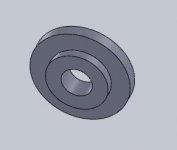
I will drill an oversized hole and insert the below piece on the back side of the bracket. The smaller diameter extrusion will be an interference fit with the oversized hole with the total thickness just less than the plate thickness. The through hole will be a tight fit for the grade 8 bolts I will use. I'll use mild steel for the part to avoid future galvanic corrosion.

Obviously I need 4 pieces for my car. Anyone else want some parts? The more expensive portion of the cost is the set-up of the CNC machine. After that churning out parts is cheap. (I haven't checked with my CNC shop on cost yet but we order lots of parts from him for work so I'm sure it won't be a bank buster). Based on demand I would just divide the total cost (setup, materials, time) by the number of parts. Additionally, I will just share the dimensions of the part here once I have it all designed and checked out so anyone else can make the part for themselves it desired.

shock mount.jpg
 
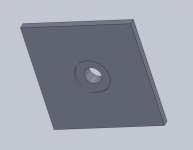
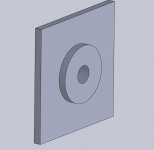
It's an interference fit (tight) but once the bolt is run through and the lock washer and nut are installed and tightened everything is secure. The first pic is a view from the shock side. The second is from the rear where the lock washer and nut will live. (the square plate is the mounting bracket.

shock assem front.jpgshock assem rear.jpg
 
That may be the most high tech mounting bit on the car.
 
After dealing with elastic stop nuts loosening , the clunk and having to tighten the bolt rather than the nut I Put the nuts on the inside of frame with new fine thread bolts and nuts and lock washers.
Being able to toque the nut instead of bolt I think it got much tighter and no clunk for last 5k miles.Holes were also oversized.
Tom
 
My recipe is to cut a heavy flat washer to fit against the shock body, then use high tensile 'Stover' nuts (all metal distorted thread lock nuts). https://www.mscdirect.com/product/details/85724227 I also have a socket with the tip ground smaller, so it fully fits onto the nut, and a long 'tappet' wrench to reach between the body and frame to get on the bolt head. Tighten to about 35 ftlb.

Works great for me, doesn't require removing body to get those stupid bolts out.

The shock gets hot in service, the alloy housing expands faster than the steel bolt even at the same temperature. I believe part of the reason they come loose is because the nut permanently distorts the housing at higher temperatures, allowing it to come loose when it cools even if the nut doesn't move. The heavy washer spreads the load out, until the housing does not permanently distort (instead the bolt stretches slightly) and hence the joint stays tight.
 
I’ll need to see the parts installed, as I still don’t see what is holding it together.
 
Back
Top