• Hey Guest!
    British Car Forum has been supporting enthusiasts for over 25 years by providing a great place to share our love for British cars. You can support our efforts by upgrading your membership for less than the dues of most car clubs. There are some perks with a member upgrade!

    **Upgrade Now**
    (PS: Upgraded members don't see this banner, nor will you see the Google ads that appear on the site.)
Tips
Tips

Rear hub failures

[ QUOTE ]
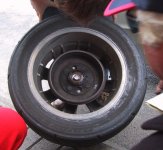
I believe that image is of a 2000/2500/2.5 Triumph saloon, which does have essentially the same IRS setup!

[/ QUOTE ]

But the saloons were a much heaver car than the TRs, so is this a less likely event for a TR?

BTW a buddy of mine in Australia was driving his 2500 PI wagon down the highway, when he heard a whopping great thump from the rear, a lot of scraping and then glanced sideways to see one of his rear wheels overtaking him! He was able to coasted to the side of the road safely, and even got his wheel back (which luckily did't hit anything either). Ouch!
 
It depends on the amount of power you are putting through the car. The rear halfshaft/hub assembly is a known weak point. If you upgrade your car it's one of the things that needs attention - not quite up there with reinforcing the diff mounts (which should be job #1) but certainly in the top 5 BEFORE you bolt bits on to the engine (imho).

If you are going to keep the car stock, and keep an eye on bearing wear then you will be fine.
 
[ QUOTE ]
It's from a 2.5PI Saloon.
If you read the posts on the forum - the link in post 2 in this thread - you'll get the skinny on what happened, and where the car is from.

[/ QUOTE ]


Got it - thanks guys... that's where I've seen that shape arch with the crease that comes off the top like that. Those are nice cars. Pete
 
From the site where this picture was posted. Scroll down a few posts:

[ QUOTE ]
My Triumph hubs had been rebuilt with new bearings and much attention to detail and still failed, admittedly after 60,000 hard kilometres. The failure started on the inside of the hub flange (where the outer bearing fits) once this had broken the stub axle quickly failed taking the brake drum with it. Both cracks seem to have propogated from the keyway slot for the woodruff key. No drive and no brakes!!! I believe the cosworth style hubs are a lot of money but well spent as a similar failure at high speed or on a fast wooded corner would have probably killed me

[/ QUOTE ]
 
[ QUOTE ]
But the saloons were a much heaver car than the TRs, so is this a less likely event for a TR?

[/ QUOTE ]True, the saloons were heavier, but I think there might be other factors here. One could be as simple as parts fatigue from age, while the other could be greater stresses now due to much stickier tires being available (possibly that combines with age / fatigue as well).

One or both theories were mentioned and discussed at great length by a bunch of us on another list, after Tony's beautiful TR4 racer became a huge, missaphen paperweight. Fatigue of old parts probably played some part, but most folks seemed to feel that the much wider and stickier race tires available now put so much more stress on parts that weren't designed for that much stress. Apparently the broken solid-axle problems were nowhere near as common back in the 1960s and 1970s.

Just a thought....
 
Hey guys , that's white 2500PI is mine, if you need any advice just say the word...

By the way my PI weighs in at 1035kgs or 2277lbs so not much more or less than a TR250 or 6. It has about 160rwhp and 225/50 x 15 Bridgestone motorsport tyres...

Andy T
 

Attachments

  • 165997-hub.jpg
    165997-hub.jpg
    172.3 KB · Views: 78
Ok so I can get it from the horses mouth. Cool.

Andy, can you explain what went wrong in words that I will i) Understand, and ii) Be able to explain to someone else.

If you have any other pics that would be awesome too.
TIA, Alan
 
OK I will be brief and to the point.

In any tuned Triumph running the IRS backend the rear hubs are an accident waiting to happen.
There are at least three factors at play:
1) Poor original design mostly centered around the keyway in the axle and hub flange being a stress raiser allowing cracks to form and propagate. They are mostly OK when new in ordinary use. Race tyres will often cause failure... Kastner replaced TR4A hubs every two to three races in the 60's before going to Corvair or Mercedes hubs
2)Fatigue from being 30-40 years old... they are now failing regularly in normal use
3)Poor rebuilds causing sudden failure

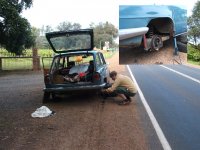
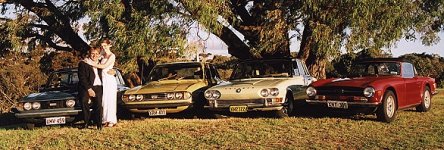
I own four cars with the same rear end design and have had two hubs break. One on a competition car and one on a daily driver ( on the way to my Wedding !!!)

They had different modes of failure 1.On the white car it was obvious the flange had failed first due to a rusty polished failure whilst the axle was a clean break.
2. On my station wagon it was the axle alone that failed... the result is the same!!!!

I am now using a hub marketed by Cambridge motorsport. It is based on cosworth stub axle with a Quaife flange.
 

Attachments

  • 166304-Disaster.JPG
    166304-Disaster.JPG
    188 KB · Views: 65
Oh BTW, my best man brought a spare along 2 hours later and after a quick brake rebuild we were on our way!!!!
 

Attachments

  • 166306-wed.jpg
    166306-wed.jpg
    178.6 KB · Views: 70
Thanks Andy, it's nice to hear it from someone with first hand experience - although I suspect nicer for us than you. Did you consider that the car may have been jealous...

The aim here was to try to replicate the cosworth type hubs in the US, mainly because with the current exchange rates the US dollar is practically worthless outside the country. To do a better job, it's easier if I can describe what's exactly wrong with the current setup.
 
thanks for all the info. I guess there'll be no power drifting for me. This sent chills through me!!!!!

It is completely amazing to see a solid 1 inch shaft break off like the pictures show. I would have thought the car too light to have that kind of lateral force.

I figured the spline setup was a weak point since they are cut into such a thin-sided female half shaft.

I'd certainly like to read more about alternatives.
thanks,

Jeff3113
 
Back
Top