
-
 Hi Guest!
If you appreciate British Car Forum and our 25 years of supporting British car enthusiasts with technical and anicdotal information, collected from our thousands of great members, please support us with a low-cost subscription. You can become a supporting member for less than the dues of most car clubs.
There are some perks with a member upgrade!**Upgrade Now**
(PS: Subscribers don't see this gawd-aweful banner

Tips
- We have a special forum called "Member Articles" where you can submit actual articles for consideration for publication. Learn More
- Don't have an Avatar? If not, your avatar will default to the 1st character in your username. Go into "Account Details" to change your Avatar.
- Some basic forum navigation info: click
 Hey - did you know if you click on the title of a thread it will take you to the first unread post since you last visited that thread?
- Hey Guest - Is your British Car Club in our Clubs database? If not, send me a PM - Basil

- Looking for a local club? Click the "Clubs" tab above and browse hundreds of clubs world-wide.
- Add Android or iPhone APP: click
- Did you know - any picture or video you add in your posts in any marque-specific forum will also get added to the Media Gallery automatically.
- A few more tips about posting and replying: click
- Hey there Guest - be sure to keep your profile page up to date with interesting info about yourself: learn more
- More tips and tricks on Posting and Replying: click
 but were afraid to ask:
  STOP!! Never post your email address in open forums. Bots can "harvest" your email! If you must share your email use a Private Message or use the
  smilie in place of the real @
- Want to mention another member in a post & get their attention? WATCH THIS

- So, you created a "Group" here at BCF and would like to invite other members to join? Watch this!
- Hey Guest - A post a day keeps Basil from visiting you in the small hours and putting a bat up your nightdress!
- Hey Guest - do you know of an upcoming British car event?
 Pretty Please - add it to our Events forum(s) and add to the calendar! >> Here's How <<
- Hey Guest - you be stylin' Change the look and feel of the forum to fit your taste. Check it out
- If you run across an inappropriate post, for example a post that breaks our rules or looks like it might be spam, you can report the post to the moderators: Learn More
- If you would like to try some different "looks" or styles for the site, scroll to the very bottom, on the left and click the Style Selector.
You are using an out of date browser. It may not display this or other websites correctly.
You should upgrade or use an alternative browser.
You should upgrade or use an alternative browser.
Rear end squat
- Thread starter roofman
- Start date


LastDeadLast
Jedi Knight

Offline
You're most likely going to need new springs. Luckily, you can change them in about 2 hours.
G
Guest
Guest
Guest
Offline
Just don't get shipwrights syndrome. That 2 hours will turn into 2 days
/ubbthreads/images/graemlins/grin.gif
/ubbthreads/images/graemlins/grin.gif
LastDeadLast
Jedi Knight
Offline
It turned into 3 years for me.....
T
Tinster
Guest
Guest
Offline
2 Hrs?? Well now, Tinster makes no claim to knowing
much of anything about TR6 auto repairs. But in rather
slow tempo, I kinda figured out how to change the coil
springs.(Trying to find the cause of "crunching" sounds
from the rear end.)
It took me about 8 to 10 hours 'cause I ain't no expert.
But the car rose 1.25" in height and the loud crunch was
gone when I pushed down hard on the rear end.
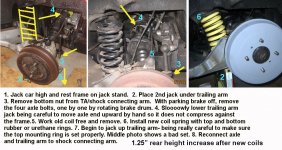
So here's a how-to-do photo of a non-technical fellow's
approach to the task. I apologize in advance to Mr Bentley
as well as to the experts here.
tinster the tool rookie
much of anything about TR6 auto repairs. But in rather
slow tempo, I kinda figured out how to change the coil
springs.(Trying to find the cause of "crunching" sounds
from the rear end.)
It took me about 8 to 10 hours 'cause I ain't no expert.
But the car rose 1.25" in height and the loud crunch was
gone when I pushed down hard on the rear end.
So here's a how-to-do photo of a non-technical fellow's
approach to the task. I apologize in advance to Mr Bentley
as well as to the experts here.
tinster the tool rookie
Attachments
G
Guest
Guest
Guest
Offline
if it rose up you must have got TRF springs...


G
Guest
Guest
Guest
Offline
Ditto the TRF springs causing the rear to lift too much. (They may have since corrected this) I ended up with competition springs from BPNW, actually lowered the car a bit (I like that) and made the squat go away. Go figure. Also, Dale, pardon me if I am misreading your great photos but did you unbolt the swing axle at the diff to get your springs out? My eyes are a bit hazy at 5 in the morning. One only needs to unbolt the shock arm for the spring to come. Might help to rotate the hub a bit to get the max amount of drop, depending on where the U-joint lies.
Unlike the front spring, which requires a spring compressor, the rear spring will just safely muscle out. Theis is the only area in the Benley manual that I totally disagree with where they tell you to use a hydraulic jack to lower the front suspension and remove the spring. Downright deadly.
Bill
Unlike the front spring, which requires a spring compressor, the rear spring will just safely muscle out. Theis is the only area in the Benley manual that I totally disagree with where they tell you to use a hydraulic jack to lower the front suspension and remove the spring. Downright deadly.
Bill

As regards the front spring and the Bentley manual. I agree that the jack alone methode is not the safest. Though I must confess to having done it. Though having done it I see no reason to ever do it again because you need a compressor to put them back in so why not use it to take them out safely.
T
Tinster
Guest
Guest
Offline
Hey Bill,
Yeah I unbolted the swing axles. I tried just unbolting
the shock arm but then when I lowered the TA, the axle
hit hard on the frame before I could get the coil spring free. Therefore I freed up the axles.
BTW: Not shown in the photo. When any part of my old body
is under the auto, I work very safe. Front wheels chocked,
frame raised with a locking 20 ton hydraulic ram cylinder,
frame on jack stand (just in case) and then a second jack
to move things up and down.
But heck, I'm just a hack trying to get my old beast to
run. I know almost nothin' about these TRs.
Yeah I unbolted the swing axles. I tried just unbolting
the shock arm but then when I lowered the TA, the axle
hit hard on the frame before I could get the coil spring free. Therefore I freed up the axles.
BTW: Not shown in the photo. When any part of my old body
is under the auto, I work very safe. Front wheels chocked,
frame raised with a locking 20 ton hydraulic ram cylinder,
frame on jack stand (just in case) and then a second jack
to move things up and down.
But heck, I'm just a hack trying to get my old beast to
run. I know almost nothin' about these TRs.

swift6
Yoda
Offline
[ QUOTE ]
BTW: Not shown in the photo. When any part of my old body is under the auto, I work very safe. Front wheels chocked, frame raised with a locking 20 ton hydraulic ram cylinder, frame on jack stand (just in case) and then a second jack to move things up and down.
[/ QUOTE ]
To make sure you stick around longer, you should raise the entire car onto 4 sturdy stands. Not just one end. If you are keeping one end on the ground then you are placing a side load on the jack stands, which they really are not designed for. Chocking the wheels on one side won't keep the jack stands from going out the other if they fail from the side load.
After you raise the car onto the four stands (which now loads the stands how they are designed to be loaded for optimum stability) then give it a 'shake test' to make sure its resting on the stands securely.
I use the big 6-8 ton stands. Overkill for the weight of the car but very reassuring when your under it. Plus they can lift the car higher for more working room. Always a good thing. Also, try to stay away from the cheap stamped and short stands. I had a pair until I saw a set collapse under an MG Midget. When I thought about all the times my heavier TR6 was on those and I was under it, a cold shiver went up my spine. Tossed 'em first thing. /ubbthreads/images/graemlins/crazy.gif
At times I have cheated and only done one side but I chastised myself brutally for doing so. /ubbthreads/images/graemlins/jester.gif
/ubbthreads/images/graemlins/cheers.gif
BTW: Not shown in the photo. When any part of my old body is under the auto, I work very safe. Front wheels chocked, frame raised with a locking 20 ton hydraulic ram cylinder, frame on jack stand (just in case) and then a second jack to move things up and down.
[/ QUOTE ]
To make sure you stick around longer, you should raise the entire car onto 4 sturdy stands. Not just one end. If you are keeping one end on the ground then you are placing a side load on the jack stands, which they really are not designed for. Chocking the wheels on one side won't keep the jack stands from going out the other if they fail from the side load.
After you raise the car onto the four stands (which now loads the stands how they are designed to be loaded for optimum stability) then give it a 'shake test' to make sure its resting on the stands securely.
I use the big 6-8 ton stands. Overkill for the weight of the car but very reassuring when your under it. Plus they can lift the car higher for more working room. Always a good thing. Also, try to stay away from the cheap stamped and short stands. I had a pair until I saw a set collapse under an MG Midget. When I thought about all the times my heavier TR6 was on those and I was under it, a cold shiver went up my spine. Tossed 'em first thing. /ubbthreads/images/graemlins/crazy.gif
At times I have cheated and only done one side but I chastised myself brutally for doing so. /ubbthreads/images/graemlins/jester.gif
/ubbthreads/images/graemlins/cheers.gif

RobT
Jedi Warrior
Offline
[ QUOTE ]
I use the big 6-8 ton stands. Overkill for the weight of the car but very reassuring when your under it.
[/ QUOTE ]
I agree. Better safe than sorry. There was a guy in our neighbourhood several years ago (before we moved here) that was working under his car and the jack sliped. He unfortunately is no longer with us as a result.
I use 4 of these AC Hydraulics stands with the flat rubber tops - the TR frame sits nicely on these, and they do not scratch the finish.
https://www.ultimategarage.com/minijack.htm
Rob.
I use the big 6-8 ton stands. Overkill for the weight of the car but very reassuring when your under it.
[/ QUOTE ]
I agree. Better safe than sorry. There was a guy in our neighbourhood several years ago (before we moved here) that was working under his car and the jack sliped. He unfortunately is no longer with us as a result.
I use 4 of these AC Hydraulics stands with the flat rubber tops - the TR frame sits nicely on these, and they do not scratch the finish.
https://www.ultimategarage.com/minijack.htm
Rob.
G
Guest
Guest
Guest
Offline
I'm with you, Dale. Safety is everything. Us old codgers don't heal a good as them young'ens out there.
I am all for the 4 jack stand method. Also, on the TR6, when you plan on getting it up high to scoot underneath, make sure that the rear stands are placed behind the rear axle. If you place them in front of the axle, you will notice that your doors don't close well. An indication of the inherent flex in the frame on these cars. No, my frame is not rotten at the swing arm area, although I first thought this when I couldn't close my doors up in the air. I was reassured that this is the nature of the beast, they do flex. Plus, if you are ever working on anything like the top, doors, floorboards, you will need the car to be resting as if it were on the ground, ie, behind the rear axles.
Another reason for using 4 stands. How many times have you had to lift on a suspension component in the air and notice that the whole car lifts off the other stand. Make sure the stands are of a high quality (as stated above) and are in a stable area of the frame. I will have to move the front left stand to a different position, usually forward, and resort to using a smaller stand with a long throw, to change my oil. The darn oil drain is right where the left front jack stand sits. Caution as always, this can be tricky. I also have a variety of wooden and rubber blocks for my jack (a 4K jack, American made) to lift on various parts of the frame, engine, etc. The T-shirt area requires a broad surfaced wooden jacking point to jack from, that is, to be able to spread the weight of the car over the frame and not the T-shirt shaped sheet metal in this area.
Little things you usually figure out on your own, sometimes a small pearl from someone else.
Bill
I am all for the 4 jack stand method. Also, on the TR6, when you plan on getting it up high to scoot underneath, make sure that the rear stands are placed behind the rear axle. If you place them in front of the axle, you will notice that your doors don't close well. An indication of the inherent flex in the frame on these cars. No, my frame is not rotten at the swing arm area, although I first thought this when I couldn't close my doors up in the air. I was reassured that this is the nature of the beast, they do flex. Plus, if you are ever working on anything like the top, doors, floorboards, you will need the car to be resting as if it were on the ground, ie, behind the rear axles.
Another reason for using 4 stands. How many times have you had to lift on a suspension component in the air and notice that the whole car lifts off the other stand. Make sure the stands are of a high quality (as stated above) and are in a stable area of the frame. I will have to move the front left stand to a different position, usually forward, and resort to using a smaller stand with a long throw, to change my oil. The darn oil drain is right where the left front jack stand sits. Caution as always, this can be tricky. I also have a variety of wooden and rubber blocks for my jack (a 4K jack, American made) to lift on various parts of the frame, engine, etc. The T-shirt area requires a broad surfaced wooden jacking point to jack from, that is, to be able to spread the weight of the car over the frame and not the T-shirt shaped sheet metal in this area.
Little things you usually figure out on your own, sometimes a small pearl from someone else.
Bill
swift6
Yoda
Offline
[ QUOTE ]
Also, on the TR6, when you plan on getting it up high to scoot underneath, make sure that the rear stands are placed behind the rear axle. If you place them in front of the axle, you will notice that your doors don't close well.
[/ QUOTE ]
I ususally place my rear stands on the frame where the trailing arms mount. Have never had a problem opening or closing the doors when I place them there. I guess our mileage does vary. /ubbthreads/images/graemlins/grin.gif
I also place my front stands as close to the front suspension as possible.
Yes the one stand does get in the way for oil changes but a piece of aluminum can be placed as a deflector to get the oil to go where you want it to. Actually, most any type of rigid piece could be used for that. Even cardboard for a one time use thing.
Also, on the TR6, when you plan on getting it up high to scoot underneath, make sure that the rear stands are placed behind the rear axle. If you place them in front of the axle, you will notice that your doors don't close well.
[/ QUOTE ]
I ususally place my rear stands on the frame where the trailing arms mount. Have never had a problem opening or closing the doors when I place them there. I guess our mileage does vary. /ubbthreads/images/graemlins/grin.gif
I also place my front stands as close to the front suspension as possible.
Yes the one stand does get in the way for oil changes but a piece of aluminum can be placed as a deflector to get the oil to go where you want it to. Actually, most any type of rigid piece could be used for that. Even cardboard for a one time use thing.

Alan_Myers
Luke Skywalker
Offline
Hi,
Yes, most seem to agree that TR6, in particular, were too softly sprung in the rear even when brand new. It is a common improvement to uprate the rear coil springs a bit to reduce "squat", even if this costs a little ride comfort.
Just to clarify a little regarding TRF springs for the IRS cars, yes the uprated springs they've been selling did tend to raise the car's ride height 1 to 1.5". They still sell these and, if that's your choice, it would be best to replace front and rear as a complete, matched set. (It so happens the owner of TRF has an IRS car himself, a TR5, and likes the increased ride height of the one type of springs.)
As a second choice, TRF also sells "stock" rate and height springs.
And, a third option, TRF now also has uprated springs that lower the car about 1 or 1.5". Again, it's a very good idea in this case to replace as a full, matched set, not just front or rear pairs alone.
Along with these springs, TRF now sells alloy spring spacers that can be used to tune ride height front or rear even more accurately, in .5, .75 and 1" thicknesses. Check for more info in their online catalogs or talk to John at their Level II sales line (or email him).
BTW, I've got no financial or other interest in TRF. I just find it nice that a company offers choices and listens to its customers.
/ubbthreads/images/graemlins/cheers.gif
Yes, most seem to agree that TR6, in particular, were too softly sprung in the rear even when brand new. It is a common improvement to uprate the rear coil springs a bit to reduce "squat", even if this costs a little ride comfort.
Just to clarify a little regarding TRF springs for the IRS cars, yes the uprated springs they've been selling did tend to raise the car's ride height 1 to 1.5". They still sell these and, if that's your choice, it would be best to replace front and rear as a complete, matched set. (It so happens the owner of TRF has an IRS car himself, a TR5, and likes the increased ride height of the one type of springs.)
As a second choice, TRF also sells "stock" rate and height springs.
And, a third option, TRF now also has uprated springs that lower the car about 1 or 1.5". Again, it's a very good idea in this case to replace as a full, matched set, not just front or rear pairs alone.
Along with these springs, TRF now sells alloy spring spacers that can be used to tune ride height front or rear even more accurately, in .5, .75 and 1" thicknesses. Check for more info in their online catalogs or talk to John at their Level II sales line (or email him).
BTW, I've got no financial or other interest in TRF. I just find it nice that a company offers choices and listens to its customers.
/ubbthreads/images/graemlins/cheers.gif
G
Guest
Guest
Guest
Offline
The TRF uprated springs look a lot like Goodparts ones - but at a higher price.
The 'better' swaybars bear more than a passing resemblance also...
The 'better' swaybars bear more than a passing resemblance also...
G
Guest
Guest
Guest
Offline
Zero.
Bill
Bill