• Hey Guest!
    British Car Forum has been supporting enthusiasts for over 25 years by providing a great place to share our love for British cars. You can support our efforts by upgrading your membership for less than the dues of most car clubs. There are some perks with a member upgrade!

    **Upgrade Now**
    (PS: Upgraded members don't see this banner, nor will you see the Google ads that appear on the site.)
Tips
Tips

TR2/3/3A Question on A-type overdrive solenoid

TuffTR250

Jedi Warrior
Country flag
Offline
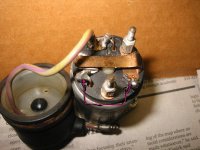
I don't have the overdrive mounted to the transmission yet and therefore no gear oil in the OD. I took the cover off the solenoid so I could see the "points" under that cover. The bottom portion of the solenoid points was pushed way down and thus setting at an angle, and the top portion of the points was touching the bottom point only on the very edge.So I bent the bottom portion up so the top point and bottom point were matching up flat to flat. I then mounted the solenoid onto the overdrive and adjusted the actuating lever, and adjusted the set screw below the plunger of the solenoid to have .151" clearance. I've connected the solenoid body to the negative battery terminal via a wire and have a wire from the positive battery terminal that I use to touch the solenoid lead. When I touch the positive wire to the solenoid lead the plunger is immediately pulled up and opens the points on top of the solenoid. However, as I leave the power applied the plunger chatters up and down, and the points chatter open and closed very fast. What does this tell me about the solenoid coil windings, is something wrong with them? Thanks for any help!
Regards, Bob
 
Sounds to me like the 'holding coil' may have failed. But, even though I have had an OD for 10 years, I have little experience trouble-shooting them.
 
I agree with Geo. Hold the plunger closed with the points open, and then take an ohm reading of the holding coil. If it is infinite, then the coil is broken. If it has a plausible reading for ohms (like several hundred to several thousand) then it may need a smaller air gap so it can reach full travel before the points cut out.
 
The holding coil should be around 12 ohms. Anything higher than 20 or so indicates it has failed.

If so, try to check the places where the actual winding wire is connected. I don't have it handy, but ISTR the ground side of the coil was just a spot weld to the case, which could break and potentially be soldered back together.

FWIW, I also added a diode across the pull-in contacts, in hopes of making them last longer. Too soon to say if it will really help, but the theory is sound.
 
Thanks John and Randall!! When I measure ohms with my multi-tester set at the 20K spot in the ohm position and the red terminal connected to the lead wire and the black wire hooked to the body of the solenoid, I get a "1" when I raise the plunger to open the solenoid points. It is reading all zero's when the plunder is down and the solenoid points closed.

After Randall's response I looked at the wires on the top of the solenoid, and I noticed that the very small wire that goes to the back end of the top points piece is not connected. It does sorta look like it burned off right at the solder since it looks like there's a tiny bit of grayish material on the end of the wire right next to the solder blob. The big blob of solder is still there but the small wire is loose from it. I think I'm going to have to borrow my son's soldering gun that is made for soldering a lot smaller wires than mine does, so I don't blow away the wire. BTW, even with that loose solder joint the plunger is still being pulled up when power connected. Once I can solder that wire I'll report back the results as to whether that fixed the problem.
Regards,
Bob
 
In 2000, I was at VTR in Portland, Oregon when I had a problem with my solenoid. So I ordered one from Moss in Calif. and installed it. After about 7,200 miles I arrived back home and soon after that, the solenoid failed. I took it out and peeled back the rubber top cap. Inside I found it was full of white RTV silicone and a piece about the size of a green pea was lodged between the contacts for the holding coil. I removed it, and it worked after that.

Don Elliott, Montreal
 
The solder that was in there before appeared to be standard eutectic lead/tin. At least it melted and mixed with the solder I added when adding the diode, and that's what I was using. Even on the solenoid that overheated and ruined the insulation, I didn't see any signs of solder melting.
 
Of course the diode can be added at the relay. Not as elegant but adequate. I think it has been 10 years now on that relay but 'so far so good' is about all I can say.
 
While I do advocate a diode at the relay, it only protects the relay contacts (and that has been very effective for me for some 20 years).

The diode inside the solenoid is to protect the cutout contacts in the solenoid and hopefully make them last longer as well. There is no way to do that at the relay.
 
Randall, I'm not very knowledgeable of electrical components. Can you tell me the detail on a diode to use?, specs, p/n's, where to buy, any information I might need to buy some. Thanks!
Regards, Bob
 
I was able to get a small "pencil" soldering iron and I soldered the loose small wire to the connector at the back end of the points tab. It was not easy getting the solder to stick to the wire. Hard to clean that tiny wire. But it finally stuck, and hopefully it will stay stuck. I tested it with ohm meter and I'm getting 11.8 ohms when I test the hold up coil as described by John and Randall. I also attached the solenoid lead to a car battery and the plunger clicked up and stayed up without the chatter of the points I was getting before. So it seems to be working. I am wondering how reliable it will be. It's a really old solenoid. Since I'm going to try to fully bench test the overdrive and transmission once I pull the transmission from my TR3 and install the OD main shaft and OD, I believe I will then have some idea of how reliable the solenoid will be. Thanks for the help on finding the problem with this solenoid.
Regards,
Bob
 
Success...good to hear! Water seems to be the biggest killer, even when these were new. There were at least 4 TSO's related to keeping water out of the solenoids. Avoid big puddles and I bet it'll outlast us all.
 
One thing I have noticed is that it takes much more force to move the operating lever when the engine is running or the OD is on a motorized test stand. This is because the oil pressure has to be overcome to open the operating valve. So, a weak closing coil that works when the unit is at rest may not when it has to overcome the oil pressure. Also, I remember that a problem with chattering points was solved by dressing them with a points file.
Berry
 
Thanks Berry! That's a good point. I'll watch out for that when I get around to bench testing my OD/Transmission.

A question for the forum, if I find that I need a new solenoid, what is the best source for them...quality, price, delivery? Thanks!
Regards, Bob
 
Bob-I bought the repro sol. from Moss around the first of the year. It was on sale for about $30 at time and I was skeptical about the quality, but so far so good.
Berry
 
Randall, I'm not very knowledgeable of electrical components. Can you tell me the detail on a diode to use?, specs, p/n's, where to buy, any information I might need to buy some. Thanks!
Regards, Bob
Almost any small silicon rectifier diode will do. I bought an assortment at Radio Shack for about $3, that turned out to be all 1N4004 diodes, so that is what I used at both the relay and the solenoid.
https://www.radioshack.com/products/rectifier-diodes
(looks like the price went up a bit)
However, I believe that even a 1N1001 would work fine (along with any of the other diodes they list as possibly being in that assortment).

Obviously, the diode is polarity sensitive, so you can't go switching ground polarity after installing it. There is a white stripe on one end of the diode, which must be installed towards the positive side ie ground if your car is still positive ground. If you have converted to negative ground, then the other end of the diode goes to ground. (Sorry the stripe doesn't show clearly in my photo, but it's there.)
 
Randall, to make sure I'm understanding the two points where you soldered the diode between on the top of the OD solenoid, I have attached a picture with an arrow drawn (poorly ) between the two points I believe you recommend. Is this correct? My car is negative ground. And I believe you put the end of the diode with the stripe toward the solder blob on the left side of my picture, is that correct? Sorry if these are dumb questions but I don't understand electrical very well.
IMG_6283- paint.jpg
Regards, Bob
 
Back
Top