• Hey Guest!
    British Car Forum has been supporting enthusiasts for over 25 years by providing a great place to share our love for British cars. You can support our efforts by upgrading your membership for less than the dues of most car clubs. There are some perks with a member upgrade!

    **Upgrade Now**
    (PS: Upgraded members don't see this banner, nor will you see the Google ads that appear on the site.)
Tips
Tips

Push rod return spring

SMGoose

Senior Member
Offline
Opinions requested: While pulling out the gearbox on my TR4, I noticed there was no spring or anchor from the slave cylinder to the operating shaft (#s 20 and 21)
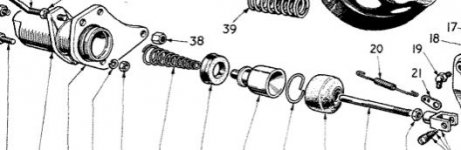
Screen Shot 2013-02-08 at Friday, February 8, 2013  |  4.01.03 PM.jpg


I ordered new ones when I ordered clutch components, but I heard that sometimes that spring keeps the clutch from fully disengaging (or something to that effect) and that I should just leave it off.
Also my push rod is not adjustable like the one pictured, it's just a solid rod and fork. The other thing worth mentioning is that I'm putting in a TR6 gearbox which has the thicker flange.

Is this just one of those "see how it goes" type of things and adjust according to trail and error? Or does anyone have particular experience in this area?
 
Scott, I vote for the adjustable rod, as you are changing a couple of numbers in the equation, having this rod will at least give you options.
The spring on the other hand was not on the TR6, but I have added it on occasion when some pressure plates did not give the desired return.

Wayne
 
There are two different configurations; and the books don't always show the right components for either one. For the TR2-4 configuration, the return spring (items 20 & 21) are used, but the pushrod has to be adjusted from time to time to keep some freeplay (so the clutch can fully engage), without having too much freeplay (which would make the pedal too low).

But the TR4A-TR6 configuration does not use the return spring and instead keeps the spring inside the slave cylinder. This configuration is self-adjusting, because the spring inside the slave holds the piston out until the TOB just rides on the clutch plate. No free play, but also not enough force to keep the clutch from fully engaging. Since you don't have an adjustable pushrod, I'd suggest going with the self-adjusting configuration.

To deal with the thicker flange, I just made up a shorter pushrod. Since mine is the adjustable type, it was easy to cut a length of rod and thread it for the clevis to screw on. Hopefully you can just trim off part of the pushrod you have (but don't take too much). You need to leave some room for the piston to move deeper in the cylinder though, as that is what will happen as the clutch plate wears in use. The TR6 of course just mounts the slave bracket on the other side of the bellhousing (where it has a flat plate), but that area isn't flat on a TR3/4 unless you modify the dust cover (or leave it off).
 
Randall, what is the correct procedure for adjusting an adjustable clutch slave cylinder push rod on a TR3A with a TR4 transmission? (Mine has a TR4 transmission)Thanks!
Regards,
Bob
 
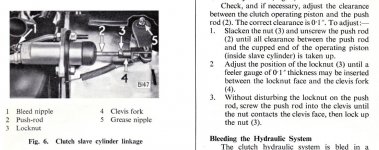
The procedure from the TR4 workshop manual is probably best (works for all TR3/A/B with Girling hydraulics)

untitled.JPG
 
Ok I'm coming back to this because I've officially got the rebuilt TR6 gearbox installed and ready to go. In the process, I discovered that I had had a TR4A clutch, pressure plate, and release bearing on my TR4. That's the setup I stuck with when I ordered a new bearing and clutch disc.

So with that setup for the clutch and gearbox, and the non-adjustable pushrod, is it safe to assume my slave cylinder is the self-adjusting type with the built-in spring? How do I verify?

I ask because I started it up the other day to test it out and it wouldn't go into reverse--just grinded. I figure my clutch isn't releasing completely. I had thought that with the thicker flange and new disc, if anything, I'd need a shorter pushrod but it seems I have the opposite problem.

One other question: My shift lever is from the TR4 but I noticed the shift lever listed for the TR6 gearbox is slightly different (cap retaining bolt through the TR4 lever instead of locating pin for the TR6). Everything assembled just fine, but I'm just wondering if it will cause problems.
 
Disregard the first part of this last message. I just read the clutch hydraulics overhaul article on Buckeye Triumphs and will try the suggestions there. I feel really close to getting back on the road (fingers crossed)!
 
Back
Top