• Hi Guest!
    If you appreciate British Car Forum and our 25 years of supporting British car enthusiasts with technical and anicdotal information, collected from our thousands of great members, please support us with a low-cost subscription. You can become a supporting member for less than the dues of most car clubs.

    There are some perks with a member upgrade!
    **Upgrade Now**
    (PS: Subscribers don't see this gawd-aweful banner
Tips
Tips

Proper brake fluid

JP_Furble

Senior Member
Offline
I know this subject has probably been cussed and discussed many times, but what kind of brake fluid is safe to use in our older British cars? I'm just now beginning the restoration of the brake system and FYI will have completely new distribution pipes, hoses, slave cylinder, and rear brake cylinders. The front calipers will be rebuilt as will the brake master and clutch master cylinders.

Thanks,
JPF
 
JPF;
I have been using Castrol GT LMA brake fluid ( meets dot 3 and 4 specs)
for years in my healey.
The Healey manual states " castrol girling brake fluid or a fluid conforming to specifcation 70.R3"
 
Just to play the devil's advocate, :madder: Why not silicone?

Pros: Won't harm paint, Won't absorb water as much as regular fluid

Cons: Softer pedal, More expensive
 
There is talk that silicon (brake fluid, not boobs)will be phases out as the army doesn't like it and is not using it any more. Big source of revenue. They found problems with oxygen absorption causing the soft pedal and a few others things. This was discussed at Rendezvous last year during a tech session.
The paint harm is when it sits on paint for a while. I've never had a problem when it is cleaned up within 20 minutes. I've never left it on longer. (I was not careful with my MG but I am VERY careful with the Healey . Either way never a problem).
As to expensive, I had trouble even finding Castrol and when I did, it was twice what it was in the past.
 
Silicone fluids can also affect repaint as silicone leads to the dreaded fisheye. The standard brake fluid only eats paint if it is left to sit as T.H. reports. Standard brake fluid is easy to remove before painting but silicones are not. They are sneaky, and can come back to bite you upon repaint. I'd go with the Castrol GT LMA. or similar w/ fluid change at intervals. --elrey
 
I have talked to rebuilders who said NOT to use silicon. The rubber in our systems is not compatible with it. Someone wrote a paper on this subject several years ago, but I don't have it. This was discussed on the Healey list several years ago and I concluded Castrol LMA is the safest bet for our cars.
 
Silicon brake fluid is one of the best things about driving one of my cars. I know I can leave it set over the winter and still have brakes in the Spring. I've used it in MG TC, TD , TF MGA, MGB TR3, TR4 . I've had problems with the main piston seals swelling ( cured with light machine work), but nothing else. Its pretty much no maintenance. In all fairness to a scientific comparison , I restored an MGB with Castrol LMA . All new master, lines, rebuilt calipers. I even bled the system twice in the last 12 yrs. I had to replace both rear wheel cylinders after 9 yrs. as they had frozen solid. I would only use Castrol dot 4 in a car that already had it in. Everything else including the E-type gets Dot 5. Rebuilders argue from a point of liability. Any deviation from factory spec. on your part releases them from warranty.
 
Silicone has no affect on rubber brake parts. Red hydraulic oil that is used in some brake applications requires different rubber components. Silicone will compress more than conventional brake fluid, giving a soft pedal when hot. Otherwise it is a good alternative for people who dont use cars as daily drivers or hard on the brake pedal.
 
fordtrucks4ever said:
Silicone has no affect on rubber brake parts.

:nonono:
Unlike a Poly-glycol fluid, silicone-based brake fluids do not absorb water.However, Silicone will cause natural rubber to swell, Most aftermarket rubber parts that are compatible have a Butl base.


Red hydraulic oil that is used in some brake applications requires different rubber components. Silicone will compress more than conventional brake fluid, giving a soft pedal when hot. Otherwise it is a good alternative for people who dont use cars as daily drivers or hard on the brake pedal.

---------------------------Keoke-- :driving:
 
OK silicone has no affect on synthetic rubber parts. Is that better?

I remember trying to repair some brake issues on an old forklift. It had been converted over to red hydraulic oil to offset the problems with water absorption from conventional brake fluid. This forklift spent more time sitting than in use. When i tore apart the wheel cylinders, I was slightly suprised to find out just how big a 1" wheel cylinder cup could swell. I popped out the piston and then the rubber cup started its eventful journey out. When it finally made itself free the diameter was nearly 3". I still dont know how that much swollen material was able to retain itself in the wheel cylinder.
 
So...I am making a mistake using the standard, off the shelf Dot 3 in my BJ8? They don't stock Castrol anywhere here...I think what I have used is NAPA dot 3 and Autozone brand Dot 3. Thanks,, Lee
 
"Silicone will cause natural rubber to swell." Are any new brake components made of natural rubber? I heard natural rubber went out with WWII.
 
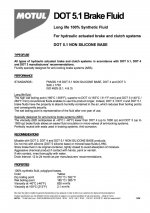
After a lot of consideration on Silicone Fluid, I have chose for my AH 100/6 the MOTUL DROP 5.1 synthetic BUT NOT silicone based,
compatible with DROP 4 and DROP 3 with better characteristics

https://www.motul.com/it/en/products/77 a1MOTUL 5.1 Brake Fl-001.jpg
 
As for me, I have converted to dot 5 after doing a major brake rebuild 5 years ago, I have never had a problem with my brake components since. I was tired of the paint eating dot 3 and I was rebuilding the masters in my british cars all too often when using dot 3 over the last 23 years. The question I have is if dot 5 is so bad...then why have all the major motorcycle manufactures been using it all these years including Harley Davidson and Honda for motorcycles with non ABS braking systems?

In fact I buy my dot 5 at My local Harley Dealer for my British cars. As for the military, they may have stopped using dot 5 for any number of reasons including dot 5 is not designed for there vehicles equipped with ABS systems. I would not follow there foot steps because they are consumers and not engineers designers or chemists. I would rather trust the engineers and designers in the private sector such as Honda or Harley Davidson as they have been using dot 5 for many years for non ABS braking systems and still do!

I have gotten into more then a few panic braking situations with people pulling out in front of me and never had a problem with good brake pressure (and quick reflexes) and getting my Healey stopped! I simply am conveying my own experience using Both Dot 3 and dot 5. I will keep using dot 5 in all of my classics as it as proven to me at least, it is the best brake fluid for the Classic British cars I own and drive. Commonly driving my Healey about 150 miles per week. Michael.
 
Hi all, In all my years I have never found one brand of brake fluid much different than any other when I comes to my street driven cars. Also in making your choices don't get confused between synthetic vice silicone. About four years ago I did the final assembly on a '56 vette. I decided to try silicone brake fluid for the first time. My motivation was that the paint on the car was like new but had been sprayed almost 20 years earlier, (talk about a long restoration project). I was concerned that if I had any leaks and they sprayed unto the frame or sheetmetal anywhere, that I would not be able to match the paint perfectly. Well I am very happy with the silicone. So this summer when assembling my Healey I also used silicone. It is working prefectly. Natural brake fluid will damage your paint if spilled or sprayed on it. And it will do it in alot less than 20 minutes. Sometimes you might get lucky and get it wiped off quickly with no immediately visible damage but most times one wipe and the paint is damaged if not completely removed. Another consideration for using silicone is my hands. If you do get the natural brake fluid on your skin (mostly hands) and you are working with it awhile and continue to get it on your hands, by the end of the day your hands will have a burning sensation and washing them with anything does not remove the sensation nor does it remove completely the smell. Along with all the specialty cleaners and washes, I have soaked my hands in lemon juice or orange juice and still can't remove all the residual smell. Anyway, i like silicone. So far. Dave
 
In 43 years working on LBCs, I've never spilled or sprayed any brake fluid that removed any paint. I've always used Castrol and it is still available. I like the feel of a hard solid peddle. I am told the air absorbed in Dot 5 makes a softer peddle but I have never felt it on friends Dot five cars. There is talk that Dot 5 will be discontinued as the military is moving away from it (they are the biggest consumer). I don't think enough water or air gets sucked through the hole in the reservoir to effect the braking. I think both are good so it is personal choice.
 
Back
Top